Advertisements
Advertisements
Estimate the average thermal energy of a helium atom at the temperature on the surface of the Sun (6000 K).
Concept: undefined >> undefined
Three vessels of equal capacity have gases at the same temperature and pressure. The first vessel contains neon (monatomic), the second contains chlorine (diatomic), and the third contains uranium hexafluoride (polyatomic).
Do the vessels contain an equal number of respective molecules?
Concept: undefined >> undefined
Advertisements
The transverse displacement of a string (clamped at its both ends) is given by
y(x, t) = 0.06 sin `2/3` x cos (120 πt)
where x and y are in m and t in s. The length of the string is 1.5 m and its mass is 3.0 × 10⁻² kg.
Answer the following:
Does the function represent a travelling wave or a stationary wave?
Concept: undefined >> undefined
The transverse displacement of a string (clamped at its both ends) is given by
y(x, t) = 0.06 sin `2/3` x cos (120 πt)
where x and y are in m and t in s. The length of the string is 1.5 m and its mass is 3.0 × 10⁻² kg.
Answer the following:
Interpret the wave as a superposition of two waves travelling in opposite
directions. What is the wavelength, frequency, and speed of each wave?
Concept: undefined >> undefined
If |A| = 2 and |B| = 4, then match the relations in column I with the angle θ between A and B in column II
| Column I | Column II |
| (a) |A × B| = 0 | (i) θ = 30° |
| (b) |A × B| = 8 | (ii) θ = 45° |
| (c) |A × B| = 4 | (iii) θ = 90° |
| (d) |A × B| = `4sqrt(2)` | (iv) θ = 0° |
Concept: undefined >> undefined
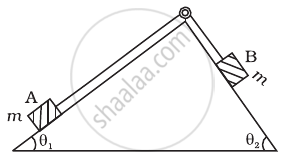
In figure, a body A of mass m slides on plane inclined at angle θ1 to the horizontal and µ1 is the coefficent of friction between A and the plane. A is connected by a light string passing over a frictionless pulley to another body B, also of mass m, sliding on a frictionless plane inclined at angle θ2 to the horizontal. Which of the following statements are true?
- A will never move up the plane.
- A will just start moving up the plane when `µ = (sin θ_2 - sin θ_1)/(cos θ_1)`
- For A to move up the plane, θ2 must always be greater than θ1.
- B will always slide down with constant speed.
Concept: undefined >> undefined
The velocity of a body of mass 2 kg as a function of t is given by `v(t) = 2t hati + t^2hatj`. Find the momentum and the force acting on it, at time t = 2s.
Concept: undefined >> undefined
A cricket bowler releases the ball in two different ways
- giving it only horizontal velocity, and
- giving it horizontal velocity and a small downward velocity. The speed vs at the time of release is the same. Both are released at a height H from the ground. Which one will have greater speed when the ball hits the ground? Neglect air resistance.
Concept: undefined >> undefined
An electron and a proton are moving under the influence of mutual forces. In calculating the change in the kinetic energy of the system during motion, one ignores the magnetic force of one on another. This is because ______.
Concept: undefined >> undefined
A man, of mass m, standing at the bottom of the staircase, of height L climbs it and stands at its top.
- Work done by all forces on man is equal to the rise in potential energy mgL.
- Work done by all forces on man is zero.
- Work done by the gravitational force on man is mgL.
- The reaction force from a step does not do work because the point of application of the force does not move while the force exists.
Concept: undefined >> undefined
A bullet of mass m fired at 30° to the horizontal leaves the barrel of the gun with a velocity v. The bullet hits a soft target at a height h above the ground while it is moving downward and emerges out with half the kinetic energy it had before hitting the target.
Which of the following statements are correct in respect of bullet after it emerges out of the target?
- The velocity of the bullet will be reduced to half its initial value.
- The velocity of the bullet will be more than half of its earlier velocity.
- The bullet will continue to move along the same parabolic path.
- The bullet will move in a different parabolic path.
- The bullet will fall vertically downward after hitting the target.
- The internal energy of the particles of the target will increase.
Concept: undefined >> undefined
Give example of a situation in which an applied force does not result in a change in kinetic energy.
Concept: undefined >> undefined
Two bodies of unequal mass are moving in the same direction with equal kinetic energy. The two bodies are brought to rest by applying retarding force of same magnitude. How would the distance moved by them before coming to rest compare?
Concept: undefined >> undefined
A raindrop of mass 1.00 g falling from a height of 1 km hits the ground with a speed of 50 ms–1. Calculate
- the loss of P.E. of the drop.
- the gain in K.E. of the drop.
- Is the gain in K.E. equal to a loss of P.E.? If not why.
Take g = 10 ms–2
Concept: undefined >> undefined
Suppose the average mass of raindrops is 3.0 × 10⁻⁵ kg and their average terminal velocity 9 ms–1. Calculate the energy transferred by rain to each square metre of the surface at a place which receives 100 cm of rain in a year.
Concept: undefined >> undefined
A rocket accelerates straight up by ejecting gas downwards. In a small time interval ∆t, it ejects a gas of mass ∆m at a relative speed u. Calculate KE of the entire system at t + ∆t and t and show that the device that ejects gas does work = `(1/2)∆m u^2` in this time interval (neglect gravity).
Concept: undefined >> undefined
As observed from earth, the sun appears to move in an approximate circular orbit. For the motion of another planet like mercury as observed from earth, this would ______.
Concept: undefined >> undefined
Different points in earth are at slightly different distances from the sun and hence experience different forces due to gravitation. For a rigid body, we know that if various forces act at various points in it, the resultant motion is as if a net force acts on the c.m. (centre of mass) causing translation and a net torque at the c.m. causing rotation around an axis through the c.m. For the earth-sun system (approximating the earth as a uniform density sphere).
Concept: undefined >> undefined
Particles of masses 2M, m and M are respectively at points A, B and C with AB = ½ (BC). m is much-much smaller than M and at time t = 0, they are all at rest (Figure). At subsequent times before any collision takes place ______.

Concept: undefined >> undefined
