Advertisements
Advertisements
Identify the type of reaction taking place in the following case and write the balanced chemical equation for the reaction.
Potassium iodide reacts with lead nitrate to produce potassium nitrate and lead iodide.
Concept: undefined >> undefined
When a potassium iodide solution is added to a solution of lead (II) nitrate in a test tube, a precipitate is formed.
List two types of reactions in which this reaction can be placed.
Concept: undefined >> undefined
Advertisements
The following reaction is an example of:
\[\ce{4NH3_{(g)} + 5O2_{(g)} -> 4NO_{(g)} + 6H2O_{(g)}}\]
(i) displacement reaction
(ii) combination reaction
(iii) redox reaction
(iv) neutralisation reaction
Concept: undefined >> undefined
Which option denotes a double displacement reaction?
Concept: undefined >> undefined
Which among the following is (are) double displacement reaction(s)?
(i) \[\ce{Pb + CuCl -> PbCl2 + Cu}\]
(ii) \[\ce{Na2SO4 + BaCl2 -> BaSO4 + 2NaCl}\]
(iii) \[\ce{C + O2 -> CO2}\]
(iv) \[\ce{CH4 + 2O2 -> CO2 + 2H2O}\]
Concept: undefined >> undefined
Barium chloride on reacting with ammonium sulphate forms barium sulphate and ammonium chloride. Which of the following correctly represents the type of reaction involved?
(i) Displacement reaction
(ii) Precipitation reaction
(iii) Combination reaction
(iv) Double displacement reaction
Concept: undefined >> undefined
In the double displacement reaction between aqueous potassium iodide and aqueous lead nitrate, a yellow precipitate of lead iodide is formed. While performing the activity if lead nitrate is not available, which of the following can be used in place of lead nitrate?
Concept: undefined >> undefined
Balance the following chemical equation and identify the type of chemical reaction.
`"TiCl"_4("l") + "Mg"("s") -> "Ti"("s") + "MgCl"_2("s")`
Concept: undefined >> undefined

Identify the product which represents the solid state in the above reaction.
Concept: undefined >> undefined
A chemical reaction in which exchange of ions occurs between the reactants is known as ______.
Concept: undefined >> undefined
Write balanced chemical equation for the following word equation.
Lead nitrate + Potassium iodide → Lead iodide + Potassium nitrate
Is this a double displacement reaction? Justify your answer. Name the compound precipitated and write the ions present in it.
Concept: undefined >> undefined
Write the method of preparation of Ca(OH)2. What happens when CO2 is passed through it? Write balanced chemical equation for the reaction involved.
Concept: undefined >> undefined
Give an example of a double displacement reaction.
Concept: undefined >> undefined
One half of a convex lens of focal length 10 cm is covered with a black paper. Can such a lens produce an image of a complete object placed at a distance of 30 cm from the lens? Draw a ray diagram to justify your answer. A 4 cm tall object is placed perpendicular to its principal axis of a convex lens of focal length 20 cm. The distance of the object from the lens is 15 cm. Find the nature, position and the size of the image.
Concept: undefined >> undefined
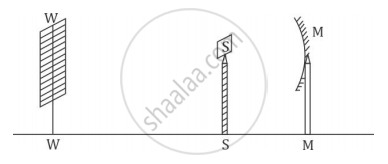
A student obtains a sharp image of the distant window (W) of the school laboratory on the screen (S) using the given concave mirror (M) to determine its focal length. Which of the following distances should he measure to get the focal length of the mirror?
Concept: undefined >> undefined
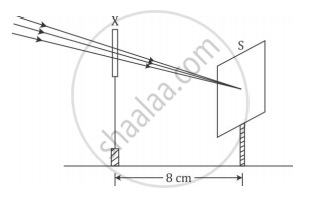
A student used a device (X) to obtain/focus the image of a well illuminated distant building on a screen (S) as shown below in the diagram. Select the correct statement about the device (X).
Concept: undefined >> undefined
A 4 cm tall object is placed on the principal axis of a convex lens. The distance of the object from the optical centre of the lens is 12 cm and its sharp image is formed at a distance of 24 cm from it on a screen on the other side of the lens. If the object is now moved a little away from the lens, in which way (towards the lens or away from the lens) will he have to move the screen to get a sharp image of the object on it again? How will the magnification of the image be affected?
Concept: undefined >> undefined
Explain the following term related to spherical lenses:- optical centre
Concept: undefined >> undefined
A student focused the Sun rays using an optical device 'X' on a screen S as shown.
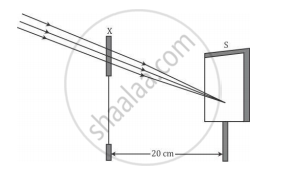
From this it may be concluded that the device 'X' is a (select the correct option)
(A) Convex lens of focal length 10 cm.
(B) Convex lens of radius of curvature 20 cm.
(C) Convex lens of focal length 20 cm.
(D) Concave mirror of focal length 20 cm.
Concept: undefined >> undefined
Define the following term in the context of spherical mirrors:- Pole
Concept: undefined >> undefined
