Please select a subject first
Advertisements
Advertisements
Two balls having 20kg and 30 kg masses are moving towards each other with velocities of 10 m/s and 5 m/s respectively as shown in the figure.
If after the impact ,the ball having 30 kg mass is moving with 6 m/s velocity to the right then determine the coefficient of restitution between the two balls.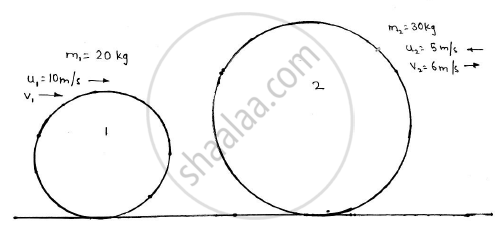
Concept: Velocity and Acceleration in Terms of Rectangular Co-ordinate System
The V-X graph of a rectilinear moving particle is shown. Find the acceleration of the particle at 20m,80 m and 200 m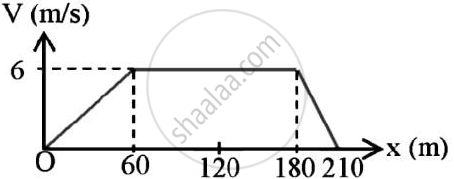
Concept: Velocity and Acceleration in Terms of Rectangular Co-ordinate System
A bar 2 m long slides down the plane as shown.The end A slides on the horizontal floor with a velocity of 3 m/s.Determine the angular velocity of rod AB and the velocity of end B for the position shown.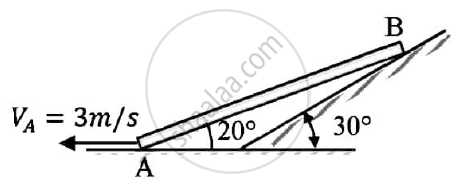
Concept: Velocity and Acceleration in Terms of Rectangular Co-ordinate System
A 500 N Crate kept on the top of a 15° sloping surface is pushed down the plane with an initial velocity of 20m/s. If μs = 0.5 and μk = 0.4, determine the distance travelled by the block and the time it will take as it comes to rest.
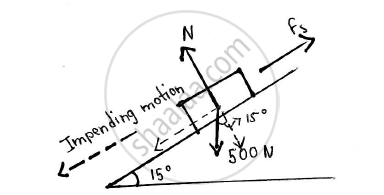
Given: Weight of crate = 500 N
Initial velocity(u) = 20 m/s
μs = 0.5
μk = 0.4
θ = 15°
Final velocity (v) = 0 m/s
To find: Distance travelled by the block Time it will take before coming to rest
Concept: Velocity and Acceleration in Terms of Rectangular Co-ordinate System
Derive the equation of path of a projectile and hence show that equation of path of projectile is a parabolic curve.
Concept: Velocity and Acceleration in Terms of Rectangular Co-ordinate System
particle is moving in X-Y plane and it’s position is defined by`bar r=(3/2 t^2)bar l+(2/3 t^3) barJ "Find radius of curvature when t=2sec." `
Concept: Velocity and Acceleration in Terms of Rectangular Co-ordinate System
A Force of 100 N acts at a point P(-2,3,5)m has its line of action passing through Q(10,3,4)m. Calculate moment of this force about origin (0,0,0).
Concept: Velocity and Acceleration in Terms of Rectangular Co-ordinate System
From (v-t) diagram find (1) Distance travelled in 10 second.
(2) Total distance travelled in 50 second.
(3) Retardation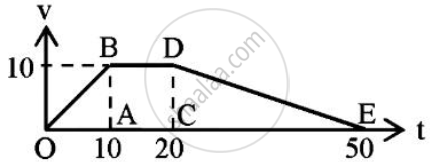
Concept: Motion Curves (a-t, v-t, s-t curves)
Blocks P1 and P2 are connected by inextensible string.Find velocity of block P1,if it falls by 0.6 m starting from rest.
The co-efficient of friction is 0.2.The pulley is frictionless.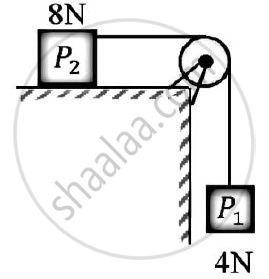
Concept: Velocity and Acceleration in Terms of Rectangular Co-ordinate System
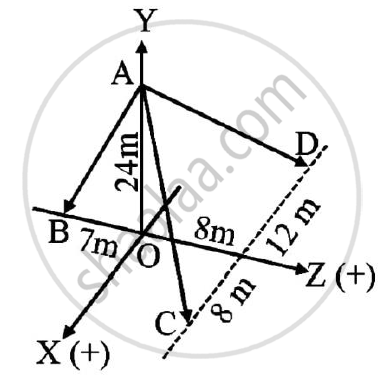
Co-ordinate distance are in m units for the space frame in figure.
There are 3 members AB,AC and AD.There is a force W=10 kN acting at A in a vertically upward direction.
Determine the tension in AB,AC and AD.
Concept: Velocity and Acceleration in Terms of Rectangular Co-ordinate System
A glass ball is dropped on a smooth horizontal floor from which it bounces to a height of 9m.On the second bounce it rises to a height of 6 m.From what height was the ball dropped and find the coefficient of restitution between the glass and the floor.
Given : First bounce height = 9 m
Second bounce height = 6 m
To find : Co-efficient of restitution
Concept: Velocity and Acceleration in Terms of Rectangular Co-ordinate System
Angular velocity of connector BC is 4 r/s in clockwise direction.What is the angular velocities of cranks AB and CD?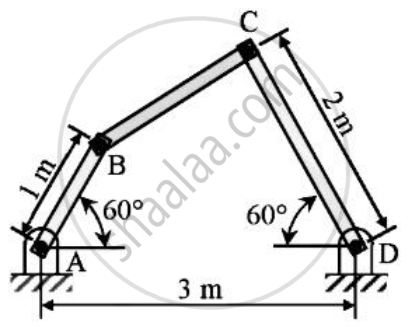
Concept: Velocity and Acceleration in Terms of Rectangular Co-ordinate System
The acceleration time diagram for a linear motion is shown. Construct velocity time diagram and displacement time diagram for the motion assuming that the motion starts with a initial velocity of 5 m/s from the starting point.
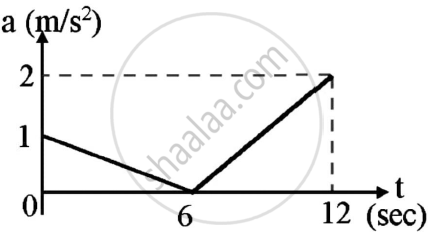
Given : Acceleration time graph
To draw : Velocity time graph
Displacement time graph
Concept: Velocity and Acceleration in Terms of Rectangular Co-ordinate System
Determine the speed at which the basket ball at A must be thrown at an angle 30o so that if makes it to the basket at B.
Also find at what speed it passes through the hoop.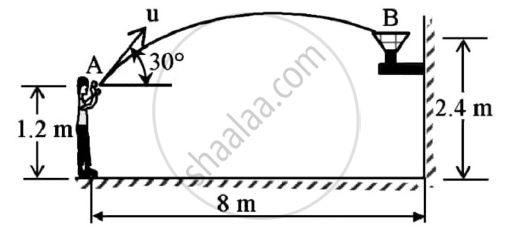
Concept: Motion Curves (a-t, v-t, s-t curves)
Figure shows a collar B which moves upwards with constant velocity of 1.5 m/s.At the instant when θ=50o.Determine :
(i)The angular velocity of rod pinned at B and freely resting at A against 25o sloping ground.
(ii)The velocity of end A of the rod.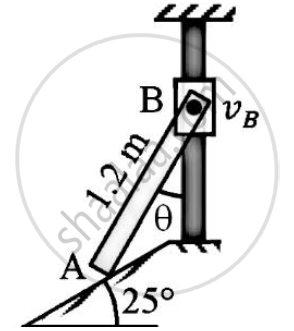
Concept: Motion Curves (a-t, v-t, s-t curves)
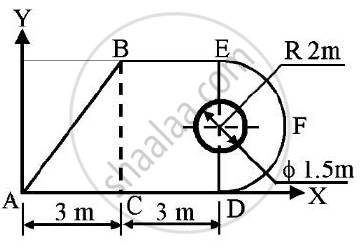
A circle of diameter 1.5 m is cut from a composite plate.Determine the centroid of the remaining area of plate.
Concept: Velocity and Acceleration in Terms of Rectangular Co-ordinate System
A rod AB has an angular velocity of 2 rad/sec,counter clock wise as shown.End C of rod BC is free to move on a horizontal surface.Determine:
(1)Angular velocity of rod BC
(2)Velocity of C
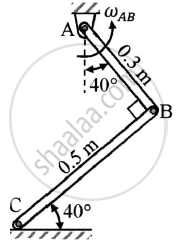
Given : ωAB=2 rad/sec (anti clockwise)
To find : ωBC
VC
Concept: Velocity and Acceleration in Terms of Rectangular Co-ordinate System
A particle falling under gravity travels 25 m in a particular second. Find the distance travelled by it in the next 3 seconds.
Given : Particle falls 25 m in a particular second
Sn=-25 m
u=0 m/s
To find : Distance travelled by it in next 3 seconds
Concept: Tangentialand Normal Component of Acceleration
Velocity-time diagram for a particle travelling along a straight line is shown in Figure 10. Draw acceleration-time and displacement-time diagram for the particle. Also find important values of acceleration and displacement.
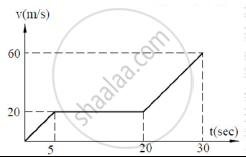
Concept: Velocity and Acceleration in Terms of Rectangular Co-ordinate System
A 75kg person stands on a weighing scale in an elevator. 3 seconds after the motion starts from rest, the tension in the hoisting cable was found to be 8300N. Find the reading of the scale, in kg during this interval. Also find the velocity of the elevator at the end of this interval. The total mass of the elevator, including mass of the person and the weighing scale, is 750kg. If the elevator is now moving in the opposite direction, with same magnitude of acceleration, what will be the new reading of the scale?
Concept: Velocity and Acceleration in Terms of Rectangular Co-ordinate System
