Advertisements
Advertisements
The figure below shows a simple pendulum of mass 200 g. It is displaced from the mean position A to the extreme position B. The potential energy at the position A is zero. At the position B the pendulum bob is raised by 5 m.

- What is the potential energy of the pendulum at the position B?
- What is the total mechanical energy at point C?
- What is the speed of the bob at the position A when released from position B?
(Take g = 10 ms-2, given that there is no loss of energy.)
Concept: Application of the Principle of Conservation of Energy
Which class of lever will always have MA > 1 and why?
Concept: Levers
A boy uses a single fixed pulley to lift a load of 50 kgf to some height. Another boy uses a single movable pulley to lift the same load to the same height. Compare the effort applied by them. Give a reason to support your answer.
Concept: Pulley
A pulley system with VR = 4 is used to lift a load of 175 kgf through a vertical height of 15 m. The effort required is 50 kgf in the downward direction. (g = 10 N kg-1)
Calculate:
- Distance moved by the effort
- Work done by the effort
- M.A. of the pulley system
- Efficiency of the pulley system
Concept: Pulley
With reference to the terms mechanical advantage, velocity ratio and efficiency of a machine, name and define the term that will not change for the machine of a given design.
Concept: Concept of Machines
From the diagram given below. answer the question that follows:
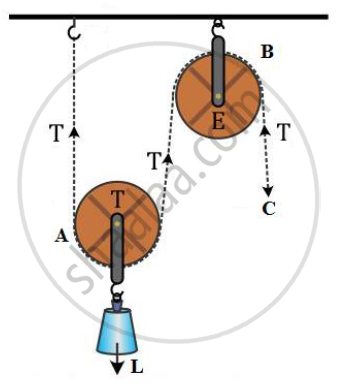
- What kind of pulleys are A and B?
- State the purpose of pulley B.
- What effort has to be applied at C just raise the load L = 20 kgf?
(Neglect the weight of pulley A and friction)
Concept: Pulley
A pulley system has three pulleys. A load of 120 N is overcome by applying an effort of 50 N. Calculate the Mechanical Advantage and Efficiency of this system.
Concept: Pulley
A block and tackle system has V.R. = 5.
Draw a neat labeled diagram of a system indicating the direction of its load and effort.
Concept: Pulley
A block and tackle system has V.R. = 5.
Rohan exerts a pull of 150 kgf. What is the maximum load he can raise with this pulley system if its efficiency = 75%?
Concept: Pulley
What is the principle of an ideal machine?
Concept: Concept of Machines
Two forces each of 5N act vertically upwards and downwards respectively on the two ends of a uniform metre rule which is placed at its mid-point as shown in the diagram. Determine the magnitude of the resultant moment of these forces about the midpoint.
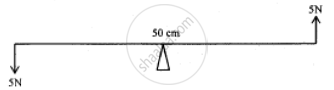
Concept: Concept of Machines
Draw a diagram to show how a single pulley can be used so as to have its ideal M.A= 2.
Concept: Concept of Machines
The diagram below shows a lever in use:
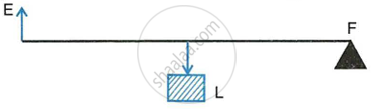
- To which class of levers does it belong?
- Without changing the dimensions of the lever, if the load is shifted towards the fulcrum what happens to the mechanical advantage of the lever?
Concept: Levers
Draw a diagram of a block and tackle system of pulleys having a velocity ratio of 5. In your diagram indicate clearly the points of application and the directions of the load L and effort E. Also mark the tension T in each strand.
Concept: Combination of Pulleys
The pulley system has drawn lifts a load of 150 N when an effort of 60 N is applied. Find its mechanical advantage.
Concept: Pulley
Is the above pulley system an ideal machine or not?
Concept: Pulley
The diagram below shows a claw hammer used to remove a nail :
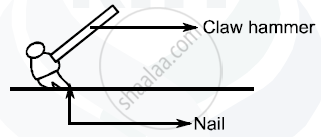
(i) To which class of lever does it belong ?
(ii) Give one more example of the same class of lever mentioned by you in (i) for which the mechanical advantage is greater than one.
Concept: Concept of Machines
The diagram below shows a pulley arrangement :
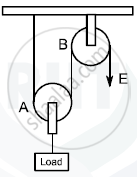
(i) Copy the diagram and mark the direction of tension on each strand of the string.
(ii) What is the velocity ratio of the arrangement ?
(iii) If the tension acting on the string is T, then what is the relationship between T and effort E ?
(iv) If the free end of the string moves through distance x, find the distance by which the load is raised.
Concept: Pulley
The following belong to which class of lever?
A pair of scissors
Concept: Levers
