Advertisements
Advertisements
Given below is the transverse section of the spinal cord. Read the information below the diagram and fill in the blanks:
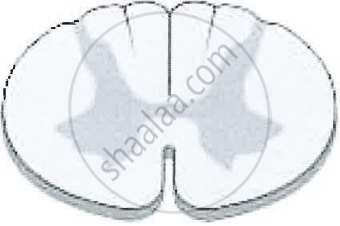
The spinal cord extends from the medulla oblongata of the brain and runs down through the whole length of the vertebral column. The spinal cord is covered by the meninges. It conducts impulses from the skin and muscles to the brain. It also conducts impulses from the brain to the muscles of the trunk and limbs.
The spinal cord is a part of the (a) ______ Nervous System. The grey matter in the picture given above consists of (b) ______ while the white matter consists of (c) ______. The spinal cord is concerned with the (d) ______ actions below the neck. (e) ______ is the bony structure that protects the spinal cord.
Concept: The Spinal Cord
The kind of lens required to correct Myopia
Concept: Defects of Vision and Their Corrections > Myopia
Deafness is causal due to the rupturing of the Pinna.
Concept: Human Ear
Given below is a representation of a kind of pollution. Study the same and answer the questions that follow

(i) Name the kind of pollution.
(ii) List any three common sources of this pollution.
(iii) Mention three harmful effects of this pollution on human health.
(iv) Explain the term ‘Pollutant’.
(v) Name two soil pollutants
Concept: Human Ear
Mention the exact location of the Semi-circular canals
Concept: Human Ear
Mention the exact location of the Eustachian tube
Concept: Human Ear
find odd one from following: Malleus, iris, Stapes, Incus.
Concept: Human Ear
State the exact location of the Ciliary body
Concept: Human Ear
Given below is a diagram depicting a defect of the human eye, study the same and then answer the questions that follow:
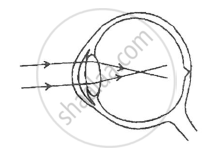
(i) Name the defect shown in the diagram.
(ii) What are the two possible that cause this defect?
(iii) Name the type of lens used to correct this defect.
(iv) With the help of a diagram show how the defect shown above is rectified using a suitable lens.
Concept: Human Ear
Given in the box below are a set of 14 biological terms. Of these, 12 can be paired into 6 matching pairs. Out of the six pairs, one has been done for you as an example.
Example : endosmosis - Turgid cell.
Identify the remaining five matching pairs :
| Cushing’s syndrome, Turgid cell, Iris, Free of rod and cone cells, Colour of eyes, Hypoglycemia, Active transport, Acrosome, Addison’s disease, Blind spot, Hyperglycemia, Spermatozoa, Endosmosis, Clotting of blood. |
Concept: Human Ear
- Draw a well-labelled diagram of the membranous labyrinth found in the inner ear.
- Based on the diagram drawn above in (i), give a suitable term for each of the following descriptions:
- The sensory cells that help in hearing.
- The part that is responsible for static balance of the body.
- The membrane-covered opening that connects the middle ear to the inner ear.
- The fluid present in the middle chamber of cochlea.
- The structure that maintains dynamic equilibrium of the body.
Concept: Human Ear
Briefly explain the following terms: Power of accommodation
Concept: Human Ear
State the exact location of the Organ of Corti
Concept: Human Ear
fill in the blanks with suitable functions: Ciliary body and __________.
Concept: Human Ear
A fluid that occupies the larger cavity of the eye ball behind the lens is
___________.
Concept: Human Ear
the biological/technical terms for a thin membrane covering the entire front part of the eye.
Concept: Human Ear
the biological/technical terms for the lens of eye losing flexibility resulting in a kind of long-sightedness in middle aged people.
Concept: Defects of Vision and Their Corrections > Myopia
Differentiate between the Rods and Cones of Retina (Type of pigment)
Concept: Human Ear
