Advertisements
Advertisements
Discuss briefly the efforts made by various Women’s Movements in India, to root out the social evils of:
- Dowry.
- Domestic violence in the 1970s and 1980’s.
Concept: Anti-Dowry Movement and Struggle Against Domestic Violence
Why did Britain and France follow a policy of appeasement towards Germany and Italy?
Concept: Anglo-french Appeasement Policies
Discuss any four significant changes in Mussolini’s foreign policy after 1935, till the outbreak of World War II.
Concept: Anglo-french Appeasement Policies
In the context of the Middle East crisis, what is meant by the term Intifada?
Concept: Israel PLO OSLO Peace Accord (1993)
Name the first All-India Peasant Organisation.
Concept: Growth of Socialist Ideas >> Kisan Sabha Movement
Against which social evil was a campaign launched by the Shree Sangharsh Organisation?
Concept: Growth of Socialist Ideas >> Trade Union Activities
Explain the salient features of Mountbatten Plan.
Concept: Transfer of Power (1945-1947) >> The Mountbatten Plan
What was the significance of Attlee’s Declaration of 20th February 1947?
Concept: Transfer of Power (1945-1947) >> Attlee's Declaration of 1947
What was the full form of AIKS?
Concept: Growth of Socialist Ideas >> Kisan Sabha Movement
On the morning of June 3, 1947, the day the partition was announced, Mahatma Gandhi told Rajendra Prasad, “I can see only evil in the plan”.
- Identify the Plan that Mahatma Gandhi was referring to? State any three clauses of the Plan.
- Discuss any four reasons for the acceptance of the plan by major political parties of India.
Concept: Transfer of Power (1945-1947) >> The Mountbatten Plan
Name any two states whose union with India involved armed intervention by the Indian army.
Concept: The Foundation of Indian Democracy
Name two major political parties that played an important role during the General Elections of 1967.
Concept: The Foundation of Indian Democracy
Answer the following question.
Name two important leaders of the Naxalite Movement in Bengal.
Concept: Naxal Movement >> Main Leaders of the Movement
The following is a picture of the famous trio of the Janata government, waiting for the swearing-in ceremony at the Rashtrapati Bhawan in 1977. Which one of the following BEST describes the reason for its short-lived tenure?
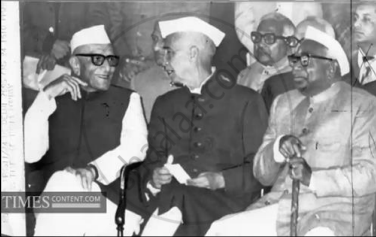
Concept: The Janata Government (1977–1979)
Why did China attack India in 1962?
Concept: Sino-Indian War
What were the consequences of the Indo-china war?
Concept: Sino-Indian War
Where was the first Summit of the Non- Aligned Nations held?
Concept: Concept of Non-Alignment Movement >> Belgrade Conference
Answer the following question.
Trace the circumstances that led to the outbreak of the Indo-China war in 1962.
Concept: Sino-Indian War
How did the Bandung and Belgrade Conferences lead to the formation and development of the Non-Aligned Movement (NAM)?
Concept: Concept of Non-Alignment Movement >> Belgrade Conference
State one important example of Anglo-French appeasement of Hitler (1938) that made war inevitable.
Concept: Anglo-french Appeasement Policies
