Advertisements
Advertisements
Who among the following demanded justice for women, not reserved seats or separate electorates in the Constituent Assembly?
Concept: Defining Rights
Who among the following in the Constituent Assembly proposed 'horizontal tricolour National flag of saffron, white and green in equal proportion'?
Concept: A Tumultuous Time
Explain the arguments given in favour of strong Centre in the Constituent Assembly.
Concept: The Powers of the State
Match the following:
| Column-I (Leaders) |
Column-II - (Role in the Constituent Assembly) |
||
| A. | Jawaharlal Nehru | i. | President of the Constituent Assembly |
| B. | B.R. Ambedkar | ii. | Constitutional Advisor |
| C. | Rajendra Prasad | iii. | Chairman of the Drafting Committee |
| D. | B.N. Rau | iv. | Worked on the 'Objective Resolution' |
Concept: A Tumultuous Time
Consider the given statements regarding Constituent Assembly and select the correct from the following options:
- Motilal Nehru moved resolution of National flag in the Constituent Assembly.
- G.B. Pant was the Legal Advisor.
- Sardar Patel was the Constitutional Advisor.
- K.M. Munshi was called as Frontier Gandhi.
Concept: A Tumultuous Time
"One of the topics most vigorously debated in the Constituent Assembly was the respective rights of the Central and State governments." Analyse the statement with supporting arguments.
Concept: The Powers of the State
Which of the following empire issued gold coins for the very first time in first century CE?
Concept: Towns and Trade
Why have many scholars written the months after Independence as being Gandhiji's "finest hours? Explain.
Concept: A Leader Announces Himself
Quit India movement was genuinely a mass movement bringing into its ambit hundreds of thousands of ordinary Indians. Elucidate the statement with suitable examples.
Concept: Knowing Gandhi
‘Gandhiji had mobilized a wider discontentment against the British rule in the Salt Satyagraha.’ Elucidate the statement with suitable examples.
Concept: The Salt Satyagraha a Case Study
Who among the following was the first Director-General of the Archaeological Survey of India (ASI)?
Concept: Mohenjodaro: a Planned Urban Centre
Match the following and select the correct option.
| List-I Harappan Site |
List-II Famous for |
| 1. Lothal | a. Specialised centres for making shell objects. |
| 2. Kalibangan | b. Near sources of carnelian. |
| 3. Dholavira | c. Evidence of ploughed field found. |
| 4. Nageshwar | d. Water reservoirs found. |
Concept: Finding Out About Craft Production
Assertion (A): Archaeologists and historians find the Harappan script enigmatic
Reason (R): The Harrapan script remains undeciphered to date.
Concept: Seals, Script, Weights
Describe any three sources to know about the Harrapan civilization.
Concept: Seals, Script, Weights
Describe any three features of the Harrapan drainage system.
Concept: Mohenjodaro: a Planned Urban Centre
Consider the following statements regarding Harappan Culture and choose the correct option.
- The most unique feature was the development of urban centres.
- The settlements were divided into two sections i.e. the citadel and the lower town.
- Drainage system was ordinary and unplanned.
- Roads were not laid out along a grid pattern.
Concept: Mohenjodaro: a Planned Urban Centre
Identify the craft centres related to the Harapan civilization with the help of the given information.
|
Concept: Finding Out About Craft Production
Read the source given below and answer the questions that follow.
|
“There cannot be any divided loyalty” Govind Ballabh Pant argued that in order to become loyal citizens people had to stop focusing only on the community and the self: For the success of democracy one must train himself in the art of self-discipline. In democracies, one should care less for himself and more for others. There cannot be any divided loyalty. All loyalties must exclusively be centred around the State. If in a democracy, you create rival loyalties, or you create a system in which any individual or group, instead of suppressing his extravagance, cares nought for larger or other interests, then democracy is doomed. |
- How did G.B Pant encourage citizens to make a unified nation?
- Why did he urge citizens for loyal towards nation?
- How was loyalty considered the base of the social pyramid?
Concept: The Earliest States
Identify the given image from the following options.
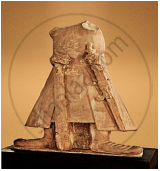
Concept: New Notions of Kingship
“Magadha was the most powerful Mahajanpada ‘. Examine the statement.
Concept: The Earliest States
