Definitions [5]
When an equation, involving trigonometrical ratios of an angle A, is true for all values of A, the equation is called a trigonometric identity.
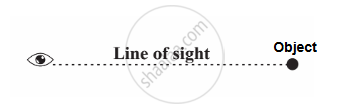
The straight line joining the eye of the observer to the point on the object being viewed.
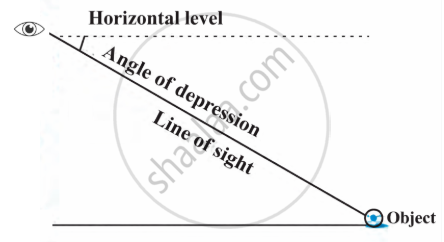
The angle between the line of sight and the horizontal through the observer’s eye, when the object is below the level of the observer’s eye.
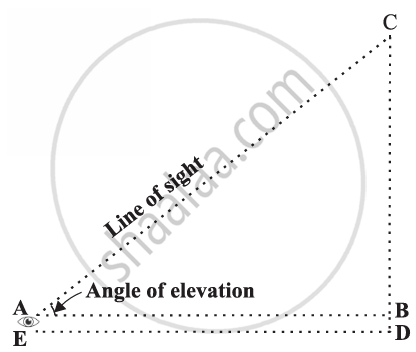
The angle between the line of sight and the horizontal through the observer’s eye, when the object is above the level of the observer’s eye.
Two angles are said to be allied when their sum or difference is either 0 (zero) or an integral multiple of n/2.
Examples:
- −θ, π2 ± θ, π ± θ, 3π2 ± θ, 2π ± θ,etc.
Formulae [1]
\[sineA=\frac{\text{Perpendicular}}{\text{Hypotenuse}}\]
\[cosineA=\frac{\mathrm{Base}}{\text{Hypotenuse}}\]
\[tangentA=\frac{\text{Perpendicular}}{\mathrm{Base}}\]
\[cotangent A = \frac{\text{Base}}{\text{Perpendicular}}\]
\[secantA=\frac{\text{Hypotenuse}}{\mathrm{Base}}\]
\[cosecantA=\frac{\text{Hypotenuse}}{\text{Perpendicular}}\]
Theorems and Laws [126]
Prove that `(cos^2θ)/(sinθ) + sin θ = "cosec" θ`.
L.H.S. = `(cos^2θ)/(sinθ) + sin θ`
= `(cos^2θ + sin^2θ)/(sin θ)`
= `1/(sin θ)` ...[∵ sin2θ + cos2θ = 1]
= cosec θ
= R.H.S.
∴ `(cos^2θ)/(sin θ) + sin θ = "cosec" θ`
Prove the following trigonometric identities.
sec A (1 − sin A) (sec A + tan A) = 1
We have to prove sec A(1 − sin A)(sec A + tan A) = 1
We know that sec2 A − tan2 A − 1
So,
sec A(1 − sin A)(sec A + tan A) = {sec A(1 − sin A)}(sec A + tan A)
= (sec A − sec A sin A)(sec A + tan A)
= `(sec A - 1/cos A sin A) (sec A + tan A)` ...`(∵ sec theta = 1/costheta)`
= `(sec A - sin A/cos A) (sec A + tan A)` ...`(∵ tan theta = sin theta/costheta)`
= (sec A − tan A)(sec A + tan A)
= sec2 A − tan2 A
= 1 = R.H.S. ... (∵ sec2 θ = 1 tan2 θ)
Prove that sec2θ + cosec2θ = sec2θ × cosec2θ.
L.H.S. = sec2θ + cosec2θ
= `1/(cos^2θ) + 1/(sin^2θ)`
= `(sin^2θ + cos^2θ)/(cos^2θ.sin^2θ)`
= `1/(cos^2θ.sin^2θ)` ...[∵ sin2θ + cos2θ = 1]
= `1/(cos^2θ) xx 1/(sin^2θ)`
= sec2θ × cosec2θ
= R.H.S.
∴ sec2θ + cosec2θ = sec2θ × cosec2θ
Prove the following identities:
`secA/(secA + 1) + secA/(secA - 1) = 2cosec^2A`
L.H.S. = `secA/(secA + 1) + secA/(secA - 1)`
= `(sec^2A - secA + sec^2A + secA)/(sec^2A - 1`
= `(2sec^2A)/tan^2A` ...(∵ sec2 A – 1 = tan2 A)
= `(2/cos^2A)/(sin^2A/cos^2A)`
= `2/sin^2A`
= 2 cosec2 A = R.H.S.
`(cos^3 θ + sin^3 θ)/(cos θ + sin θ) + (cos ^3 θ - sin^3 θ)/(cos θ - sin θ) = 2`
LHS= `(cos^3 θ + sin^3 θ)/(cos θ + sin θ) + (cos ^3 θ - sin^3 θ)/(cos θ - sin θ) `
=` ((cos θ + sin θ)(cos^2 θ - cos θ sin θ + sin^2 θ))/((cos θ + sin θ)) + ((cos θ - sin θ)(cos^2 θ + cos θ sin θ + sin^2 θ))/((cos θ - sin θ))`
= (cos2 θ + sin2 θ − cos θ sin θ) + (cos2 θ + sin2 θ + cos θ sin θ)`
= (1 − cos θ sin θ) + (1 + cos θ sin θ)
= 2
= RHS
Hence, LHS = RHS
Prove that `(sin θ + tan θ)/(cos θ) = tan θ (1 + sec θ)`.
L.H.S. = `(sin θ + tan θ)/(cos θ)`
= `(sin θ)/(cos θ) + (tan θ)/(cos θ)`
= tan θ + tan θ sec θ
= tan θ (1 + sec θ)
= R.H.S.
∴ `(sin θ + tan θ)/(cos θ) = tan θ (1 + sec θ)`
Prove that `(cosθ)/(1 + sinθ) = (1 - sinθ)/(cosθ)`.
L.H.S. = `(cosθ)/(1 + sinθ)`
= `(cosθ)/(1 + sinθ) xx (1 - sinθ)/(1 - sinθ)` ...[On rationalising the denominator]
= `(cosθ(1 - sinθ))/(1 - sin^2θ)`
= `(cosθ(1 - sinθ))/(cos^2θ)` ...`[(∵ sin^2θ + cos^2θ = 1),(∴ 1 -sin^2θ = cos^2θ)]`
= `(1 - sinθ)/(cosθ)`
= R.H.S.
∴ `(cosθ)/(1 + sinθ) = (1 - sinθ)/(cosθ)`
Prove the following trigonometric identities.
`"cosec" theta sqrt(1 - cos^2 theta) = 1`
We know that `sin^2 theta + cos^2 theta = 1`
So,
LHS = `"cosec" theta sqrt(1 - cos^2 theta)`
= `"cosec" theta sqrt (sin^2 theta)`
= cosec θ . sin θ
`1/sin theta xx sin theta`
= 1
= RHS hence proved.
`1 + (tan^2 θ)/((1 + sec θ)) = sec θ`
LHS = `1 + (tan^2 θ)/((1 + sec θ))`
=` 1 + ((sec^2 θ - 1))/((sec theta + 1))`
=`1 + ((sec theta + 1)(sec theta - 1))/((sec theta + 1))`
=`1 + (sec theta - 1)`
= sec θ
LHS = RHS
`1/((1+ sin θ)) + 1/((1 - sin θ)) = 2 sec^2 θ`
LHS =`1/((1+ sin θ)) + 1/((1 - sin θ))`
= `((1 - sin θ) + (1 + sin θ))/((1 + sin θ)(1 - sin θ))`
= `2/(1 - sin^2 θ)`
= `2/(cos^2 θ)`
= 2 sec2 θ
= RHS
Hence Proved.
Prove the following identities.
cot θ + tan θ = sec θ cosec θ
L.H.S. = cot θ + tan θ
L.H.S. = `costheta/sintheta + sintheta/costheta`
L.H.S. = `(cos^2theta + sin^2theta)/(sintheta costheta)`
[cos2 θ + sin2 θ = 1]
L.H.S. = `1/(sintheta costheta)`
Use Reciprocal Identities:
The expression can be split into `(1/sin θ) xx (1/cos θ)`.
`1/sin θ` = cosec θ
`1/cos θ` = sec θ
L.H.S. = cosec θ.sec θ
L.H.S. = sec θ.cosec θ
∴ L.H.S. = R.H.S.
`sqrt((1 + sin θ)/(1 - sin θ)) = sec θ + tan θ`
LHS = `sqrt((1 + sin θ)/(1 - sin θ))`
=`sqrt(((1 + sin θ))/(1 - sin θ) xx ((1 + sin θ))/(1 + sin θ))`
=` sqrt(((1 + sin θ)^2)/(1 - sin^2 θ))`
=`sqrt(((1 + sin θ)^2)/(cos^2 θ))`
=`(1 + sin θ)/cos θ`
=`1/cos θ + (sin θ)/(cos θ)`
= sec θ + tan θ
= RHS
Prove that
`sqrt((1 + sin θ)/(1 - sin θ)) + sqrt((1 - sin θ)/(1 + sin θ)) = 2 sec θ`
`"LHS" = sqrt((1 + sin θ)/(1 - sin θ)) + sqrt((1 - sin θ)/(1 + sin θ))`
Taking L.H.S and rationalizing the numerator and denominator with its respective conjugates, we get,
`"LHS" = sqrt((1 + sin θ)/(1 - sin θ) × (1 + sin θ)/(1 + sin θ)) + sqrt((1 - sin θ)/(1 + sin θ) × (1 - sin θ)/(1 - sin θ))`
`"LHS" = sqrt((1 + sin θ)^2/(1 - sin^2 θ)) + sqrt((1 - sin θ)^2/(1 - sin^2 θ))`
`"LHS" = sqrt((1 + sin^2θ)/(1 - sin^2 θ)) + sqrt((1 - sin^2θ)/(1 - sin^2 θ))`
`"LHS" = sqrt((1 + sin^2θ)/(cos^2 θ)) + sqrt((1 - sin^2θ)/(cos^2 θ))`
`"LHS" = (1 + sin θ)/(cos θ) + (1 - sin θ)/(cos θ)`
`"LHS" = (1 + cancel(sin θ) + 1 -cancel(sin θ))/(cos θ)`
LHS = `2/(cos θ)`
LHS = 2. `1/(cos θ)`
LHS = 2. sec θ
RHS = 2. sec θ
LHS = RHS
Hence proved.
Prove that: `(sin θ - 2sin^3 θ)/(2 cos^3 θ - cos θ) = tan θ`.
LHS = `(sin θ - 2sin^3 θ)/(2 cos^3 θ - cos θ)`
= `(sin θ(1 - 2sin^2 θ))/(cos θ(2 cos^2 θ - 1))`
= `(tan θ(1 - 2(1 - cos^2 θ)))/(2 cos^2θ - 1 )`
= `(tan θ(1 - 2 + 2 cos^2 θ))/(2 cos^2θ - 1 )`
= `(tan θ(2 cos^2 θ - 1))/(2 cos^2θ - 1 )`
= tan θ
= RHS
Hence proved.
Prove the following trigonometric identities.
tan2 θ − sin2 θ = tan2 θ sin2 θ
LHS = tan2 θ − sin2 θ
= `sin^2 θ/cos^2 θ - sin^2 θ` `[∵ tan^2 θ = sin^2 θ/cos^2 θ]`
`=> sin^2 θ [1/cos^2 θ- 1]`
`sin^2 θ [(1 - cos^2 θ)/cos^2 θ]`
`=> sin^2 θ. sin^2 θ/cos^2 θ = sin^2 θ tan^2 θ `
LHS = RHS
Hence proved
Prove that `sqrt((1 - sin θ)/(1 + sin θ)) = sec θ - tan θ`.
L.H.S. = `sqrt(((1 - sin θ)(1 - sin θ))/((1 + sin θ)(1 - sin θ)))`
= `sqrt((1 + sin^2θ - 2sinθ)/(1 - sin^2θ)`
= `sqrt((1 + sin^2θ - 2sinθ)/(cos^2θ)`
= `sqrt( 1/cos^2θ + sin^2θ/cos^2θ - (2sin θ)/cos θ xx 1/cosθ`
= `sqrt( sec^2θ + tan^2 θ - 2 tan θ . sec θ)`
= `sqrt((sec θ - tan θ)^2)`
= sec θ – tan θ
= R.H.S.
Hence proved.
L.H.S. = `sqrt((1 - sin θ)/(1 + sin θ))`
= `sqrt(((1 - sin θ)(1 - sin θ))/((1 + sin θ)(1 - sin θ))`
= `sqrt(((1 - sin θ)^2)/(1 - sin^2θ)`
= `sqrt(((1 - sin θ)^2)/(cos^2θ)`
= `(1 - sin θ)/(cos θ)`
= `1/(cos θ) - (sin θ)/(cos θ)`
= sec θ – tan θ
= R.H.S.
Hence Proved.
Prove the following identities:
`(cos theta "cosec" theta - sin theta sec theta )/(cos theta + sin theta) = "cosec" theta - sec theta`
LHS = `(cos theta cosec theta - sin theta sec theta )/(costheta + sin theta)`
=`((cos theta sin theta)/(sin theta cos theta))/(cos theta + sin theta)`
=`(cos^2 theta - sin^2 theta)/(cos theta sin theta ( cos theta + sin theta))`
=`((cos theta + sin theta )( cos theta - sin theta))/(cos theta sin theta ( cos theta + sin theta))`
=`((cos theta - sin theta ))/(cos theta sin theta)`
=`1/ sin theta - 1/ cos theta`
=`cosec theta - sec theta`
= RHS
Hence, LHS = RHS
Prove that:
`tanA/(1 - cotA) + cotA/(1 - tanA) = secA "cosec" A + 1`
L.H.S. = `tanA/(1 - cotA) + cotA/(1 - tanA)`
= `tanA/(1 - 1/tanA) + (1/tanA)/(1 - tanA)`
= `tan^2A/(tanA - 1) + 1/(tanA(1 - tanA))`
= `(tan^3A - 1)/(tanA(1 - tanA))`
= `((tanA - 1)(tan^2A + 1 + tanA))/(tanA(tanA - 1)`
= `(sec^2A + tanA)/tanA`
= `(1/cos^2A)/(sinA/cosA) + 1`
= `1/(sinAcosA) + 1`
= sec A cosec A + 1 = R.H.S.
If (cot θ + tan θ) = m and (sec θ – cos θ) = n, prove that `(m^2 n)^(2//3) - (mn^2)^(2//3) = 1`.
We have `(cot theta + tan theta ) = m and ( sec theta - cos theta )=n`
Now, `m^2 n = [(cot theta + tan theta )^2 (sec theta - cos theta )]`
=`[(1/tan theta + tan theta )^2 (1/cos theta- cos theta )]`
=`(1+tan^2 theta)^2/tan^2 theta xx ((1-cos^2 theta))/costheta`
=`sec^4 theta/tan^2 theta xx sin^2 theta/ cos theta`
=`sec ^4 theta /(sin^2 theta/cos^2 theta) xx sin^2 theta / cos theta`
=`(cos^2 xxsec^4 theta)/costheta`
=`cos theta sec^4 theta`
=`1/ sec theta xx sec ^4 theta = sec^3 theta`
∴`(m^2 n)^(2/3) =(sec^3 theta )^(2/3) = sec^2 theta`
Again, `mn^2 = [(cot theta + tan theta )( sec theta - cos theta )^2 ]`
=`[(1/tan theta + tan theta).(1/ cos theta - cos theta)^2]`
=`((1+ tan^2 theta))/tan theta xx ((1- cos^2 theta)^2)/cos^2 theta `
=`sec^2 theta/tan theta xx sin^4 theta/cos^2 theta`
=`sec^2 theta/(sintheta/costheta) xx sin^4 theta/ cos^2 theta`
=`(sec^2 xx sin^3 theta)/cos theta`
=`1/ cos^2 theta xx sec^3 theta/ cos theta = tan^3 theta `
∴ `(mn^2)^(2/3) = (tan ^3 theta )^(2/3) = tan^2 theta`
Now,` (m^2n)^(2/3) - (mn^2)^(2/3)`
=`sec^2 theta - tan^2 theta =1 `
=RHS
Hence proved.
If (cosec θ – sin θ) = a3 and (sec θ – cos θ) = b3, prove that a2b2(a2 + b2) = 1.
We have `( cosec theta - sin theta ) = a^3`
= > ` a^3 = (1/ sin theta - sin theta)`
= > `a^3 = ((1- sin^2 theta))/sin theta = cos^2 theta / sin theta`
∴ `a=(cos^(2/3) theta)/(sin ^(1/3) theta)`
Again, `(sec theta - cos theta ) = b^3`
= >`b^3 = (1/cos theta - cos theta )`
=` ((1-cos^2 theta))/ cos theta`
=` (sin^2 theta)/cos theta`
∴ b =` (sin ^(2/3) theta)/(cos ^(1/3) theta)`
Now , LHS = `a^2 b^2 (a^2 + b^2 ) `
=` a^3 (ab^2) + ( a^2 b^2 ) b^3 `
=`a^3 ( ab^2 ) + ( a^2 b^2 ) b^3 `
=`(cos^2 theta)/(sin theta) xx [(cos ^(2/3) theta)/(sin^(1/3) theta) xx (sin ^(4/3)theta)/(cos ^(2/3) theta)] + [ ( cos ^(4/3) theta theta)/(sin ^(2/3) theta)xx(sin^(2/3)theta)/(cos ^(1/3)theta)] xx sin^2 theta/ cos theta`
=`cos^2 theta / sin theta xx sin theta + cos theta xx sin^2theta / costheta`
=`cos^2 theta + sin^2 theta = 1`
= RHS
Hence, proved
cosec4 θ − cosec2 θ = cot4 θ + cot2 θ
LHS = cosec4 θ − cosec2 θ
LHS = cosec2 θ (cosec2 θ − 1)
LHS = (cot2 θ + 1)cot2 θ ...`{(cot^2 θ + 1 = cosec^2 θ),(∵ cot^2 θ = cosec^2 θ - 1):}`
LHS = cot4 θ + cot2 θ
RHS = cot4 θ + cot2 θ
RHS = LHS
Hence proved.
RHS = cot4 θ + cot2 θ
RHS = cot2 θ (cot2 θ + 1)
RHS = (cosec2 θ − 1)cosec2 θ ...`{(cot^2 θ + 1=cosec^2 θ),(∵ cot^2θ = cosec^2 θ - 1):}`
RHS = cosec4 θ − cosec2 θ
LHS = cosec4 θ − cosec2 θ
RHS = LHS
Hence proved.
Prove the following identities:
`(1 + tan theta + cot theta)(sin theta - cos theta) = ((sec theta)/("cosec"^2 theta) - ("cosec" theta)/(sec^2 theta))`
LHS = `(1 + tan theta + cot theta )(sintheta - cos theta) `
= `sin theta + tan theta sin theta + cot theta sin theta - cos theta - tan theta cos theta - cot theta cos theta `
= `sin theta + tan theta sin theta + cos theta/sin theta xx sin theta - cos theta - sin theta/cos theta xx cos theta - cot theta cos theta`
= `sin theta + tan theta sin theta + cos theta - cos theta - sin theta - cot theta cos theta`
= `tan theta sin theta - cot theta cos theta`
= `sin theta/cos theta xx 1/(cosec theta) - cos theta/sin theta xx 1/sec theta`
= `1/(cosec theta) xx 1/(cosec theta) xx sec theta - 1/sec theta xx 1/sec theta xx cosec theta`
= `sec theta/(cosec^2 theta) - (cosec theta)/sec^2 theta`
= RHS
Hence, LHS = RHS
Prove the following trigonometric identities:
sin2 A cot2 A + cos2 A tan2 A = 1
We have to prove `sin^2 A cot^2 A + cos^2 A tan^2 A = 1`
We know that `sin^2 A + cos^2 A = 1`
So,
`sin^2 A cot^2 A + cos^2 A tan^2 A = sin^2 A (cos^2 A)/(sin^2 A) + cos^2 A(sin^2 A)/(cos^2 A)`
`= cos^2 A + sin^2 A`
= 1
If (tan θ + sin θ) = m and (tan θ – sin θ) = n, prove that (m2 – n2)2 = 16 mn.
We have `(tan theta + sin theta ) = m and ( tan theta - sin theta )=n`
Now,LHS = `(m^2-n^2)^2`
=`[(tan^2 theta + sin theta )^2 - "( tan theta - sin theta )^2]^2`
=`[(tan^2 theta + sin^2 theta + 2 tan theta sin theta )-( tan^2 theta + sin^2 theta -2 tan theta sin theta )]^2`
=`[(tan^2 theta +sin^2 theta + 2 tan theta sin theta - tan^2 theta - sin^2 theta+ 2 tan theta sin theta )]^2`
=`(4 tan theta sin theta )^2`
=`16 tan^2 theta sin^2 theta`
=`16 (sin ^2 theta )/(cos^2 theta ) sin^2 theta`
=`16 ((1- cos^2 theta) sin ^2 theta)/ cos^2 theta`
=` 16 [ tan^2 theta (1- cos^2 theta)]`
=`16 (tan^2 theta - tan^2 theta cos^2 theta)`
=`16 (tan^2 theta -(sin^2 theta)/(cos^2 theta) xx cos^2 theta )s`
=`16 ( tan^2 theta - sin^2 theta )`
=`16 (tan theta + sin theta ) ( tan theta - sin theta)`
=`16 mn [(tan theta + sin^theta )( tan theta - sin theta ) =mn]`
=`∴ (m^2 - n^2 )(m^2 - n^2 )^2 = 16 mn`
If x = a sec θ + b tan θ and y = a tan θ + b sec θ, prove that (x2 – y2) = (a2 – b2).
We have `x^2 - y^2 = [( a sec theta + b tan theta )^2 - ( a tan theta + b sec theta )^2]`
= `(a^2 sec^2 theta + b^2 tan^2 theta + 2 ab sec theta tan theta) - (a^2 tan^2 theta + b^2 sec^2 theta + 2 ab tan theta sec theta)`
= `a^2 sec^2 theta + b^2 tan^2 theta - a^2 tan^2 theta - b^2 sec^2 theta`
= `(a^2 sec^2 theta - a^2 tan^2 theta)-( b^2 sec^2 theta - b^2 tan ^2 theta)`
= `a^2 ( sec^2 theta - tan^2 theta )-b^2 ( sec^2 theta - tan^2 theta)`
= `a^2 - b^2 [∵ sec^2 theta - tan^2 theta =1]`
Hence, `x^2 - y^2 = a^2 - b^2`
Prove the following identities:
`(1 + cos theta + sin theta)/(1 + cos theta - sin theta) = (1 + sin theta )/(cos theta)`
LHS =` (1+ cos theta + sin theta)/(1+ cos theta-sin theta)`
=` ({(1+cos theta)+ sin theta}{(1+ cos theta)+ sin theta})/({(1+ cos theta )-sin theta}{(1+ cos theta )+ sin theta}) {"Multiplying the numerator and denominator by "(1 + costheta +sin theta}`
=`({(1+ cos theta)+ sin theta}^2)/({(1+ cos theta )^2-sin ^2 theta})`
=`(1+ cos^2 theta + 2 cos theta + sin ^2 theta + 2 sin theta (1+ cos theta))/(1+ cos^2 theta + 2 cos theta - sin ^2 theta)`
=`(2+2 cos theta + 2 sin theta (1+ cos theta))/(1+ cos ^2 theta + 2 cos theta -(1-cos^2 theta))`
=`(2(1+ cos theta)+2sin theta (1+ cos theta))/(2 cos^2 theta+2 cos theta)`
=`(2(1+ cos theta) (1+ sin theta))/( 2 cos theta (1+ cos theta))`
=`(1+sin theta)/cos theta`
= RHS
Prove the following identities:
`(sec theta + tan theta)/(sec theta - tan theta) = (sec theta + tan theta)^2 = 1 + 2 tan^2 theta + 2 sec theta tan theta`
Here, `(sec theta + tan theta ) /( sec theta - tan theta)`
=`((sec theta + tan theta ) ( sec theta + tan theta))/(( sec theta - tan theta ) ( sec theta + tan theta ))`
=` ((sec theta + tan theta )^2) /( sec^2 theta - tan^2 theta)`
=`((sec theta + tan theta )^2)/1`
=`(sec theta + tan theta )^2`
Again , `(sec theta + tan theta )2`
=` sec^2 theta + tan^2 theta + 2 sec theta tan theta `
=` 1+ tan^2 theta + tan^2 theta + 2 sec theta tan theta`
=`1+2 tan^2 theta + 2 sec theta tan theta `
If a cos θ + b sin θ = m and a sin θ – b cos θ = n, prove that (m2 + n2) = (a2 + b2).
We have `m^2 + n^2 = [(a cos theta + b sin theta)^2 + (a sin theta - b cos theta)^2]`
= `(a^2 cos^2 theta + b^2 sin ^2 theta + 2 ab cos theta sin theta) + (a^2 sin^2 theta + b^2 cos^2 theta -2ab cos theta sin theta)`
= `a^2 cos^2 theta + b^2 sin^2 theta + a^2 sin^2 theta + b^2 cos^2 theta`
= `(a^2 cos^2 theta + b^2 sin^2 theta) + (b^2 cos^2 theta + b^2 sin^2 theta)`
= `a^2 (cos^2 theta + sin^2 theta ) + b^2 (cos^2 theta + sin^2 theta)`
= `a^2 + b^2 [∵ sin^2 + cos^2 = 1]`
Hence, `m^2 + n^2 = a^2 + b^2`
Prove the following identities:
`(cot^2 theta (sec theta - 1))/((1 + sin theta)) + (sec^2 theta(sin theta - 1))/((1 + sec theta)) = 0`
LHS = `(cot^2 theta ( sec theta - 1))/((1+ sin theta))+ (sec^2 theta(sin theta-1))/((1+ sec theta))`
= `(cos^2 theta/sin^2 theta(1/costheta-1))/((+ sin theta)) + (1/cos^2 theta(sin theta -1))/((1+ 1/cos theta))`
= `((cos^2 theta)/(sin^2 theta )((1- cos theta)/(cos theta)))/((1+sin theta))+ (((sin theta -1 ))/(cos ^2theta ))/(((cos theta + 1 )/(cos theta)))`
= `(cos^2 theta (1- cos theta))/(sin^2 theta cos theta (1+ sin theta))+ ((sin theta -1) cos theta)/((cos theta +1 ) cos^2 theta)`
= `(cos theta (1-cos theta))/((1- cos^2 theta)(1+ sin theta)) + ((sin theta -1)cos theta)/((costheta + 1 ) (1- sin^2 theta))`
= `(cos theta (1-cos theta))/((1- cos theta )( 1+ cos theta )(1+ sin theta)) + (-(1 sin theta ) cos theta)/((cos theta +1)(1-sin theta )(1+ sin theta))`
= `cos theta/((1+ cos theta )(1+ sin theta)) - cos theta/((1 + cos theta)(1+ sin theta))`
= 𝜃
= RHS
Prove the following trigonometric identities.
If cos A + cos2 A = 1, prove that sin2 A + sin4 A = 1
Given : `cos A + cos^2 A = 1`
we have to prove `sin^2 A + sin^4 A = 1`
Now
`cos A + cos^2 A = 1`
`=>cos A = 1 - cos^2 A`
`=> cos A = sin^2 A`
`=> sin^2 A = cos A`
Therefore, we have
`sin^2 A + sin^4 A = cos A + (cos A)^2`
`= cos A + cos^2 A`
= 1
Hence proved.
If a cos θ + b sin θ = m and a sin θ – b cos θ = n, prove that a2 + b2 = m2 + n2
We have `m^2 + n^2 = [(a cos theta + b sin theta)^2 + (a sin theta - b cos theta)^2]`
`= (a^2 cos^2 theta + b^2 sin^2 theta + 2ab cos theta sin theta) + (a^2sin^2 theta + b^2cos^2 theta - 2ab sin theta cos theta)`
`= a^2 cos^2 theta + b^2 sin^2 theta + a^2 sin^2 theta + b^2 cos^2 theta`
`= (a^2 cos^2 theta + a^2 sin^2 theta) + (b^2 cos^2 theta + b^2 sin^2 theta)`
`= a^2(cos^2 theta + sin^2 theta) + b^2(cos^2 theta + sin^2 theta)`
`=a^2 + b^2` [∵ `sin^2 theta + cos^2 theta = 1]`
Hence, m2 + n2 = a2 + b2
Prove the following identities:
`(sin theta + 1 - cos theta)/(cos theta - 1 + sin theta) = (1 + sin theta)/(cos theta)`
LHS= `(sin theta+1cos theta)/(cos theta-1+sin theta) `
=`((sin theta+1-cos theta)(sin theta+cos theta+1))/((cos theta -1 + sin theta)(sin theta + cos theta +1))`
=`((sin theta + 1 )^2 - cos^2 theta)/((sin theta + cos theta )^2 -1^2)`
=`(sin^2 theta +1+2 sin theta - cos^2 theta)/(sin^2 + cos^2 theta+2 sin theta cos theta -1)`
=`(sin^2 theta + sin^2 theta + cos^2 theta +2sin theta - cos^2 theta)/(2 sin theta cos theta)`
=`(2 sin ^2 theta + 2 sin theta)/(2 sin theta cos theta)`
=`(2 sin theta (1+ sin theta))/(2 sin theta cos theta)`
=`(1+sin theta)/cos theta`
= RHS
Prove the following trigonometric identities.
`((1 + sin theta - cos theta)/(1 + sin theta + cos theta))^2 = (1 - cos theta)/(1 + cos theta)`
In the given question, we need to prove `((1 + sin theta - cos theta)/(1 + sin theta + cos theta))^2 = (1 - cos theta)/(1 + cos theta)`
Taking `sin theta` common from the numerator and the denominator of the L.H.S, we get
`((1 + sin theta - cos theta)/(1 + sin theta + cos theta))^2 = (((sin theta)(cosec theta + 1 -cot theta))/((sin theta)(cosec theta + 1 + cot theta)))^2`
`= ((1 + cosec theta - cot theta)/(1 + cosec theta + cot theta))^2`
Now, using the property `1 + cot^2 theta = cosec^2 theta` we get
`((1 + cosec theta - cot theta)/(1 + cosec theta + cot theta))^2 = (((cosec^2 theta - cot^2 theta) +cosec theta - cot theta)/(1 + cosec theta + cot theta))^2`
Using `a^2 - b^2 = (a + b)(a - b) we get
`(((cosec^2 theta - cot^2 theta)(cosec theta - cot theta))/(1 + cosec theta + cot theta))^2 = (((cosec theta - cot theta)(cosec theta + cot theta + 1))/(1 + cosec theta + cot theta))^2`
`= (cosec theta - cot theta)^2`
Using `cot theta = cos theta/sin theta` and `cosec = 1/sin theta` we get
`(cosec theta - cot theta)^2 = (1/sin theta - cos theta/sin theta)^2`
`= ((1 - cos theta)/sin theta)^2`
Now, using the property `sin^2 theta + cos^2 theta = 1` we get
`(1 - cos theta)^2/sin^2 theta = (1 - cos theta)/(1 - cos^2 theta)`
`= (1 - cos theta)^2/((1 + cos theta)(1 - cos theta))`
`= (1 - cos theta)/(1 + cos theta)`
Hence proved.
Prove that: `sqrt((sec theta - 1)/(sec theta + 1)) + sqrt((sec theta + 1)/(sec theta - 1)) = 2 cosec theta`
LHS = `sqrt((1/cos theta - 1)/(1/cos theta + 1)) + sqrt((1/cos theta +1)/(1/cos theta - 1))`
`= sqrt(((1 - cos theta)/cos theta)/((1+ cos theta)/cos theta)) + sqrt(((1 + cos theta)/cos theta)/((1 - cos theta)/cos theta)`
`= sqrt((1 - cos theta)/(1 + cos theta)) +sqrt((1 + cos theta)/(1 - cos theta))`
`= sqrt((1 - cos theta)/(1 + cos theta) xx (1 - cos theta)/(1 - cos theta)) + sqrt((1 + cos theta)/(1 - cos theta) xx (1 + cos theta)/(1 + cos theta))`
`= sqrt((1 - cos theta)^2/(1 - cos^2 theta)) + sqrt((1 + cos theta)^2/(1 - cos^2 theta))`
`=(1 - cos theta)/sin theta + (1 + cos theta)/sin theta`
`= (1 - cos theta + 1 + cos theta)/sin theta`
`= 2/sin theta`
= 2 cosec
Prove that: `sqrt((1 - cos θ)/(1 + cos θ)) = "cosec" θ - cot θ`.
LHS = `sqrt((1 - cos θ)/(1 + cos θ) xx (1 - cos θ)/(1 - cos θ))`
= `sqrt((1 - cos θ)^2/(1 - cos^2θ))`
= `(1 - cos θ)/(sqrt(1 - cos^2θ))`
= `(1 - cos θ)/(sqrt(sin^2θ))`
= `(1 - cos θ)/(sin θ)`
= `(1)/(sin θ) - (cos θ)/(sin θ)`
= cosec θ − cot θ
= RHS
Hence proved.
Prove the following trigonometric identities.
`(sec A - tan A)/(sec A + tan A) = (cos^2 A)/(1 + sin A)^2`
We need to prove `(sec A - tan A)/(sec A + tan A) = (cos^2 A)/(1 + sin A)^2`
Here, we will first solve the LHS.
Now using `sec theta = 1/cos theta` and `tan theta = sin theta/cos theta`, we get
`(sec A - tan A)/(sec A + tan A) = (1/cos A - sin A/cos A)/(1/cos A + sin A/cos A)`
`= ((1 - sin A)/cos A)/((1 + sin A)/cos A)`
`= (1 - sin A)/(1 + sin A)`
Further, multiplying both numerator and denominator by 1 + sin A we get
`(1 - sin A)/(1 + sin A) = ((1 - sin A)/(1 + sin A))((1 + sin A)/(1 = sin A))`
`= ((1 -sin A)(1 + sin A))/(1 + sin A)^2`
`= (1 - sin^2 A)/(1 + sin A)^2`
Now, using the property `cos^2 theta + sin^2 theta = 1`, we get
So,
`(1 - sin^2 A)/(1 + sin A)^2 = cos^2 A/(1 + sin A)^2` = RHS.
Hence proved
If tan A = n tan B and sin A = m sin B, prove that `cos^2A = (m^2 - 1)/(n^2 - 1)`
Given that, tan A = n tan B and sin A = m sin B.
`=> n = tanA/tanB` and `m = sinA/sinB`
∴ `(m^2 - 1)/(n^2 - 1) = ((sinA/sinB)^2 - 1)/((tanA/tanB)^2 - 1)`
= `(sin^2A/sin^2B - 1/1)/(tan^2A/(tan^2B) - 1)`
= `((sin^2A - sin^2B).tan^2B)/(sin^2B.(tan^2A - tan^2B))`
= `((sin^2A - sin^2B)/tan^2B)/((tan^2A - tan^2B)/sin^2B)`
= `((sin^2A - sin^2B)sin^2B)/((sin^2A/cos^2A-sin^2B/cos^2B)cos^2Bsin^2B)`
= `(sin^2A - sin^2B)/(((sin^2A.cos^2B - sin^2B.cos^2A)/(cos^2A.cos^2B)) cos^2B)`
= `((sin^2A - sin^2B)cos^2A)/(sin^2A.cos^2B - sin^2B.cos^2A)`
= `((sin^2A - sin^2B)cos^2A)/(sin^2A(1 - sin^2B) - sin^2B (1 - sin^2A))`
= `((sin^2A - sin^2B)cos^2A)/(sin^2A - sin^2A.sin^2B - sin^2B + sin^2B.sin^2A)`
= `((sin^2A - sin^2B)cos^2A)/(sin^2A -sin^2B)`
= cos2 A
Prove the following trigonometric identities:
`(1 - cos theta)/sin theta = sin theta/(1 + cos theta)`
We have to prove `(1 - cos theta)/sin theta = sin theta/(1 + cos theta)`
We know that, `sin^2 theta + cos^2 theta = 1`
Multiplying both numerator and denominator by `(1 + cos theta)`, we have
`(1 - cos theta)/sin theta = ((1 - cos theta)(1 + cos theta))/(sin theta(1 + cos theta))`
`= (1 - cos^2 theta)/(sin theta(1 + cos theta))`
` = (sin^2 theta)/(sin theta(1 + cos theta))`
`= sin theta/(1 + cos theta)`
Prove that `sin A/(sec A + tan A - 1) + cos A/("cosec" A + cot A - 1) = 1`.
LHS = `(sec A)/(sec A + tan A - 1) + cos A/(cosec A + cot A - 1)`
= `(sin A)/(1/cos A + sin A/cos A - 1) + cos A/(1/sin A + cos A/sin A - 1)`
= `(sin A/(1 + sin A - cos A))/cos A + ((cos A)/(1 + cos A - sin A))/(sin A)`
= `(sin A.cos A)/(1 + sin A - cos A) + (sin A. cos A)/(1 + cos A - sin A)`
= `(sin A. cos A( 1 + cos A - sin A + 1 + sin A - cos A))/([ 1 + (sin A - cos A)][1 - (sin A - cos A)])`
= `(2sin A. cos A)/((1)^2 - (sin A - cos A)^2)`
= `(2sin A. cos A)/(1 - (sin^2 A + cos^2 A - 2 sin A.cos A))`
= `(2 sin A. cos A)/(1 - 1 + 2 sin A. cos A)`
= `2/2 = 1`
= RHS
Hence proved.
Prove the following trigonometric identities.
`(1 + sin θ)/cos θ+ cos θ/(1 + sin θ) = 2 sec θ`
We have to prove `(1 + sin θ)/cos θ + cos θ/(1 + sin θ) = 2 sec θ`
We know that, `sin^2 θ + cos^2 θ = 1`
Multiplying the denominator and numerator of the second term by (1 − sin θ), we have
= `(1 + sin θ)/cos θ + cos θ/(1 + sin θ)`
`(1 + sin θ)/cos θ = (cos θ(1 - sin θ))/((1 + sin θ)(1 - sin θ))`
`(1 + sin θ)/cos θ = (cos θ (1 - sin θ))/(1-sin θ)`
= `(1 + sin θ)/cos θ + (cos θ(1 - sin θ))/cos^2 θ`
= `(1 + sin θ)/cos θ + (1 - sin θ)/cos θ`
= `(1 + sin θ + 1 - sin θ)/cos θ`
`= 2/cos θ`
= 2 sec θ
LHS = `(1 + sin θ)/cos θ + cos θ/(1 + sin θ)`
= `(( 1 + sin θ)^2 + cos^2 θ)/(cos θ(1 + sin θ))`
= `(1 + sin^2 θ + 2 sin θ + cos^2 θ)/(cos θ(1 + sin θ ))`
= `(1 + (sin^2θ + cos^2 θ) + 2 sin θ)/(cos θ(1 + sin θ))`
= `(1 + 1 + 2sin θ)/(cos θ(1 + sin θ))`
= `(2(1 + sin θ))/(cos θ(1 + sin θ))`
= 2 sec θ
Hence proved.
Prove the following trigonometric identities.
`tan theta + 1/tan theta` = sec θ.cosec θ
We know that `sec^2 theta - tan^2 theta = 1`
So,
`tan theta + 1/tan theta = (tan^2 theta + 1)/tan theta`
`= sec^2 theta/tan theta`
`= sec theta sec theta/tan theta`
`= sec theta = (1/cos theta)/(sin theta/cos theta)`
`= sec theta cosec theta`
Prove that `(cos(90^circ - A))/(sin A) = (sin(90^circ - A))/(cos A)`.
L.H.S. = `(cos(90^circ - A))/(sin A)`
= `(sin A)/(sin A)`
= 1
R.H.S. = `(sin(90^circ - A))/(cos A)`
= `(cos A)/(cos A)`
= 1
∴ L.H.S. = R.H.S.
Prove that: `(sec θ - tan θ)/(sec θ + tan θ ) = 1 - 2 sec θ.tan θ + 2 tan^2θ`
LHS = `(sec θ - tan θ)/(sec θ + tan θ )`
= `(sec θ - tan θ)/(sec θ + tan θ ) xx (sec θ - tan θ)/(sec θ - tan θ )`
= `(sec θ - tan θ)^2/(sec^2θ - tan^2θ )`
= `(sec^2θ + tan^2θ - 2sec θ.tan θ )/1`
= 1 + 2 tan2θ − 2 sec θ. tan θ
= R.H.S.
Hence proved.
Prove the following trigonometric identities.
`(tan^2 A)/(1 + tan^2 A) + (cot^2 A)/(1 + cot^2 A) = 1`
In the given question, we need to prove `(tan^2 A)/(1 + tan^2 A) + (cot^2 A)/(1 + cot^2 A) = 1`
Here, we will first solve the LHS.
Now using `tan theta = sin theta/cos theta` and `cot theta = cos theta/sin theta` we get
`tan^2 A/(1 + tan^2 A) + cot^2 A/(1 + cot^2 A) = ((sin^2 A/cos^2 A))/((1 + sin^2 A/cos^2 A)) + ((cos^2 A/sin^2 A))/((1 + cos^2 A/sin^2 A))`
`= ((sin^2 A/cos^2 A))/(((cos^2 + sin^2 A)/cos^2 A)) + ((cos^2 A/sin^2 A))/(((sin^2 A + cos^2 A)/sin^2 A))`
`= ((sin^2 A/cos^2 A))/((1/cos^2 A)) + ((cos^2 A/sin^2 A))/((1/(sin^2 A)))` (using `sin^2 theta + cos^2 theta = 1`)
On further solving by taking the reciprocal of the denominator, we get,
`(sin^2 A/cos^2 A)/(1/cos^2 A) + (cos^2 A/sin^2 A)/(1/sin^2 A) = ((sin^2 A)/(cos^2 A)) (cos^2 A/1) + (cos^2 A/sin^2 A)(sin^2 A/1)`
`= sin^2 A + cos^2 A` (Using `sin^2 theta + cos^2 theta = 1`)
= 1
Hence proved.
If cos θ + cot θ = m and cosec θ – cot θ = n, prove that mn = 1
LHS = mn
`= (cosec theta + cot theta) (cosec theta - cot theta)`
`= cosec^2 theta - cot^2 theta`
= 1 [∵ `(a + b)(a - b) = a^2 - b^2 cosec^2 theta - cot^2 theta = 1`]
= RHS Proved
Prove the following trigonometric identities.
`1/(sec A + tan A) - 1/cos A = 1/cos A - 1/(sec A - tan A)`
In the given question, we need to prove `1/(sec A + tan A) - 1/cos A = 1/cos A - 1/(sec A - tan A)`
Here, we will first solve the L.H.S.
Now using `sec theta = 1/cos theta` and `tan theta = sin theta/cos theta`, we get
`1/(sec A + tan A) - 1/cos A = 1/(1/cos A + sin A/cos A) - (1/cos A)`
`= 1/(((1 + sin A)/cos A)) - (1/cos A)`
`= (cos A/(1 + sin A)) - (1/cos A)`
`= (cos^2 A - (1 + sin A))/((1 + sin A)(cos A))`
On further solving, we get
`(cos^2 A -(1 + sin A))/((1 + sin A)(cos A)) = (cos^2 A - 1 - sin A)/((1 + sin A)(cos A))`
`= (-sin^2 A - sin A)/((1 + sin A)(cos A))` (Using `sin^2 theta = 1 - cos^2 theta)`
`= (-sin A(sin A + 1))/((1 + sin A)(cos A))`
`= (-sin A)/cos A`
= − tan A
Similarly, we solve the R.H.S.
`((1 - sin A) - cos^2 A)/((cos A)(1 - sin^2 A)) = (1 - sin A - cos^2 A)/((cos A)(1 - sin A))`
`= (sin^2 A - sin A)/((cos A)(1 - sin A))` (Using `sin^2 theta = 1- cos^2 theta`)
`= (-sin A(1 - sin A))/((cos A)(1 - sin A))`
`= (-sin A)/cos A`
= − tan A
So, L.H.S = R.H.S
Hence proved.
Prove the following trigonometric identities:
`sin theta/(1 - cos theta) = cosec theta + cot theta`
We have to prove `sin theta/(1 - cos theta) = cosec theta + cot theta`
We know that `sin^2 theta + cos^2 theta = 1`
`sin theta/(1 - cos theta) = (sin theta (1 + cos theta))/(1 - cos^2 theta)`
`= (sin theta (1 + cos theta))/(1 - cos^2 theta)`
`= (sin theta (1 + cos theta))/(sin^2 theta)`
`= (1 + cos theta)/sin theta`
`= 1/sin theta + cos theta/sin theta`
`= cosec theta + cot theta`
Prove the following trigonometric identities.
(sec2 θ − 1) (cosec2 θ − 1) = 1
We know that
sec2 θ − tan2 θ = 1
cosec2 θ − cot2 θ = 1
So,
(sec2 θ − 1)(cosec2 θ − 1) = tan2 θ × cot2 θ
= (tan θ × cot θ)
= `(tan θ xx 1/tan θ)^2`
= (1)2
= 1
Prove the following trigonometric identities.
sec6 θ = tan6 θ + 3 tan2 θ sec2 θ + 1
We need to prove `sec^6 theta = tan^6 theta + 3 tan^2 theta sec^2 theta + 1`
Solving the L.H.S, we get
`sec^6 theta = (sec^2 theta)^3`
`= (1 + tan^2 theta)^3`
Further using the identity `(a + b)^3 = a^3 + b^3 + 3a^2b + 3ab^2`, we get
`(1 + tan^2 theta)^3 = 1 + tan^6 theta + 3(1)^2 (tan^2 theta) + 3(1)(tan^2 theta)^2`
`= 1 + tan^6 theta + 3 tan^2 theta + 3 tan^4 theta`
`= 1 + tan^6 theta + 3 tan^2 theta + 3 tan^4 theta`
`= 1 + tan^6 theta + 3 tan^2 theta (1 + tan^2 theta)`
`= 1 + tan^6 theta + 3 tan^2 theta sec^2 theta` (using `1 + tan^2 theta = sec^2 theta`)
Hence proved.
Prove the following trigonometric identities.
`tan θ/(1 - cot θ) + cot θ/(1 - tan θ) = 1 + tan θ + cot θ`
We need to prove `tan θ/(1 - cot θ) + cot θ/(1 - tan θ) = 1 + tan θ + cot θ`
Now using cot θ = `1/tan θ` in the LHS, we get
`tan θ/(1 - cot θ) + cot θ/(1 - tan θ) = tan θ/(1 - 1/tan θ) + (1/tan θ)/(1 - tan θ)`
`= tan θ/(((tan θ - 1)/tan θ)) + 1/(tan θ(1 - tan θ))`
`= (tan θ)/(tan θ - 1)(tan θ) + 1/(tan θ(1 - tan θ)`
`= tan^2 θ/(tan θ - 1) - 1/(tan θ(tan θ - 1))`
`= (tan^3 θ - 1)/(tan θ(tan θ - 1))`
Further using the identity `a^3 - b^3 = (a - b)(a^2 + ab + b^2)`, we get
`(tan^3 θ - 1)/(tan(tan θ - 1)) = ((tan θ - 1)(tan^2 θ + tan θ + 1))/(tan θ (tan θ - 1))`
`= (tan^2 θ + tan θ + 1)/(tan θ)`
`= tan^2 θ/tan θ+ tan θ/tan θ + 1/tan θ`
= tan θ + 1 + cot θ
Hence `tan θ/(1 - cot θ) + cot θ/(1 - tan θ) = 1 + tan θ + cot θ`
Prove the following trigonometric identities.
`(1 - sin θ)/(1 + sin θ) = (sec θ - tan θ)^2`
We have to prove `(1 - sin θ)/(1 + sin θ) = (sec θ - tan θ)^2`
We know that, sin2 θ + cos2 θ = 1
Multiplying both numerator and denominator by (1 − sin θ), we have
`(1 - sin θ)/(1 + sin θ) = ((1 - sin θ)(1 - sin θ))/((1 + sin θ)(1 - sin θ))`
`= (1 - sin θ)^2/(1 - sin^2 θ)`
`= ((1 - sin θ)/cos θ)^2`
`= (1/cos θ - sin θ/cos θ)^2`
`= (sec θ - tan θ)^2`
Prove the following trigonometric identities:
(1 + tan2 θ) (1 − sin θ) (1 + sin θ) = 1
We have to prove `(1 + tan^2 theta)(1 - sin theta)(1 + sin theta) = 1`
We know that
`sin^2 theta + cos^2 theta = 1`
`sec^2 theta - tan^2 theta = 1`
So
`(1 + tan^2 theta)(1 - sin theta) = (1 + tan^2 theta){(1 - sin theta)(1 + sin theta)}`
` = (1 + tan^2 theta)(1 - sin^2 theta)`
`= sec^2 theta cos^2 theta`
` = 1/cos^2 theta cos^2 theta`
= 1
Prove the following trigonometric identities.
`(1 + cos θ + sin θ)/(1 + cos θ - sin θ) = (1 + sin θ)/cos θ`
`(1 + cos θ + sin θ)/(1 + cos θ - sin θ) = (1 + sin θ)/cos θ`
Consider the LHS = `(1 + cos θ + sin θ)/(1 + cos θ - sin θ)`
`= ((1 + cos θ + sin θ)/(1 + cos θ - sin θ))((1 + cos θ + sin θ)/(1 + cos θ + sin θ))`
`= (1 + cos θ + sin θ)^2/((1 + cos θ)^2 sin^2 θ)`
`= (2 + 2(cos θ + sin θ + sin θ cos θ))/(2 cos^2 θ+ 2 cos θ)`
`= (2(1 + cos θ)(1 + sin θ))/(2 cos θ (1 + cos θ))`
`= (1 + sin θ)/cos θ`
= RHS
Hence proved
Prove that `(tan θ + sin θ)/(tan θ - sin θ) = (sec θ + 1)/(sec θ - 1)`
LHS = `(sin θ/cos θ + sin θ)/(sin θ/cos θ - sin θ)`
= `(sin θ (1/cos θ + 1))/(sin θ (1/cos θ - 1))`
= `(sec θ + 1)/(sec θ - 1)`
= RHS
Hence proved.
Prove that `sqrt((1 + sin A)/(1 - sin A))` = sec A + tan A.
LHS = `sqrt((1 + sin A)/(1 - sin A))`
= `sqrt((1 + sin A)/(1 - sin A) xx (1 + sin A)/(1 + sin A)`
= `sqrt((1 + sin A)^2/(1 - sin^2 A))`
= `sqrt((1 + sin A)^2/cos^2 A)`
= `(1 + sin A)/cos A`
= sec A + tan A = RHS
Prove that `"cosec" θ xx sqrt(1 - cos^2θ) = 1`.
L.H.S. = `"cosec" θ xx sqrt(1 - cos^2θ)`
= `"cosec" θ xx sqrt(sin^2θ)` ...`[(∵ sin^2θ + cos^2θ = 1),(therefore 1 - cos^2θ = sin^2θ)]`
= cosec θ × sin θ
= 1 ...[∵ sin θ × cosec θ = 1]
= R.H.S.
Prove that:
`sqrt(( secθ - 1)/(secθ + 1)) + sqrt((secθ + 1)/(secθ - 1)) = 2 "cosec"θ`
LHS = `sqrt(( secθ - 1)/(secθ + 1)) + sqrt((secθ + 1)/(secθ - 1))`
= `(sqrt( secθ - 1) sqrt( secθ - 1) + sqrt( secθ + 1)sqrt( secθ + 1))/(sqrt(secθ - 1)sqrt(secθ + 1))`
= `((sqrt( secθ - 1))^2 + (sqrt( secθ + 1))^2)/(sqrt(secθ - 1)sqrt(secθ + 1))`
= `(secθ - 1 + secθ + 1)/(sqrt(sec^2 - 1))`
= `(2secθ)/sqrt(tan^2θ)`
= `(2secθ)/(tanθ)`
= `(2 1/cosθ)/(sinθ/cosθ)`
= `(2 1/sinθ)`
= 2 cosecθ.
If x = h + a cos θ, y = k + b sin θ.
Prove that `((x - h)/a)^2 + ((y - k)/b)^2 = 1`.
Given: x = h + a cos θ
x − h = a cos θ ...(i)
y = k + b sin θ
y − k = b sin θ ...(ii)
The given equation is
`((x - h)/a)^2 + ((y - k)/(b))^2 = 1`
LHS = `((a cos θ)/a)^2 + ((b sin θ)/b)^2 ` ...[Putting the values of (i) and (ii)]
= cos2θ + sin2θ
= 1
= RHS
Hence proved.
If sinθ + sin2 θ = 1, prove that cos2 θ + cos4 θ = 1
We have,
sinθ + sin2 θ = 1
⇒ sinθ = 1 – sin2 θ
⇒ sin θ = cos2 θ ......[∵ sin2 θ + cos2 θ = 1]
(sinθ)2 = (cos2 θ)2
sin2 θ = cos4 θ
= cos2 θ + cos4 θ
= sin θ + sin2 θ
cos2 θ + cos4 θ = 1
Prove that sin6A + cos6A = 1 – 3sin2A . cos2A.
L.H.S. = sin6A + cos6A
= (sin2A)3 + (cos2A)3
= (1 – cos2A)3 + (cos2A)3 ...`[(∵ sin^2A + cos^2A = 1),(∴ 1 - cos^2A = sin^2A)]`
= 1 – 3cos2A + 3(cos2A)2 – (cos2A)3 + cos6A ...[∵ (a – b)3 = a3 – 3a2b + 3ab2 – b3]
= 1 – 3 cos2A (1 – cos2A) – cos6A + cos6A
= 1 – 3 cos2A sin2A
= R.H.S.
∴ sin6A + cos6A = 1 – 3sin2A . cos2A
Prove that (1 – cos2A) . sec2B + tan2B (1 – sin2A) = sin2A + tan2B.
L.H.S. = (1 – cos2A) . sec2B + tan2B (1 – sin2A)
= `sin^2A * 1/(cos^2B) + (sin^2B)/(cos^2B) (1 - sin^2A)` ...`[(∵ sin^2A + cos^2A = 1),(∴ 1 - cos^2A = sin^2A)]`
= `(sin^2A)/(cos^2B) + (sin^2B)/(cos^2B) - (sin^2A sin^2B)/(cos^2B)`
= `(sin^2A)/(cos^2B) - (sin^2A sin^2B)/(cos^2B) + (sin^2B)/(cos^2B)`
= `(sin^2A)/(cos^2B) (1 - sin^2B) + tan^2B`
= `(sin^2A)/(cos^2B) (cos^2B) + tan^2B`
= sin2A + tan2B
= R.H.S.
∴ (1 – cos2A) . sec2B + tan2B (1 – sin2A) = sin2A + tan2B
tan2θ – sin2θ = tan2θ × sin2θ. For proof of this complete the activity given below.
Activity:
L.H.S. = `square`
= `square (1 - (sin^2θ)/(tan^2θ))`
= `tan^2θ (1 - square/((sin^2θ)/(cos^2θ)))`
= `tan^2θ (1 - (sin^2θ)/1 xx (cos^2θ)/square)`
= `tan^2θ (1 - square)`
= `tan^2θ xx square` ...[1 – cos2θ = sin2θ]
= R.H.S.
L.H.S. = \[\boxed{\text{tan}^2θ - \text{sin}^2θ}\]
= \[\boxed{\text{tan}^2θ} \left(1 - \frac{\text{sin}^2θ}{\text{tan}^2θ}\right)\]
= \[\tan^2\theta\left(1-\frac{\boxed{\sin^2\theta}}{\frac{\sin^2\theta}{\cos^2\theta}}\right)\]
= \[\tan^{2}\theta\left(1-\frac{\sin^{2}\theta}{1}\times\frac{\cos^{2}\theta}{\boxed{\sin^{2}\theta}}\right)\]
= \[\text{tan}^2θ \left(1 - \boxed{\text{cos}^2θ}\right)\]
= \[\text{tan}^2θ × \boxed{\text{sin}^2θ}\] ...[1 – cos2θ = sin2θ]
= R.H.S.
Prove that `(sin θ + "cosec" θ)/(sin θ) = 2 + cot^2θ`.
L.H.S. = `(sin θ + "cosec" θ)/(sin θ)`
= `(sin θ)/(sin θ) + ("cosec" θ)/(sin θ)`
= 1 + cosec θ × cosec θ ...`[∵ "cosec" θ = 1/(sin θ)]`
= 1 + cosec2θ
= 1 + 1 + cot2θ ...[∵ 1 + cot2θ = cosec2θ]
= 2 + cot2θ
= R.H.S.
∴ `(sin θ + "cosec" θ)/(sin θ) = 2 + cot^2θ`
Prove that cot2θ × sec2θ = cot2θ + 1.
L.H.S. = cot2θ × sec2θ
= `(cos^2θ)/(sin^2θ) xx 1/(cos^2θ)`
= `1/(sin^2θ)`
= cosec2θ
= 1 + cot2θ ...[∵ 1 + cot2θ = cosec2θ]
= R.H.S.
∴ cot2θ × sec2θ = cot2θ + 1
Prove that `(1 + sin θ)/(1 - sin θ) = (sec θ + tan θ)^2`.
L.H.S. = `(1 + sin θ)/(1 - sin θ)`
= `((1 + sinθ)/(cosθ))/((1 - sinθ)/(cosθ))` ...[Dividing numerator and denominator by cos θ]
= `(1/cosθ + (sinθ)/(cosθ))/(1/cosθ - (sinθ)/(cosθ)`
= `(secθ + tanθ)/(secθ - tanθ)`
= `(secθ + tanθ)/(secθ - tanθ) xx (secθ + tanθ)/(secθ + tanθ)` ...[On rationalising the denominator]
= `(secθ + tanθ)^2/(sec^2θ - tan^2θ)`
= `(secθ + tanθ)^2/1` ...`[(∵ 1 + tan^2θ = sec^2θ),(∴ sec^2θ - tan^2θ = 1)]`
= (sec θ + tan θ)2
= R.H.S.
∴ `(1 + sinθ)/(1 - sinθ) = (sec θ + tan θ)^2`
Prove that `(cot A)/(1 - cot A) + (tan A)/(1 - tan A) = -1`.
L.H.S. = `(cot A)/(1 - cot A) + (tan A)/(1 - tan A)`
= `(cot A)/(1 - 1/(tan A)) + (tan A)/(1 - tan A)`
= `(cot A)/((tan A - 1)/(tan A)) + (tan A)/(1 - tan A)`
= `(cot A tan A)/(tan A - 1) + (tan A)/(1 - tan A)`
= `1/(tan A - 1) + (tan A)/(1 - tan A)` ...[∵ cot A tan A = 1]
= `- 1/(1 - tan A) + (tan A)/(1 - tan A)`
= `- (1/(1 - tan A) - (tan A)/(1 - tan A))`
= `-((1 - tan A)/(1 - tan A))`
= –1
= R.H.S.
∴ `(cot A)/(1 - cot A) + (tan A)/(1 - tan A) = -1`
Prove that 2(sin6A + cos6A) – 3(sin4A + cos4A) + 1 = 0.
sin6A + cos6A = (sin2A)3 + (cos2A)3
= (1 – cos2A)3 + (cos2A)3 ...`[(∵ sin^2A + cos^2A = 1),(∴ 1 - cos^2A = sin^2A)]`
= 1 – 3 cos2A + 3(cos2A)2 – (cos2A)3 + cos6A ...[∵ (a – b)3 = a3 – 3a2b + 3ab2 – b3]
= 1 – 3 cos2A(1 – cos2A) – cos6A + cos6A
= 1 – 3 cos2A sin2A
sin4A + cos4A = (sin2A)2 + (cos2A)2
= (1 – cos2A)2 + (cos2A)2
= 1 – 2 cos2A + (cos2A)2 + (cos2A)2 ...[∵ (a – b)2 = a2 – 2ab + b2]
= 1 – 2 cos2A + 2 cos4A
= 1 – 2 cos2A(1 – cos2A)
= 1 – 2 cos2A sin2A
L.H.S. = 2(sin6A + cos6A) – 3(sin4A + cos4A) + 1
= 2(1 – 3 cos2A sin2A) – 3(1 – 2 cos2A sin2A) + 1
= 2 – 6 cos2A sin2A – 3 + 6 cos2A sin2A + 1
= 0
= R.H.S.
∴ 2(sin6A + cos6A) – 3(sin4A + cos4A) + 1 = 0
Prove that `(1 + sin B)/(cos B) + (cos B)/(1 + sin B) = 2 sec B`.
L.H.S = `(1 + sin B)/(cos B) + (cos B)/(1 + sin B)`
= `((1 + sin B)^2 + cos^2B)/(cos B(1 + sin B))`
= `(1 + 2 sin B + sin^2B + cos^2B)/(cos B(1 + sin B))` ...[∵ (a + b)2 = a2 + 2ab + b2]
= `(1 + 2 sin B + 1)/(cos B(1 + sin B))` ...[∵ sin2B + cos2B = 1]
= `(2 + 2 sin B)/(cos B(1 + sin B))`
= `(2(1 + sin B))/(cos B(1 + sin B))`
= `2/(cos B)`
= 2 sec B
= R.H.S.
∴ `(1 + sin B)/(cos B) + (cos B)/(1 + sin B) = 2 sec B`
If cosec A – sin A = p and sec A – cos A = q, then prove that `(p^2q)^(2/3) + (pq^2)^(2/3) = 1`.
cosec A – sin A = p ...[Given]
∴ `1/(sin A) - sin A = p`
∴ `(1 - sin^2A)/(sin A) = p`
∴ `(cos^2A)/(sin A) = p` ...(i) `[(∵ sin^2A + cos^2A = 1),(∴ 1 - sin^2A = cos^2A)]`
sec A – cos A = q ...[Given]
∴ `1/(cos A) - cos A = q`
∴ `(1 - cos^2A)/(cos A) = q`
∴ `(sin^2A)/(cos A) = q` ...(ii) `[(∵ sin^2A + cos^2A = 1),(∴ 1 - cos^2A = sin^2A)]`
L.H.S. = `(p^2q)^(2/3) + (pq^2)^(2/3)`
= `[((cos^2A)/(sin A))^2 ((sin^2A)/(cos A))]^(2/3) + [((cos^2A)/(sin A))((sin^2A)/(cos A))^2]^(2/3)` ...[From (i) and (ii)]
= `((cos^4A)/(sin^2A) xx (sin^2A)/(cos A))^(2/3) + ((cos^2A)/(sin A) xx (sin^4A)/(cos^2A))^(2/3)`
= `(cos^3A)^(2/3) + (sin^3A)^(2/3)`
= cos2A + sin2A
= 1
= R.H.S.
∴ `(p^2q)^(2/3) + (pq^2)^(2/3) = 1`
Prove that `sqrt((1 + cos A)/(1 - cos A)) = "cosec" A + cot A`.
L.H.S. = `sqrt((1 + cos A)/(1 - cos A))`
= `sqrt((1 + cos A)/(1 - cos A) xx (1 + cos A)/(1 + cos A))` ...[On rationalising the denominator]
= `sqrt((1 + cos A)^2/(1 - cos^2 A))`
= `sqrt((1 + cos A)^2/(sin^2 A)` ...`[(∵ sin^2A + cos^2A = 1),(∴ 1 - cos^2A = sin^2A)]`
= `(1 + cos A)/(sin A)`
= `1/(sin A) + (cos A)/(sin A)`
= cosec A + cot A
= R.H.S.
∴ `sqrt((1 + cos A)/(1 - cos A)) = "cosec" A + cot A`
Prove that sec2θ – cos2θ = tan2θ + sin2θ.
L.H.S. = sec2θ – cos2θ
= sec2θ – (1 – sin2θ) ...`[(∵ sin^2θ + cos^2θ = 1),(∴ 1 - sin^2θ = cos^2θ)]`
= sec2θ – 1 + sin2θ
= tan2θ + sin2θ ...`[(∵ 1 + tan^2θ = sec^2θ),(∴ tan^2θ = sec^2θ - 1)]`
= R.H.S.
∴ sec2θ – cos2θ = tan2θ + sin2θ
Prove that cosec θ – cot θ = `(sin θ)/(1 + cos θ)`.
L.H.S. = cosec θ – cot θ
= `1/(sin θ) - (cos θ)/(sin θ)`
= `(1 - cos θ)/(sin θ)`
= `(1 - cos θ)/(sin θ) xx (1 + cos θ)/(1 + cos θ)` ...[On rationalising the numerator]
= `(1 - cos^2θ)/(sinθ(1 + cosθ))`
= `(sin^2θ)/(sinθ(1 + cosθ))` ...`[(∵ sin^2θ + cos^2θ = 1),(∴ 1 - cos^2θ = sin^2θ)]`
= `(sin θ)/(1 + cos θ)`
= R.H.S.
∴ cosec θ – cot θ = `(sin θ)/(1 + cos θ)`
Prove that `(cot A + "cosec" A - 1)/(cot A - "cosec" A + 1) = (1 + cos A)/(sin A)`.
L.H.S. = `(cot A + "cosec" A - 1)/(cot A - "cosec" A + 1)`
= `(cot A + "cosec" A - ("cosec"^2A - cot^2A))/(cot A - "cosec" A + 1)` ...`[(∵ 1 + cot^2A = "cosec"^2A),(∴ "cosec"^2A - cot^2A = 1)]`
= `(cot A + "cosec" A - ("cosec" A + cot A)("cosec" A - cot A))/(cot A - "cosec" A + 1)` ...[∵ a2 – b2 = (a + b) (a – b)]
= `((cot A + "cosec" A)(1 - "cosec" A + cot A))/(cot A - "cosec" A + 1)`
= cot A + cosec A
= `(cos A)/(sin A) + 1/(sin A)`
= `(cos A + 1)/(sin A)`
= R.H.S.
∴ `(cot A + "cosec" A - 1)/(cot A - "cosec" A + 1) = (1 + cos A)/(sin A)`
Prove that `sec^2A - "cosec"^2A = (2sin^2A - 1)/(sin^2A *cos^2A)`.
L.H.S. = sec2A – cosec2A
= `1/(cos^2A) - 1/(sin^2A)`
= `(sin^2A - cos^2A)/(cos^2A*sin^2A)`
= `(sin^2A - (1 - sin^2A))/(sin^2A*cos^2A)` ...`[(∵ sin^2A + cos^2A = 1),(∴ 1 - sin^2A = cos^2A)]`
= `(sin^2A - 1 + sin^2A)/(sin^2A*cos^2A)`
= `(2sin^2"A" - 1)/(sin^2"A"*cos^2"A")`
= R.H.S.
∴ `sec^2A - "cosec"^2A = (2sin^2A - 1)/(sin^2A*cos^2A)`
If cos A = `(2sqrt(m))/(m + 1)`, then prove that cosec A = `(m + 1)/(m - 1)`.
`cos A = (2sqrt(m))/(m + 1)` ...[Given]
We know that,
sin2A + cos2A = 1
∴ `sin^2A + ((2sqrt(m))/(m + 1))^2 = 1`
∴ `sin^2A + (4m)/(m + 1)^2 = 1`
∴ `sin^2A = 1 - (4m)/(m + 1)^2`
= `((m + 1)^2 - 4m)/(m + 1)^2`
= `(m^2 + 2m + 1 - 4m)/(m + 1)^2` ...[∵ (a + b)2 = a2 + 2ab + b2]
= `(m^2 - 2m + 1)/(m + 1)^2`
∴ `sin^2A = (m - 1)^2/(m + 1)^2` ...[∵ a2 – 2ab + b2 = (a – b)2]
∴ `sin A = (m - 1)/(m + 1)` ...[Taking square root of both sides]
Now, `"cosec" A = 1/(sin A)`
= `1/((m - 1)/(m + 1))`
∴ `"cosec" A = (m + 1)/(m - 1)`
Prove that `(sec A)/(tan A + cot A) = sin A`.
L.H.S. = `(sec A)/(tan A + cot A)`
= `(sec A)/((sin A)/(cos A) + (cos A)/(sin A))`
= `(sec A)/((sin^2A + cos^2A)/(cosA sinA))`
= `(sec A)/(1/(cosA sinA))` ...[∵ sin2A + cos2A = 1]
= sec A cos A sin A
= `1/(cos A) xx cos A sin A`
= sin A
= R.H.S.
∴ `(sec A)/(tan A + cot A) = sin A`
If a cos θ – b sin θ = c, then prove that (a sin θ + b cos θ) = `± sqrt(a^2 + b^2 - c^2)`
Given a cos θ – b sin θ = c
Squaring on both sides
(a cos θ – b sin θ)2 = c2
a2 cos2 θ + b2 sin2 θ – 2 ab cos θ sin θ = c2
a2 (1 – sin2 θ) + b2 (1 – cos2 θ) – 2 ab cos θ sin θ = c2
a2 – a2 sin2 θ + b2 – b2 cos2 θ – 2 ab cos θ sin θ = c2
– a2 sin2 θ – b2cos2 θ – 2 ab cos θ sin θ = – a2 – b2 + c2
a2 sin2 θ + b2 cos2 θ + 2 ab cos θ sin θ = a2 + b2 – c2
(a sin θ + b cos θ)2 – a2 + b2 – c2
a sin θ + b cos θ = `± sqrt(a^2 + b^2 - c^2)`
Hence, it is proved.
Prove the following trigonometric identities.
`1 + cot^2 theta/(1 + cosec theta) = cosec theta`
In the given question, we need to prove `1 + cot^2 theta/(1 + cosec theta) = cosec theta`
Using `cot theta = cos theta/sin theta` and `cosec theta = 1/sin theta` We get
`1 + cot^2 theta/(1 + cosec theta) = (1 = cosec theta + cot^2 theta)/(1 + cosec theta)`
`= ((1 + 1/sin theta + cos^2 theta/sin^2 theta))/((1 + 1/sin theta))`
` = (((sin^2 theta + sin theta + cos^2 theta)/sin^2 theta))/(((sin theta + 1)/sin theta))`
Further, using the property `sin^2 theta + cos^2 theta = 1`
We get
`((sin^2 theta + sin theta + cos^2 theta)/sin^2 theta)/((sin theta + 1)/sin theta) = ((1 + sin theta)/sin^2 theta)/((sin theta + 1)/sin theta)`
`= (1 + sin theta/sin^2 theta)((sin theta)/(1 + sin theta))`
`= 1/sin theta`
`= cosec theta`
Hence proved.
Prove the following trigonometric identities.
`(cos theta - sin theta + 1)/(cos theta + sin theta - 1) = cosec theta + cot theta`
We have to prove the following identity
`(cos theta - sin theta + 1)/(cos theta + sin theta - 1) = cosec theta + cot theta`
Consider the LHS = `(cos theta - sin theta + 1)/(cos theta + sin theta - 1)`
`= (cos theta - sin theta + 1)/(cos theta + sin theta - 1) xx (cos theta + sin theta + 1)/(cos theta + sin theta + 1)`
`= ((cos theta + 1)^2 - (sin theta)^2)/((cos theta + sin theta)^2 - (1)^2)`
`= (cos^2 theta + 1 + 2 cos theta - sin^2 theta)/(cos^2 theta + sin^2 theta + 2 cos theta sin theta - 1)`
`= (cos^2 theta + 1 + 2 cos theta - (1 - cos^2 theta))/(1 + 2 cos theta sin theta - 1)`
`= (2 cos^2 theta + 2 cos theta)/(2 cos theta sin theta)`
`= (2 cos^2 theta + 2 cos theta)/(2 cos theta sin theta)`
`= (2 cos theta(cos theta + 1))/(2 cos theta sin theta)`
`= (cos theta + 1)/sin theta`
`= cos theta/sin theta + 1/sin theta`
`= cot theta + cosec theta`
= RHS
Prove the following trigonometric identities:
`(1 + tan^2 theta)/(1 + cot^2 theta) = ((1 - tan theta)/(1 - cot theta))^2 = tan^2 theta`
We have to prove `(1 + tan^2 theta)/(1 + cot^2 theta) = ((1 - tan theta)/(1 - cot theta))^2 = tan^2 theta`
Consider the expression
L.H.S
`(1 + tan^2 theta)/(1 + cot^2 theta) = (1 + tan^2 theta)/(1 + 1/(tan^2 theta))`
= `(1 +tan^2 theta)/((tan^2 theta + 1)/tan^2 theta)`
`= tan^2 theta (1 + tan^2 theta)/(1 + tan^2 theta)`
`= tan^2 theta`
= R.H.S
Again, we have
L.H.S
`((1 - tan theta)/(1 - cot theta))^2 = ((1 - tan theta)/(1 - 1/(tan theta)))^2`
`= ((1 - tan theta)/((tan theta - 1)/tan theta))^2`
`=[(tantheta(1-tantheta))/-(1-tantheta)]^2`
`=(-tantheta)^2=tan^2theta`
= R.H.S
If 1 + sin2θ = 3 sin θ cos θ, then prove that tan θ = 1 or `1/2`.
Given: 1 + sin2 θ = 3 sin θ cos θ
Dividing L.H.S and R.H.S equations with sin2θ,
We get,
`(1 + sin^2 theta)/(sin^2 theta) = (3 sin theta cos theta)/(sin^2 theta)`
`\implies 1/(sin^2 theta) + 1 = (3 cos theta)/sintheta`
cosec2 θ + 1 = 3 cot θ
Since, cosec2 θ – cot2 θ = 1
`\implies` cosec2 θ = cot2 θ + 1
`\implies` cot2 θ + 1 + 1 = 3 cot θ
`\implies` cot2 θ + 2 = 3 cot θ
`\implies` cot2 θ – 3 cot θ + 2 = 0
Splitting the middle term and then solving the equation,
`\implies` cot2 θ – cot θ – 2 cot θ + 2 = 0
`\implies` cot θ(cot θ – 1) – 2(cot θ + 1) = 0
`\implies` (cot θ – 1)(cot θ – 2) = 0
`\implies` cot θ = 1, 2
Since,
tan θ = `1/cot θ`
tan θ = `1, 1/2`
Hence proved.
Given, 1 + sin2 θ = 3 sin θ cos θ
On dividing by sin2 θ on both sides, we get
`1/(sin^2θ) + 1 = 3 cot θ` ...`[∵ cot θ = cos θ/sin θ]`
⇒ cosec2 θ + 1 = 3 cot θ
⇒ 1 + cot2 θ + 1 = 3 cot θ
⇒ cot2 θ – 3 cot θ + 2 = 0
⇒ cot2 θ – 2 cot θ – cot θ + 2 = 0
⇒ cot θ (cot θ – 2) – 1(cot θ – 2) = 0
⇒ (cot θ – 2) (cot θ – 1) = 0
⇒ cot θ = 1 or 2
tan θ = 1 or `1/2`
Hence proved.
Prove the following identities:
(cosec A – sin A) (sec A – cos A) (tan A + cot A) = 1
L.H.S. = (cosec A – sin A) (sec A – cos A) (tan A + cot A)
= `(1/sinA - sinA)(1/cosA - cosA)(1/tanA + tanA)`
= `((1 - sin^2A)/sinA)((1 - cos^2A)/cosA)(sinA/cosA + cosA/sinA)`
= `(cos^2A/sinA)(sin^2A/cosA)((sin^2A + cos^2A)/(sinA.cosA))`
= `(cos^2A/sinA)(sin^2A/cosA)((1)/(sinA.cosA))`
= `(cos^2A sin^2A)/((sinA .cosA)(sinA.cosA ))`
= `(cos^2A sin^2A)/(sin^2A cos^2A)`
= 1
= R.H.S.
Prove the following identities:
(cos A + sin A)2 + (cos A – sin A)2 = 2
L.H.S. = (cos A + sin A)2 + (cos A – sin A)2
= cos2 A + sin2 A + 2 cos A . sin A + cos2 A + sin2 A – 2 cos A . sin A
= 2 sin2 A + 2 cos2 A
= 2(sin2 A + cos2 A) ...(∵ sin2 A + cos2 A = 1)
= 2 × 1
= 2
= R.H.S.
Prove that:
`(cot A - 1)/(2 - sec^2 A) = cot A/(1 + tan A)`
L.H.S. = `(cot A - 1)/(2 - sec^2A)`
= `(((1 - tan A))/tan A)/(1 + 1 - sec^2A)`
= `(((1 - tan A))/tan A)/(1 - tan^2A)`
= `(((1 - tan A))/(tan A))/((1 + tan A)(1 - tan A))`
= `(1/tan A)/(1 + tan A)`
= `cot A/(1 + tan A)`
= R.H.S.
Hence proved.
Prove the following trigonometry identity:
(sin θ + cos θ)(cosec θ – sec θ) = cosec θ ⋅ sec θ – 2 tan θ
LHS = (sin θ + cos θ)(cosec θ – sec θ)
= `(sin θ + cos θ)(1/sin θ - 1/cos θ)`
= `(sin θ + cos θ)((cos θ - sin θ)/(sin θ * cos θ))`
= `(cos^2θ - sin^2θ)/(sinθ * cosθ)`
= `(1 - 2sin^2θ)/(sinθ*cosθ)`
= `1/(sinθ * cosθ) - (2 sin^2θ)/(sinθ * cosθ)`
= `cosec θ · sec θ - (2 sin^2 θ)/(sin θ * cos θ)`
= cosec θ · sec θ – 2 tan θ
= RHS
Hence proved.
Prove that `1/("cosec" θ - cot θ) = "cosec" θ + cot θ`.
L.H.S. = `1/("cosec" θ - cot θ)`
= `1/("cosec" θ - cot θ) xx ("cosec" θ + cot θ)/("cosec" θ + cot θ)` ...[On rationalising the denominator]
= `("cosec" θ + cot θ)/("cosec"^2θ - cot^2θ)` ...[∵ (a – b)(a + b) = a2 – b2]
= `("cosec" θ + cot θ)/1` ...`[(∵ 1 + cot^2θ = "cosec"^2θ),(∴ "cosec"^2θ - cot^2θ = 1)]`
= cosec θ + cot θ = R.H.S.
∴ `1/("cosec" θ - cot θ) = "cosec" θ + cot θ`
Prove that sin4A – cos4A = 1 – 2 cos2A.
L.H.S. = sin4A – cos4A
= (sin2A)2 – (cos2A)2
= (sin2A + cos2A)(sin2A – cos2A) ...[∵ a2 – b2 = (a + b)(a – b)]
= (1)(sin2A – cos2A) ...[∵ sin2A + cos2A = 1]
= sin2A – cos2A
= (1 – cos2A) – cos2A ...`[(∵ sin^2A + cos^2A = 1),(∴ 1 - cos^2A = sin^2A)]`
= 1 – 2 cos2A
= R.H.S.
∴ sin4A – cos4A = 1 – 2 cos2A
Prove that `(1 + sec A)/(sec A) = (sin^2A)/(1 - cos A)`.
L.H.S. = `(1 + sec A)/(sec A)`
= `1/(sec A) + (sec A)/(sec A)`
= cos A + 1
= `(1 + cos A) xx (1 - cos A)/(1 - cos A)`
= `(1 - cos^2A)/(1 - cosA)`
= `(sin^2A)/(1 - cosA)` ...`[(∵ sin^2A + cos^2A = 1),(∴ 1 - cos^2A = sin^2A)]`
= R.H.S.
∴ `(1 + sec A)/(sec A) = (sin^2A)/(1 - cosA)`
Prove that sin2A . tan A + cos2A . cot A + 2 sin A . cos A = tan A + cot A.
L.H.S. = sin2A . tan A + cos2A . cot A + 2 sin A . cos A
= `sin^2A * (sin A)/(cos A) + cos^2A * (cos A)/(sin A) + 2 sin A * cos A`
= `(sin^3A)/(cos A) + (cos^3A)/(sin A) + 2 sin A * cos A`
= `(sin^4A + cos^4A + 2 sin^2A cos^2A)/(sinA cosA)`
= `(sin^2A + cos^2A)^2/(sinA cosA)` ...[∵ a2 + b2 + 2ab = (a + b)2]
= `1^2/(sinA cosA)` ...[∵ sin2A + cos2A = 1]
= `1/(sinA cosA)`
= `(sin^2A + cos^2A)/(sinA cosA)` ...[∵ 1 = sin2A + cos2A]
= `(sin^2A)/(sinA cosA) + (cos^2A)/(sinA cosA)`
= `(sin A)/(cos A) + (cos A)/(sin A)`
= tan A + cot A
= R.H.S.
∴ sin2A . tan A + cos2A . cot A + 2 sin A . cos A = tan A + cot A
Prove that sec2θ – cos2θ = tan2θ + sin2θ.
L.H.S. = sec2θ – cos2θ
= 1 + tan2θ – cos2θ ...[∵ 1 + tan2θ = sec2θ]
= tan2θ + (1 – cos2θ)
= tan2θ + sin2θ ...`[(∵ sin^2θ +cos^2θ = 1),(∴ 1 - cos^2θ = sin^2θ)]`
= R.H.S.
∴ sec2θ – cos2θ = tan2θ + sin2θ
Prove that `(tan(90 - θ) + cot(90 - θ))/("cosec" θ) = sec θ`.
L.H.S. = `(tan(90 - θ) + cot(90 - θ))/("cosec" θ)`
= `1/("cosec" θ)(cot θ + tan θ)` ...`[(∵ tan(90 - θ) = cot θ),(cot(90 - θ) = tan θ)]`
= sin θ (cot θ + tan θ)
= `sin θ ((cos θ)/(sin θ) + (sin θ)/(cos θ))`
= `sin θ ((cos^2θ + sin^2θ)/(sinθ cosθ))`
= `sin θ (1/(sin θ cos θ))` ...[∵ sin2θ + cos2θ = 1]
= `1/(cos θ)`
= sec θ
= R.H.S.
∴ `(tan(90 - θ) + cot(90 - θ))/("cosec" θ) = sec θ`
Prove that `(sin θ)/(sec θ + 1) + (sin θ)/(sec θ - 1) = 2 cot θ`.
L.H.S. = `(sin θ)/(sec θ + 1) + (sin θ)/(sec θ - 1)`
= `(sin θ)/(1/cos θ + 1) + (sin θ)/(1/(cos θ) - 1`
= `(sin θ)/((1 + cos θ)/(cos θ)) + (sin θ)/((1 - cos θ)/(cos θ))`
= `(sin θ cos θ)/(1 + cos θ) + (sin θ cos θ)/(1 - cos θ)`
= `sin θ cos θ (1 /(1 + cos θ) + 1/(1 - cos θ))`
= `sin θ cos θ [(1 - cos θ + 1 + cos θ)/((1 + cos θ)(1 - cos θ))]`
= `sin θ cos θ (2/(1 - cos^2θ))` ...[∵ (a + b)(a – b) = a2 – b2]
= `sin θ cos θ xx 2/(sin^2θ)` ...`[(∵ sin^2θ + cos^2θ = 1),(∴ 1 - cos^2θ = sin^2θ)]`
= `2 xx (cos θ)/(sin θ)`
= 2 cot θ
= R.H.S.
∴ `(sin θ)/(sec θ + 1) + (sin θ)/(sec θ - 1) = 2 cot θ`
Prove that `(sin^2θ)/(cos θ) + cos θ = sec θ`.
L.H.S. = `(sin^2θ)/(cos θ) + cos θ`
= `(sin^2θ + cos^2θ)/(cos θ)`
= `1/(cos θ)` ...[∵ sin2θ + cos2θ = 1]
= sec θ
= R.H.S.
∴ `(sin^2θ)/(cos θ) + cos θ = sec θ`
To prove cot θ + tan θ = cosec θ × sec θ, complete the activity given below.
Activity:
L.H.S. = `square`
= `square/(sinθ) + (sinθ)/(cosθ)`
= `(cos^2θ + sin^2θ)/square`
= `1/(sinθ.cosθ)` ...`[cos^2θ + sin^2θ = square]`
= `1/(sinθ) xx 1/square`
= `square`
= R.H.S.
L.H.S. = \[\boxed{\text{cot} \phantom{.} θ + \text{tan} \phantom{.}θ}\]
= \[\frac{\boxed{\text{cos}\phantom{.}θ}}{\text{sin}\phantom{.}θ} + \frac{\text{sin}\phantom{.}θ}{\text{cos}\phantom{.}θ}\]
= \[\frac{\text{cos}^2θ + \text{sin}^2θ}{\boxed{\text{sin}θ.\text{cos}θ}}\]
= `1/(sinθ.cosθ)` ...[cos2θ + sin2θ = \[\boxed{1}\]]
= \[\frac{1}{\text{sin}θ} \times \frac{1}{\boxed{\text{cos}θ}}\]
= \[\boxed{\text{cosec} \phantom{.}θ \times \text{sec} \phantom{.}θ}\]
= R.H.S.
If sin θ + cos θ = `sqrt(3)`, then prove that tan θ + cot θ = 1.
sin θ + cos θ = `sqrt(3)`
Squaring on both sides:
(sin θ + cos θ)2 = `(sqrt(3))^2`
sin2 θ + cos2 θ + 2 sin θ cos θ = 3
1 + 2 sin θ cos θ = 3
2 sin θ cos θ = 3 – 1
2 sin θ cos θ = 2
∴ sin θ cos θ = 1
L.H.S = tan θ + cot θ
= `sin theta/cos theta + cos theta/sin theta`
= `(sin^2 theta + cos^2 theta)/(sin theta cos theta)`
= `1/(sin theta cos theta)`
= `1/1` ...(sin θ cos θ = 1)
= 1 = R.H.S.
⇒ tan θ + cot θ = 1
L.H.S = R.H.S
Prove that cot2θ – tan2θ = cosec2θ – sec2θ.
L.H.S. = cot2θ – tan2θ
= (cosec2θ – 1) – (sec2θ – 1) ...`[(∵ tan^2θ = sec^2θ - 1),(cot^2θ = "cosec"^2θ - 1)]`
= cosec2θ – 1 – sec2θ + 1
= cosec2θ – sec2θ
= R.H.S.
∴ cot2θ – tan2θ = cosec2θ – sec2θ
Prove that `(cot A)/(1 - tan A) + (tan A)/(1 - cot A) = 1 + tan A + cot A = sec A . "cosec" A + 1`.
`(cot A)/(1 - tan A) + (tan A)/(1 - cot A)`
= `((cos A)/(sin A))/(1 - (sin A)/(cos A)) + ((sin A)/(cos A))/(1 - (cos A)/(sin A))`
= `((cos A)/(sin A))/((cos A - sin A)/(cos A)) + ((sin A)/(cos A))/((sin A - cos A)/(sin A))`
= `(cos A)/(sin A) xx (cos A)/(cos A - sin A) + (sin A)/(cos A) xx (sin A)/(sin A - cos A)`
= `(cos^2A)/(sin A(cos A - sin A)) + (sin^2A)/(cos A(sin A - cos A))`
= `1/(sin A - cos A) ((-cos^3A + sin^3A)/(sin A cos A))`
= `1/(sin A - cos A)((sin^3A - cos^3A)/(sin A cos A))`
= `1/(sin A - cos A) xx ((sin A - cos A)(sin^2A + sin A cos A + cos^2A))/(sin A cos A)` ...[∵ a3 – b3 = (a – b)(a2 + ab + b2)]
= `(sin^2A + sin A cos A + cos^2A)/(sin A cos A)` ...(i)
= `(1 + sin A cos A)/(sin A cos A)` ...[∵ sin2A + cos2A = 1]
= `1/(sin A cos A) + (sin A cos A)/(sin A cos A)`
= cosec A sec A + 1 ...(ii)
`(cot A)/(1 - tan A) + (tan A)/(1 - cot A)`
= `(sin^2A + sin A cos A + cos^2A)/(sin A cos A)` ...[From (i)]
= `(sin^2A)/(sin A cos A) + (sin A cos A)/(sin A cos A) + (cos^2A)/(sin A cos A)`
= `(sin A)/(cos A) + 1 + (cos A)/(sin A)`
= tan A + 1 + cot A ...(iii)
From (ii) and (iii), we get
`(cot A)/(1 - tan A) + (tan A)/(1 - cot A) = 1 + tan A + cot A = sec A . "cosec" A + 1`
sin4A – cos4A = 1 – 2cos2A. For proof of this complete the activity given below.
Activity:
L.H.S. = `square`
= (sin2A + cos2A) `(square)`
= `1 (square)` ...`[sin^2"A" + square = 1]`
= `square` – cos2A ...[sin2A = 1 – cos2A]
= `square`
= R.H.S.
L.H.S. = \[\boxed{\text{sin}^4A - \text{cos}^4A}\]
= (sin2A)2 – (cos2A)2
= \[{(\text{sin}^2A + \text{cos}^2A) (\boxed{\text{sin}^2A - \text{cos}^2A})}\] ...[∵ a2 – b2 = (a + b)(a – b)]
= \[1(\boxed{\text{sin}^2A - \text{cos}^2A})\] ...[∵ sin2A + \[\boxed{\text{cos}^2\text{A}}\] = 1]
= sin2A – cos2A
= \[\boxed{1 - \text{cos}^2A} - \text{cos}^2A\] ...[sin2A = 1 – cos2A]
= \[\boxed{1 - 2\text{cos}^2A}\]
= R.H.S.
Prove that sin θ (1 – tan θ) – cos θ (1 – cot θ) = cosec θ – sec θ.
L.H.S. = sin θ (1 – tan θ) – cos θ (1 – cot θ)
= `sin θ (1 - (sin θ)/(cos θ)) - cos θ (1 - (cos θ)/(sin θ))`
= `sin θ - (sin^2θ)/(cosθ) - cos θ + (cos^2θ)/(sinθ)`
= `sin θ + (cos^2θ)/(sinθ) - (sin^2θ)/(cosθ) - cos θ`
= `(sin^2θ + cos^2θ)/(sinθ) - ((sin^2θ + cos^2θ)/(cosθ))`
= `1/(sinθ) - 1/(cosθ)` ...[∵ sin2θ + cos2θ = 1]
= cosec θ – sec θ
= R.H.S.
∴ sin θ (1 – tan θ) – cos θ (1 – cot θ) = cosec θ – sec θ
Prove the following identities:
`sin theta/((cot theta + "cosec" theta)) - sin theta/((cot theta - "cosec" theta)) = 2`
LHS = `sin theta/((cot theta + cosec theta))- sin theta/(( cot theta - cosec theta))`
= `sin theta { ((cot theta - cosec theta )-( cot theta + cosec theta ))/(( cot theta + cosec theta ) ( cot theta - cosec theta ))}`
= `sin theta { (-2 cosec theta)/(-1)} (∵ cosec^2 theta - cot^2 theta =1)`
= `sin theta . 2 cosec theta`
= `sin theta xx2xx1/ sin theta`
= 2
= RHS
Prove the following identities:
`(1 + cos theta - sin^2 theta )/(sin theta (1 + cos theta)) = cot theta`
LHS= `(1+ cos theta - sin^2 theta )/(sin theta (1+ cos theta)`
=` ((1+ cos theta )- (1-cos^2 theta))/(sin theta(1+ cos theta))`
=`(cos theta + cos^2 theta)/( sin theta ( 1+ cos theta))`
=`(cos theta ( 1+ cos theta ))/ ( sin theta ( 1+ cos theta))`
=`cos theta/ sin theta`
= cot 𝜃
= RHS
Hence, L.H.S. = R.H.S.
Prove the following identities:
`("cosec" theta + cot theta)/("cosec" theta - cot theta) = ("cosec" theta + cot theta )^2 = 1 + 2 cot^2 theta + 2 "cosec" theta cot theta`
Here, `( cosec theta + cot theta )/( cosec theta - cot theta)`
= `((cosec theta + cot theta) ( cosec theta + cot theta ))/(( cosec theta - cot theta ) ( cosec theta + cot theta))`
=` ((cosec theta + cot theta)^2)/(( cosec ^2 theta - cot^2 theta))`
=`((cosec theta + cot theta )^2) /1`
=`(cosec theta + cot theta )^2`
Again , `( cosec theta + cot theta )^2`
= ` cosec^2 theta + cot^2 theta + 2 cosec theta cot theta `
=` 1+cot^2 theta + cot^2 theta + 2 cosec theta cot theta (∵ cosec^2 theta - cot^2 theta =1)`
=` 1+2 cot^2 theta + 2 cosec theta cot theta `
If `(x/a sin theta - y/b cos theta) = 1` and `(x/a cos theta + y/b sin theta) = 1`, prove that `(x^2/a^2 + y^2/b^2) = 2`.
We have `(x/a sin theta - y/a cos theta ) =1`
Squaring both side, we have:
`(x/a sin theta - y/b cos theta )^2 = (1)^2`
⇒ `(x^2/a^2 sin^2 theta + y^2/b^2 cos^2 theta - 2 x/a xx y/b sin theta cos theta ) = 1 .....(i)`
Again , `(x/a cos theta + y/b sin theta ) =1`
𝑆𝑞𝑢𝑎𝑟𝑖𝑛𝑔 𝑏𝑜𝑡ℎ 𝑠𝑖𝑑𝑒, 𝑤𝑒 𝑔𝑒𝑡:
`(x/a cos theta + y/b sin theta )^2 = (1)^2`
`⇒ (x^2/a^2 cos^2 theta + y^2 /b^2 sin ^2 theta + 2 x/a xx y/b sin theta cos theta ) = ....(ii)`
Now, adding (i) and (ii), we get:
`(x^2/a^2 sin^2 theta + y^2 /b^2 cos^2 theta -2 x/a xx y/b sin theta cos theta ) + (x^2/a^2 cos^2 theta + y^2 / b^2 sin^2 theta + 2 x/a xx y/b sin theta cos theta)`
⇒`x^2/a^2 sin^2 theta + y^2/b^2 cos^2 theta + x^2 /a^2 cos^2 theta + y^2/b^2 sin^2 theta =2`
⇒`(x^2/a^2 sin^2 theta + x^2/a^2 cos^2 theta)+(y^2/b^2 cos^2 theta + y^2/b^2 sin ^2 theta ) =2`
⇒`x^2/a^2 (sin^2 theta + cos^2 theta ) + y^2/b^2 (cos^2 theta + sin^2 theta ) =2`
⇒`x^2/a^2 + y^2 /b^2 =2 [∵ sin^2 theta + cos^2 theta =1]`
∴`x^2/a^2 + y^2/b^2 = 2`
If x = a cos3θ and y = b sin3θ, prove that `(x/a)^(2/3) + (y/b)^(2/3) = 1`.
We have x = a `cos^3 theta `
= > `x/a = cos^3 theta ........(i)`
Again, `y = b sin^3 theta`
= > `y/b = sin^3 theta .....(ii)`
Now, LHS = `(x/a)^(2/3) + (y/b)^(2/3)`
= `( cos^3 theta )^(2/3) + (sin^3 theta )^ (2/3 )` [ from (i) and (ii)]
=` cos^2 theta + sin^2 theta `
=1
𝐻𝑒𝑛𝑐𝑒, 𝐿𝐻𝑆 = 𝑅𝐻𝑆
Prove the following trigonometric identities:
`((1 + sin theta)^2 + (1 - sin theta)^2)/(2cos^2 theta) = (1 + sin^2 theta)/(1 - sin^2 theta)`
LHS = `(1 sin^2 theta + 2 sin theta + 1 + sin^2 theta - 2 sin theta)/(2 cos theta)`
`=> (2(1 + sin^2 theta))/(2 cos^2 theta) => (1 + sin^2 theta)/(1 - sin^2 theta)` `[∵ cos^2 theta = 1 - sin^2 theta]`
∴ LHS = RHS Hence proved
Prove the following trigonometric identities:
(1 – cos2 A) cosec2 A = 1
We know `sin^2 A + cos^2 A = 1`
`sin^2 A = 1 - cos^2 A`
`=> sin^2 A . cosec^2 A`
`=> sin^2 A . 1/(sin^2 A) = 1`
∴ L.H.S = R.H.S
Prove the following trigonometric identities:
(1 + cot2 A) sin2 A = 1
We know that `cosec^A - cot^2 A = 1`
So,
`(1 + cot^2 A)sin^2 A = cosec^2 A sin^2A`
`= (cosec A sin A)^2`
`= (1/sin A xx sin A)^2`
`= (1)^2`
= 1
Prove the following trigonometric identities:
`cos theta/(1 + sin theta) = (1 - sin theta)/cos theta`
We know that `sin^2 theta + cos^2 theta = 1`
Multiplying both numerator and the denominator by `(1 - sin theta)`, we have
`cos theta/(1 + sin theta) = (cos theta(1 - sin theta))/((1 + sin theta)(1 - sin theta))`
`= (cos theta(1 - sin theta))/(1 - sin^2 theta)`
`= (cos theta (1 - sin theta))/cos^2 theta`
`= (1 - sin theta)/cos theta`
Prove the following trigonometric identities.
`cos^2 A + 1/(1 + cot^2 A) = 1`
L.H.S. = `cos^2 A + 1/(1 + cot^2 A)`
= `cos^2 A + 1/("cosec"^2 A) ...[1 + cot^2A = "cosec"^2 A]`
= `cos^2 A + sin^2 A ...[1/("cosec" A) = sin A]`
= `cos^2 A + sin^2 A`
= 1 (R.H.S.) ...`[sin^2 A + cos^2A = 1]`
Prove the following trigonometric identities.
`(1 + sec theta)/sec theta = (sin^2 theta)/(1 - cos theta)`
We have to prove `(1 + sec theta)/sec theta = (sin^2 theta)/(1 - cos theta)`
We know that, `sin^2 theta + cos^2 theta = 1`
`(1 + sec theta)/sec theta = (1 + 1/cos theta)/(1/cos theta)`
`= ((cos theta + 1)/cos theta)/(1/cos theta)`
`= (1 + cos theta)/1`
Multiplying the numerator and denominator by `(1 - cos theta)` we have
`(1 + sec theta)/sec theta = ((1 + cos theta)(1 - cos theta))/(1- cos theta)`
`= (1 - cos^2 theta)/(1- cos theta)`
`= sin^2 theta/(1 - cos theta)`
Prove the following trigonometric identity:
`sqrt((1 + sin A)/(1 - sin A)) = sec A + tan A`
`sqrt((1 + sin A)/(1 - sin A)) = sec A + tan A`
LHS = `sqrt((1 + sin A)/(1 - sin A)`
Rationalize the numerator abd denominator with `sqrt(1 + sin A)`
LHS = `sqrt(((1 + sin A)(1 + sin A))/((1 - sin A)(1 + sin A)))`
= `sqrt((1 + sin A)^2/(1 - sin^2 A))`
= `sqrt((1 + sin A)^2/(cos^2 A))`
= `(1 + sin A)/(cos A)`
= `1/(cos A) + (sin A)/(cos A)`
= sec A + tan A
= RHS
Prove the following trigonometric identities.
`(1 + cos theta - sin^2 theta)/(sin theta (1 + cos theta)) = cot theta`
In the given question, we need to prove `(1 + cos theta - sin^2 theta)/(sin theta (1 + cos theta)) = cot theta`
Using the property `sin^2 theta + cot^2 theta = 1` we get
So
`(1 + cos theta - sin^2 theta)/(sin theta (1 + cos theta))`
`= (1 + cos theta - (1 - cos^2 theta))/(sin theta (1 + cos theta)`
`= (cos theta + cos^2 theta)/(sin theta (1 + cos theta))`
Solving further, we get
`(cos theta + cos^2 theta)/(sin(1 + cos theta)) = (cos theta (1 + cos theta))/(sin theta(1 + cos theta))`
`= cos theta/sin theta`
`= cot theta`
Hence proved.
Prove the following trigonometric identities:
tan2 A + cot2 A = sec2 A cosec2 A − 2
In the given question, we need to prove tan2 A + cot2 A = sec2 A cosec2 A − 2
Now using `tan theta = sin theta/cos theta` and `cot theta = cos theta/sin theta` in LHS we get
`tan^2 A + cot^2 A = sin^2 A/cos^2 A + cos^2 A/sin^2 A`
`= (sin^4 A + cos^4 A)/(cos^2 A sin^2 A)`
`= ((sin^2 A)^2 + (cos^2 A)^2)/(cos^2 A sin^2 A)`
Further, using the identity `a^2 + b^2 = (a + b)^2 - 2ab` we get
`((sin^2 A)^2 + (cos^2 A)^2)/(cos^2 A sin^2 A) = ((sin^2 A + cos^ A)^2 - 2 sin^2 A cos^2 A)/(sin^2 A cos^2 A)`
`= ((1)^2 - 2sin^2 A cos^2 A)/(sin^2 A cos^2 A)`
`= 1/(sin^2 A cos^2 A) - (2 sin^2 A cos^2 A)/(sin^2 A cos^2 A`
`= cosec^2 A sec^2 A - 2`
Since L.H.S = R.H.S
Hence proved.
Prove the following trigonometric identities.
`(cos theta)/(cosec theta + 1) + (cos theta)/(cosec theta - 1) = 2 tan theta`
In the given question, we need to prove `(cos theta)/(cosec theta + 1) + (cos theta)/(cosec theta - 1) = 2 tan theta`
Using the identity `a^2 - b^2 = (a + b)(a - b)`
`cos theta/((cosec theta + 1)) + cos theta/(cosec theta - 1) = (cos theta(cosec theta - 1)+ cos theta(cosec theta + 1))/(cosec^2 theta - 1)`
`= (cos theta (cosec theta - 1 + cosec theta + 1))/(cosec^2 theta -1) = (cos theta(2 cosec theta))/cot^2 theta`
`= ((2 cos theta)(1/sin theta))/((cos^2 theta/sin^2 theta))`
`= 2 ((cos theta)/(sin theta))(sin^2 theta/cos^2 theta)`
`= 2 sin theta/cos theta`
`= 2 tan theta`
Hence proved.
Prove the following trigonometric identities.
`(1 + tan^2 A) + (1 + 1/tan^2 A) = 1/(sin^2 A - sin^4 A)`
We need to prove `(1 + tan^2 A) + (1 + 1/tan^2 A) = 1/(sin^2 A - sin^4 A)`
Using the property `1 + tan^2 theta = sec^2 theta` we get
`(1 + tan^2 A)+(1 + 1/tan^2 A) = sec^2 A = ((tan^2 A + 1)/tan^2 A)`
`= sec^2 A + (sec^2 A)/(tan^2 A)`
Now using `sec theta = 1/cos theta` and `tan theta = sin theta/cos theta` we get
`sec^2 A + ((sec^2 A)/(tan^2 A)) = 1/cos^2 A + ((1/cos^2 A)/((sin^2 A)/(cos^2 A)))`
`= 1/cos^2 A + (1/cos^2A xx cos^2 A/sin^2 A)`
` = 1/cos^2 A + 1/sin^2 A`
`= (sin^2 A + cos^2 A)/(cos^2 A(sin^2 A))`
Further, using the property, `sin^2 theta + cos^2 theta = 1` we get
`(sin^2 A + cos^2 A)/(cos^2 A(sin^2 A)) = 1/(cos^2 A (sin^2 A))`
`= 1/((1 - sin^2 A)(sin^2 A))` (using `cos^2 theta = 1 - sin^2 theta`)
`= 1/(sin^2 A - sin^4 A)`
Hence proved
Prove the following trigonometric identities.
`cot^2 A cosec^2B - cot^2 B cosec^2 A = cot^2 A - cot^2 B`
L.H.S = `cot^2 A cosec^2B - cot^2 B cosec^2 A`
`= cot^2 A(1+ cot^2 B) - cot^2 B(1 + cot^2 A)` (∵ `1 + cot^2 theta = cosec^2 theta`)
`= cot^2 A + cot^2 A cot^2 B - cot^2 B - cot^2 A cot^2 B`
`= cot^2 A - cot^2 B`
Hence proved
Prove the following trigonometric identities.
`(tan^3 theta)/(1 + tan^2 theta) + (cot^3 theta)/(1 + cot^2 theta) = sec theta cosec theta - 2 sin theta cos theta`
`(tan^3 theta)/(1 + tan^2 theta) + (cot^3 theta)/(1 + cot^2 theta) ` [`∵ sec^2 theta - tan^2 theta = 1 - cosec^2 theta - cot^2 theta = 1`]
`= tan theta + cos^2 theta = cot^3 theta xx sin^3 theta`
`[∵ 1/sec^2 theta = cos^2 theta, 1/cosec^2 theta = 1 + cot^2 theta]`
`sin^3 theta/cos^3 theta xx cos^2 theta + cos^3 theta/sin^3 theta xx sin^2 theta`
`sin^3 theta/cos theta + cos^3 theta/sin theta`
`= (sin^4 theta + cos^4 theta)/(sin theta cos theta)`
` (1 - 2sin^2 theta cos^2 theta)/(sin theta cos theta)`
`1/(sin theta cos theta) - (2 sin^2 theta cos^2 theta)/(sin theta cos theta)`
`sec theta cosec theta - 2sin theta cos theta`.
Prove the following trigonometric identities.
`tan A/(1 + tan^2 A)^2 + cot A/((1 + cot^2 A)) = sin A cos A`
We have to prove `tan A/(1 + tan^2 A)^2 + cot A/((1 + cot^2 A)) = sin A cos A`
We know that `sin^2 A + cos^2 A = 1`
So
`tan A/(1 + tan^2 A)^2 + cot A/(1 + cot^2 A)^2`
`= tan A/(sec^2 A)^2 + cot A/(cosec^2 A)^2`
`= tan A/sec^4 A + cot A/(cosec^4 A)`
`= (sin A/cos A)/(1/cos^4 A) + (cos A/sin A)/(1/sin^4 A)`
`= (sin A cos^4 A)/cos A + (cos A sin^4 A)/sin A`
`= sin A cos^3 A + cos A sin^3 A`
`= sin A cos A (cos^2 A + sin^2 A)`
= sin A cos A
Hence proved.
If `a cos^3 theta + 3a cos theta sin^2 theta = m, a sin^3 theta + 3 a cos^2 theta sin theta = n`, prove that `(m + n)^(2/3) + (m - n)^(2/3) = 2a^(2/3)`
`= (a cos^3 theta + 3a cos theta sin^2 theta + a sin^3 theta + 3a cos^2 theta sin theta)^(3/2) + (a cos^3 theta + 3a cos theta sin^2 theta - a sin^3 theta - 3a cos^2 theta sin theta)^(2/3)`
`= a^(1/3) (cos^3 theta + 3 cos theta sin^2 theta + sin^3 theta + 3 cos^2 theta sin theta)^(2/3) + a^(2/3) (cos^3 theta + 3 cos theta sin^2 theta + sin^3 theta - 3 cos^2 theta sin theta)^(2/3)`
`= a^(1/3) [(cos theta + sin theta)^3]^(2/3) + a^(2/3) (cos theta - sin theta)^3]^(2/3)`
`= a^(2/3) [(cos theta + sin theta)^2] + a^(2/3) (cos theta - sin theta)^2`
`= a^(2/3) [cos^2 theta + sin^2 theta - 2sin theta cos theta]`
`= a^(2/3) [cos^2 theta + sin^2 theta + 2 sin theta cos theta] +_ a^(2/3) [cos^2 theta + sin^2 theta - 2 sin theta cos theta]`
`= a^(2/3) [1 + 2 sin theta cos theta] + a^(2/3)[1 - 2 sin theta cos theta]`
`= a^(2/3) [1 + 2 sin theta cos theta + 1 - 2 sin theta cos theta]`
`= a^(1/3) (1 + 1) = 2a^(2/3)`
R.H.S
If cos θ + cos2 θ = 1, prove that sin12 θ + 3 sin10 θ + 3 sin8 θ + sin6 θ + 2 sin4 θ + 2 sin2 θ − 2 = 1
Given `cos theta + cos^2 theta = 1`
We have to prove sin12 θ + 3 sin10 θ + 3 sin8 θ + sin6 θ + 2 sin4 θ + 2 sin2 θ − 2 = 1
From the given equation, we have
`cos theta + cos^2 theta = 1`
`=> cos theta = 1 - cos^2 theta`
`=> cos theta = sin^2 theta`
`=> sin^2 theta = cos theta`
Therefore, we have
sin12 θ + 3 sin10 θ + 3 sin8 θ + sin6 θ + 2 sin4 θ + 2 sin2 θ − 2
`= (sin^12 theta + 3 sin^10 theta + 3 sin^8 theta + sin^6 theta) + (2 sin^4 theta + 2 sin^2 theta) - 2`
`= {(sin^4 theta)^3 + 3(sin^4 theta)^2 sin^2 theta + 3 sin^4 theta(sin^2 theta)^2 + (sin^2 theta)^3} + 2(sin^4 theta + sin^2 theta) - 2`
`= (sin^4 theta + sin^2 theta)^3 + 2 (sin^4 theta + sin^2 theta) - 2`
`= (cos^2 theta + cos theta)^3 + 2 (cos^2 theta + cos theta) - 2`
`= (1)^3 + 2(1) - 2`
= 1
Hence proved
If m sinθ = n sin(θ + 2α), then prove that tan(θ + α)cotα = `(m + n)/(m - n)`
[Hint: Express `(sin(theta + 2alpha))/sintheta = m/n` and apply componendo and dividendo]
Given that: m sinθ = n sin(θ + 2α)
⇒ `(sin(theta + 2alpha))/sintheta = m/n`
Using componendo and dividendo theorem, we get,
⇒ `(sin(theta + 2alpha) + sintheta)/(sin(theta + 2alpha) - sintheta) = (m + n)/(m - n)`
⇒ `(2sin((theta + 2alpha + theta)/2).cos((theta + 2alpha - theta)/2))/(2cos((theta + 2alpha + theta)/2).sin((theta + 2alpha - theta)/2)) = (m + n)/(m - n)` .......`[(because sinA + sinB = 2sin (A + B)/2 . cos (A - B)/2),(sinA - sinB = 2cos (A + B)/2 . sin (A - B)/2)]`
⇒ `(sin(theta + alpha).cosalpha)/(cos(theta + alpha).sinalpha) = (m + n)/(m - n)`
⇒ `tan(theta + alpha)cotalpha = (m + n)/(m - n)`
Hence proved.
If cosα + cosβ = 0 = sinα + sinβ, then prove that cos2α + cos2β = -2cos(α + β).
[Hint: (cosα + cosβ)2 - (sinα + sinβ)2 = 0]
Given that: cosα + cosβ = 0
And sinα + sinβ = 0
∴ (cosα + cosβ)2 - (sinα + sinβ)2 = 0
⇒ (cos2α + cos2β + 2cosα cosβ) - (sin2α + sin2β + 2sinα sinβ) = 0
⇒ cos2α + cos2β + 2 cosα cosβ - sin2α - sin2β - 2 sinα sinβ = 0
⇒ (cos2α - sin2α) + (cos2β - sin2β) + 2(cosα cosβ - sinα sinβ) = 0
⇒ cos2α + cos2β + 2cos(α + β) = 0
Hence, cos2α + cos2β = -2cos(α + β).
Hence proved
If cos(α + β) = `4/5` and sin(α – β) = `5/13`, where α lie between 0 and `pi/4`, find the value of tan2α.
[Hint: Express tan2α as tan(α + β + α – β)]
Given that: cos(α + β) = `4/5`
∴ tan(α + β) = `3/4`
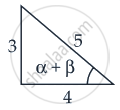
And sin(α – β) = `5/13`
∴ tan(α – β) = `5/12`
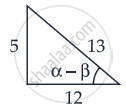
Now tan 2α = tan[α + β + α – β]
= tan[(α + β) + (α – β)]
= `(tan(alpha + beta) + tan(alpha - beta))/(1 - tan(alpha + beta).tan(alpha - beta))`
= `(3/4 + 5/12)/(1 - 3/4 xx 5/12)`
= `((9 + 5)/12)/((48 - 15)/48)`
= `14/12 xx 48/33`
= `56/33`
Hence, tan 2α = `56/33`.
If `cot theta = 3/4`, prove that `sqrt((sec theta - cosec theta)/(sec theta + cosec theta)) = 1/sqrt7`
`cot theta = "𝑎𝑑𝑗𝑎𝑐𝑒𝑛𝑡 𝑠𝑖𝑑𝑒"/"𝑜𝑝𝑝𝑜𝑠𝑖𝑡𝑒 𝑠𝑖𝑑𝑒"`
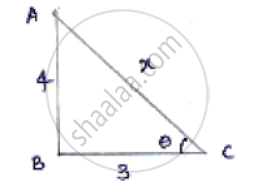
Let x be the hypotenuse by applying Pythagoras theorem.
𝐴𝐶2 = 𝐴𝐵2 + 𝐵𝐶2
𝑥2 = 16 + 9
`x^2 = 25 => x = 5`
`sec theta = (AC)/(BC) = 5/3`
`cosec theta = (AC)/(AB) = 5/4`
On substituting in equation we get
`sqrt((sec theta - cosec theta)/(sec theta + cosec theta)) = sqrt((5/3 - 5/4)/(5/3 + 5/4))`
`= sqrt(((20 - 15)/12)/((20 + 15)/12)) = sqrt(5/35) = 1/sqrt7`
If `sin θ = 3/4` prove that `sqrt(("cosec"^2θ - cot^2θ)/(sec^2θ - 1)) = sqrt(7)/3`.
We have `sin theta = 3/4`
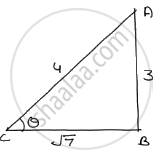
In ΔABC
`AC^2 = AB^2 + BC^2`
`=> (4)^2 = (3)^2 + BC^2`
`=> BC^2= 16 - 9`
`=> BC^2 = 7`
`=> BC = sqrt7`
`:. cosec theta = 4/3, sec theta = 4/sqrt7 and cot theta = sqrt7/3`
Now
L.H.S `sqrt((cosec^2 theta - cot^2 theta)/(sec^2 theta - 1))`
`= sqrt(((4/3)^2 - (sqrt7/3)^2)/((4/sqrt7)^2 - 1)`
`= sqrt((16/9 - 7/9)/(16/7 - 1)`
`=sqrt((9/9)/((16 - 7)/7 ))`
`= sqrt(7/9)`
`= sqrt7/3`
= R.H.S
If `tan θ = a/b` then prove that `((a sin theta - b cos theta)/(a sin theta + b cos theta)) = ((a^2 - b^2))/((a^2 + b^2))`.
Let `(a sin theta - b cos theta)/(a sin theta + b cos theta)`
Divide both Nr and Dr with cos θ of (a)
`((a sin theta - b cos theta)/cos theta)/((a sin theta + b cos theta)/cos theta)`
`= (tan theta - b)/(a tan theta + b)`
`=(a xx (a/b) - b)/(a xx (a/b) + b)`
`= (a^2 - b^2)/(a^2 + b^2)`
Key Points
sin2 A + cos2 A = 1
1 + tan2 A = sec2 A
1 + cot2 A = cosec2 A
i. \[\sin^{-1}\frac{1}{x}=\mathrm{cosec}^{-1}x\] if x ≥ 1 or x ≤ −1
\[\cos^{-1}\frac{1}{x}=\sec^{-1}x\] if x ≥ 1 or x ≤ −1
\[\tan^{-1}\frac{1}{x}=\cot^{-1}x\] if x > 0
ii. sin⁻¹(−x) = −sin⁻¹x, for x ∈ [−1, 1]
tan⁻¹(−x) = −tan⁻¹x, for x ∈ R
cosec⁻¹(−x) = −cosec⁻¹x, for x ≥ 1
cos⁻¹(−x) = π − cos⁻¹x, for x ∈ [−1, 1]
sec⁻¹(−x) = π − sec⁻¹x, for x ≥ 1
cot⁻¹(−x) = π − cot⁻¹x, for x ∈ R
\[\sin^{-1}x+\cos^{-1}x=\frac{\pi}{2},\] for x ∈ [−1, 1]
\[\tan^{-1}x+\cot^{-1}x=\frac{\pi}{2},\] for x ∈ R
\[\sec^{-1}x+\cos\sec^{-1}x=\frac{\pi}{2},\] for |x| ≥ 1
\[\tan^{-1}x+\tan^{-1}y=\tan^{-1}\left(\frac{x+y}{1-xy}\right),\] for x > 0, y > 0 and xy < 1
\[\tan^{-1}x+\tan^{-1}y=\pi+\tan^{-1}\left(\frac{x+y}{1-xy}\right),\] for x, y > 0 and xy > 1
\[\tan^{-1}x-\tan^{-1}y=\tan^{-1}\left(\frac{x-y}{1+xy}\right),\] for x, y > 0
\[2\tan^{-1}x=\sin^{-1}\left(\frac{2x}{1+x^{2}}\right),\] if −1 ≤ x ≤ 1
\[2\tan^{-1}x=\cos^{-1}\left(\frac{1-x^{2}}{1+x^{2}}\right),\] if x > 0
\[2\tan^{-1}x=\tan^{-1}\left(\frac{2x}{1-x^{2}}\right),\] if −1 < x < 1
For an acute angle A in a right-angled triangle:
-
Hypotenuse is the side opposite the right angle.
-
Perpendicular is the side opposite angle A.
-
Base is the side adjacent to angle A.
| Allied Angle | sinθ | cosecθ | cosθ | secθ | tanθ | cotθ |
|---|---|---|---|---|---|---|
| −θ | −sinθ | −cosecθ | cosθ | secθ | −tanθ | −cotθ |
| π/2 − θ | cosθ | secθ | sinθ | cosecθ | cotθ | tanθ |
| π/2 + θ | cosθ | secθ | −sinθ | −cosecθ | −cotθ | −tanθ |
| π − θ | sinθ | cosecθ | −cosθ | −secθ | −tanθ | −cotθ |
| π + θ | −sinθ | −cosecθ | −cosθ | −secθ | tanθ | cotθ |
| 3π/2 − θ | −cosθ | −secθ | −sinθ | −cosecθ | cotθ | tanθ |
| 3π/2 + θ | −cosθ | −secθ | sinθ | cosecθ | −cotθ | −tanθ |
| 2π − θ | −sinθ | −cosecθ | cosθ | secθ | −tanθ | −cotθ |
| 2π + θ | sinθ | cosecθ | cosθ | secθ | tanθ | cotθ |
Concepts [21]
- Trigonometric Identities (Square Relations)
- Trigonometric Equations
- Trigonometric Functions
- Properties of Inverse Trigonometric Functions > Self-adjusting Property
- Angles of Elevation and Depression
- Circular System
- Trigonometric Ratios
- Domain and Range of Trigonometric Functions
- Trigonometric Functions of Allied Angels
- Conditional Trigonometric Identities
- Greatest and Least Value of Trigonometric Expressions
- Solution of Trigonometric Equations (Solution in the Specified Range)
- Intervals for Inverse Trigonometric Functions
- Infinite Series of Inverse Trigonometric Functions
- Properties of Inverse Trigonometric Functions > Negative Argument Property
- Properties of Inverse Trigonometric Functions > Complementary Property
- Properties of Inverse Trigonometric Functions > Conversion Property
- Properties of Inverse Trigonometric Functions > Addition & Subtraction Formula for Inverse Tangent
- Properties of Inverse Trigonometric Functions > Double-angle Property
- Properties of Inverse Trigonometric Functions > Triple-angle Property
- Properties of Inverse Trigonometric Functions > Addition–Subtraction Formula for Inverse Sine & Cosine
