Definitions [5]
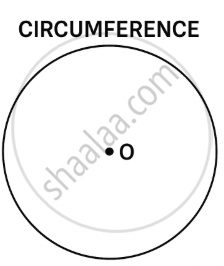
A circle is a closed curve where all points on the boundary (called the circumference) are at the same distance from a fixed point inside it.
-
The fixed point inside the circle is called the center (O)
The radius is a straight line segment that connects the center of the circle to any point on its circumference.
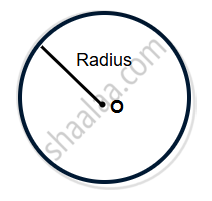
Characteristics:
-
Symbol: Usually represented as r
-
All radii of a circle have the same length
-
A circle has infinite radii (one to every point on the circumference)
-
The radius is always half the diameter
- Radius = `"Diameter"/"2"`
The diameter is a straight line segment that passes through the center of the circle and has both endpoints on the circumference.
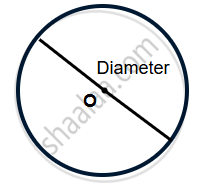
Characteristics:
-
The diameter passes through the center
-
A circle has infinite diameters
-
The diameter is the longest possible chord of a circle
-
The diameter is twice the radius
- Diameter = 2 × Radius and
A chord is a straight line segment that connects any two points on the circumference of the circle.
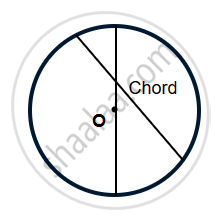
Characteristics:
-
A circle has infinite chords
-
The diameter is the longest chord in any circle
-
Chords closer to the centre are longer than chords farther from the center
Polygon: Polygon refers to a closed 2D shape which is made up of a finite number of line segments, but the perimeter is a one-dimensional measurement.
Formulae [4]

Perimeter of a rectangle = 2 × length + 2 × breadth
P = 2(1 + b) ⇒ (i) l = `P/2` − b, i.e., length = `"Perimeter"/2` − breadth
(ii) l = `P/2` − l, i.e., breadth = `"Perimeter"/2` − length

Perimeter of Square = Total boundary of the square
= Side + Side + Side + Side
P = 4 × Side
Or: P = 4s (where 's' represents the side length)
side = ` "perimeter"/"4"`
Always include the correct linear unit (cm, m, mm, km, etc.)
Perimeter of a Triangle = 3 × length of a side.
The perimeter of a regular polygon = (length of one side) × number of sides.
The perimeter of an Irregular polygon = Sum of all sides of Irregular polygons.
Theorems and Laws [14]
Two tangents TP and TQ are drawn to a circle with centre O from an external point T. Prove that ∠PTQ = 2∠OPQ.
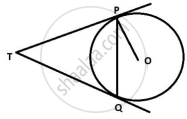
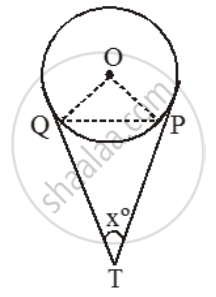
Given: A circle with centre O and an external point T from which tangents TP and TQ are drawn to touch the circle at P and Q.
To prove: ∠PTQ = 2∠OPQ.
Proof: Let ∠PTQ = xº.
Then, ∠TQP + ∠TPQ + ∠PTQ = 180º ...[∵ Sum of the ∠s of a triangle is 180º]
⇒ ∠TQP + ∠TPQ = (180º – x) ...(i)
We know that the lengths of tangent drawn from an external point to a circle are equal.
So, TP = TQ.
Now, TP = TQ
⇒ ∠TQP = ∠TPQ
`= \frac{1}{2}(180^\text{o} - x)`
`= ( 90^\text{o} - \frac{x}{2})`
∴ ∠OPQ = (∠OPT – ∠TPQ)
`= 90^\text{o} - ( 90^\text{o} - \frac{x}{2})`
`= \frac{x}{2} `
`⇒ ∠OPQ = \frac { 1 }{ 2 } ∠PTQ`
⇒ 2∠OPQ = ∠PTQ
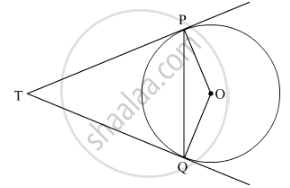
Given: TP and TQ are two tangents of a circle with centre O and P and Q are points of contact.
To prove: ∠PTQ = 2∠OPQ
Suppose ∠PTQ = θ.
Now by theorem, “The lengths of a tangents drawn from an external point to a circle are equal”.
So, TPQ is an isoceles triangle.
Therefore, ∠TPQ = ∠TQP
`= 1/2 (180^circ - θ)`
`= 90^circ - θ/2`
Also by theorem “The tangents at any point of a circle is perpendicular to the radius through the point of contact” ∠OPT = 90°.
Therefore, ∠OPQ = ∠OPT – ∠TPQ
`= 90^@ - (90^@ - 1/2theta)`
`= 1/2 theta`
= `1/2` ∠PTQ
Hence, 2∠OPQ = ∠PTQ.
Prove that the line segment joining the points of contact of two parallel tangents of a circle, passes through its centre.

Suppose CD and AB are two parallel tangents of a circle with center O
Construction: Draw a line parallel to CD passing through O i.e. OP
We know that the radius and tangent are perpendicular at their point of contact.
∠OQC = ∠ORA = 90°
Now, ∠OQC + ∠POQ = 180° (co-interior angles)
⇒ ∠POQ = 180° - 90° = 90°
Similarly, Now, ∠ORA +∠POR =180° (co-interior angles)
⇒ ∠POQ = 180° - 90° = 90°
Now,∠POR + ∠POQ = 90° + 90° =180°
Since, ∠POR and ∠POQare linear pair angles whose sum is 180°
Hence, QR is a straight line passing through center O.
In the given figure, two tangents RQ and RP are drawn from an external point R to the circle with centre O. If ∠PRQ = 120°, then prove that OR = PR + RQ.
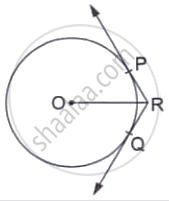

Construction Join PO and OQ
In ΔPOR and ΔQOR
OP = OQ(Radii)
RP = RQ(Tangents from the external point are congruent)
OR = OR (Common)
By SSS congruency, ΔPOR ≅ ΔQOR
∠PRO = ∠QRO(C.P.C.T)
Now,∠PRO+ ∠QRO= ∠PRQ
⇒ 2 ∠PRO = 120°
⇒ ∠PRO = 60°
Now. In ΔPOR
cos 60° `=(PR)/(OR)`
⇒ `1/2 =(PR)/(OR)`
⇒ OR = 2PR
⇒ OR = PR + PR
⇒ OR = PR +RQ
A quadrilateral is drawn to circumscribe a circle. Prove that the sums of opposite sides are equal.
Let ABCD be the quadrilateral circumscribing the circle.
Let E, F, G and H be the points of contact of the quadrilateral to the circle.
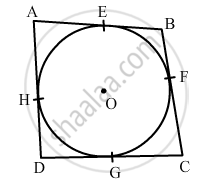
To Prove: AB + DC = AD + BC
Proof:
AB = AE + EB
AD = AH + HD
DC = DG + GC
BC = BF + FC
We have:
AE = AH (Tangents drawn from an external point to the circle are equal.)
Similarly, we have:
BE = BF
DH = DG
CG = CF
Now, we have:
AB + DC = AE + EB + DG + GC
= AH + BF + DH + CF
= (AH + DH) + (BF + CF)
= AD + BC
⇒ AB + DC = AD + BC
Thus, if a quadrilateral is drawn to circumscribe a circle, the sums of opposite sides are equal.
Hence, proved.
In figure, PA and PB are tangents from an external point P to the circle with centre O. LN touches the circle at M. Prove that PL + LM = PN + MN.
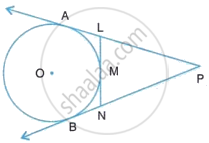
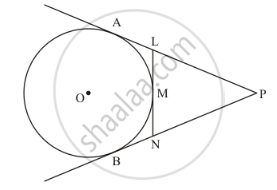
Given
O is Centre of circle
PA and PB are tangents
We know that
The tangents drawn from external point to the circle are equal in length.
From point P, PA = PB
⇒ PL + AL = PN + NB …. (i)
From point L & N, AL = LM and MN = NB } …. Substitute in (i)
PL + Lm = PN + MN
⇒ Hence proved.
If from any point on the common chord of two intersecting circles, tangents be drawn to circles, prove that they are equal.
Let the two circles intersect at points X and Y.
XY is the common chord.
Suppose ‘A’ is a point on the common chord and AM and AN be the tangents drawn A to the circle
We need to show that AM = AN.

In order to prove the above relation, following property will be used.
“Let PT be a tangent to the circle from an external point P and a secant to the circle through
P intersects the circle at points A and B, then 𝑃𝑇2 = 𝑃𝐴 × 𝑃𝐵"
Now AM is the tangent and AXY is a secant ∴ 𝐴𝑀2 = 𝐴𝑋 × 𝐴𝑌 … . . (𝑖)
AN is a tangent and AXY is a secant ∴ 𝐴𝑁2 = 𝐴𝑋 × 𝐴𝑌 … . . (𝑖𝑖)
From (i) and (ii), we have 𝐴𝑀2 = 𝐴𝑁2
∴ AM = AN
In the given figure, an isosceles triangle ABC, with AB = AC, circumscribes a circle. Prove that point of contact P bisects the base BC.
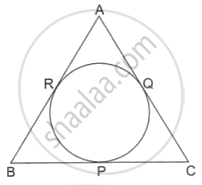
We know that tangent segments to a circle from the same external point are congruent
Now, we have
AR = AO, BR = BP and CP = CQ
Now, AB = AC
⇒ AR+ RB= AQ+ QC
⇒ AR + RB = AR + OC
⇒ RB = QC
⇒ BP = CP
Hence, P bisects BC at P.
A circle touches the side BC of a ΔABC at a point P and touches AB and AC when produced at Q and R respectively. As shown in the figure that AQ = `1/2` (Perimeter of ΔABC).

We have to prove that
AQ = `1/2` (perimeter of ΔABC)
Perimeter of ΔABC = AB + BC + CA
= AB + BP + PC + CA
= AB + BQ + CR + CA
(∵ Length of tangents from an external point to a circle are equal ∴ BP = BQ and PC = CR)
= AQ + AR ...(∵ AB + BQ = AQ and CR + CA = AR)
= AQ + AQ ...(∵ Length of tangents from an external point are equal)
= 2AQ
⇒ AQ = `1/2` (Perimeter of ΔABC)
Hence proved.
In the figure, segment PQ is the diameter of the circle with center O. The tangent to the tangent circle drawn from point C on it, intersects the tangents drawn from points P and Q at points A and B respectively, prove that ∠AOB = 90°
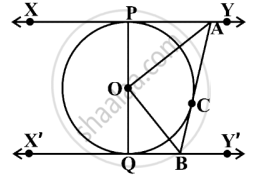
Given: PQ is the diameter of the circle. Point P, Q, C are points of contact of the respective tangents.
To prove: ∠AOB = 90°
Construction: Draw seg OC
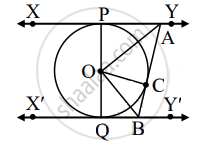
Proof:
In ∆OPA and ∆OCA,
side OP ≅ side OC ...[Radii of the same circle]
side OA ≅ side OA ...[Common side]
side PA ≅ side CA ...[Tangent segment theorem]
∴ ∆OPA ≅ ∠OCA ...[SSS test of congruency]
∴ ∠AOP ≅ ∠AOC ...[C.A.C.T.]
Let m∠AOP = m∠AOC = x ...(i)
Similarly, we can prove that ∠BOC ≅ ∠BOQ.
Let m∠BOC = m∠BOQ = y ...(ii)
m∠AOP + m∠AOC + m∠BOC + m∠BOQ = 180° ...[Linear angles]
∴ x + x + y + y = 180° ...[From (i) and (ii)]
∴ 2x + 2y = 180°
∴ 2(x + y) = 180°
∴ x + y = 90° ...(iii)
Now ∠AOB = ∠AOC + ∠BOC
= x + y ...[From (i) and (ii)]
∴ ∠AOB = ∠AOC + ∠BOC
= x + y
∴ ∠AOB = 90° ...[From (iii)]
Given: A circle inscribed in a right angled ΔABC. If ∠ACB = 90° and the radius of the circle is r.
To prove: 2r = a + b – c
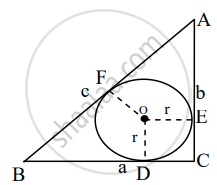
In given figure,
`{:(AF = AE),(FB = BD),(EC = DC):}}` ...(i) [Tangent Segment theorem]
In ▢ODCE,
∠ECD = 90° ...[∠ACB = 90°, A–E–C, B–D–C]
`{:(∠ODC = 90^circ),(∠OEC = 90^circ):}}` ...[Tangent theorem]
∴ ∠EOD = 90° ...[Remaining angle of ▢ODCE]
∴ ▢ODCE is a rectangle.
Also, OE = OD = r ...[Radii of the same circle]
∴ ▢ODCE is a square ...`[("A Rectangle is square if it's"),("adjcent sides are congruent")]`
∴ OE = OD = CD = CE = r ...(ii) [Sides of the square]
Consider R.H.S. = a + b – c
= BC + AC – AB
= (BD + DC) + (AE + EC) – (AF + FB) ...[B–D–C, A–E–C, A–F–B]
= (FB + r) + (AF + r) – (AF + FB) ...[From (i) and (ii)]
= FB + r + AF + r – AF – FB
= 2r
= L.H.S.
∴ 2r = a + b – c
In the given figure, the chord AB of the larger of the two concentric circles, with center O, touches the smaller circle at C. Prove that AC = CB.
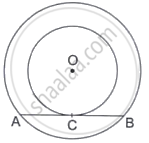
Construction: Join OA, OC and OB

We know that the radius and tangent are perpendicular at their point of contact
∴ ∠OCA = ∠OCB = 90°
Now, In Δ OCA and ΔOCB
∠OCA = ∠OCB = 90°
OA = OB (Radii of the larger circle)
OC = OC (Common)
By RHS congruency
Δ OCA ≅ Δ OCB
∴ CA =CB
In the given figure, common tangents AB and CD to the two circles with centres O1 and O2 intersect at E. Prove that AB = CD.
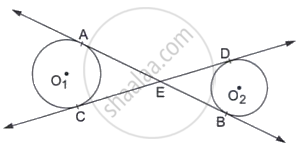
We know that tangent segments to a circle from the same external point are congruent.
So, we have
EA = EC for the circle having center O1
and
ED = EB for the circle having center O1
Now, Adding ED on both sides in EA = EC. we get
EA+ ED = EC + ED
⇒ EA + EB = EC + ED
⇒ AB = CD
In Fig., if AB = AC, prove that BE = EC
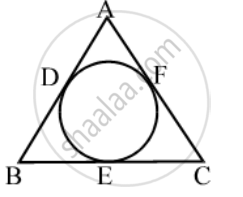
Since tangents from an exterior point to a circle are equal in length.
∴ AD = AF [Tangents from A]
BD = BE [Tangents from B]
CE = CF [Tangents from C]
Now,
AB = AC
⇒ AB – AD = AC – AD [Subtracting AD from both sides]
⇒ AB – AD = AC – AF [Using (i)]
⇒ BD = CF ⇒ BE = CF [Using (ii)]
⇒ BE = CE [Using (iii)]
Two circles touch externally at a point P. From a point T on the tangent at P, tangents TQ and TR are drawn to the circles with points of contact Q and R respectively. Prove that TQ = TR.
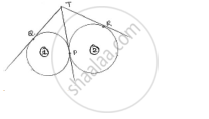
Let the circles be represented by (i) and (ii) respectively
TQ, TP are tangents to (i)
TP, TR are tangents to (ii)
We know that
The tangents drawn from external point to the circle will be equal in length.
For circle (i), TQ = TP …. (i)
For circle (ii), TP = TR …. (ii)
From (i) and (ii) TQ = TR
