Definitions [12]
A solid is defined as the form of matter, which possesses rigidity, have a definite volume, mass and shape. These characteristics are due to the existence of strong forces of attraction among the constituent particles of the solid.
Define isomorphism.
Two or more substances having the same crystal structures are called isomorphous substances, and the phenomenon is called isomorphism. For example, NaF and MgO, NaNO3 and CaCO3 are isomorphous pairs and have the same atomic ratios, 1 : 1 and 1 : 1 : 3, respectively, of the constituent atoms.
Define unit cell.
A basic repeating structural unit of a crystalline solid is called a unit cell.
Define Anisotropy.
The ability of crystalline solids to change values of physical properties when measured in different directions is called anisotropy.
The three-dimensional arrangement of constituent particles of a crystalline solid in space, in which each particle is depicted as a point, is known as a crystal lattice.
A unit cell is the smallest group of lattice points that, when repeated in all directions, will develop the entire lattice.
Packing efficiency is the ratio of volumes occupied by atoms in unit cell to the total volume of the unit cell. It is also known as the packing fraction or the density of packing.
The defects are basically irregularities in the arrangement of constituent particles. These irregularities are called crystal defects.
A doped semiconductor, having higher conductivity than a pure intrinsic semiconductor, is an extrinsic semiconductor.
A pure semiconductor with very low but finite electrical conductivity is called an intrinsic semiconductor.
The process by which impurities are introduced into semiconductors to enhance their conductivity is called doping.
Define the following term:
Ferromagnetism
Ferromagnetism is defined as the phenomenon in which substances, such as iron, cobalt and nickel, are strongly attracted by a magnetic field. Such substances are called ferromagnetic substances.
Formulae [1]
Packing fraction or Packing efficiency = \[\frac{\text{Total volume of spheres}}{\text{Volume of the unit cell}}\times100\]
Theorems and Laws [1]
Name the law or principle to which the following observations confirm:
When 9650 coulombs of electricity is passed through a solution of copper sulphate, 3.175 g of copper is deposited on the cathode (at. wt. of Cu = 63.5).
Faraday’s first law of electrolysis: The mass of a substance deposited or liberated at an electrode is directly proportional to the quantity of electricity passed through the electrolyte.
Given: Charge passed = 9650 C
Atomic mass of Cu = 63.5
Valency of Cu in CuSO4 = 2
Equivalent mass of Cu = `63.5/2` = 31.75
Now, Mass deposited = `9650/96500 xx 31.75`
= 0.1 × 31.75
= 3.175 g
Key Points
| Property | Crystalline Solids | Amorphous Solids |
|---|---|---|
| Arrangement of particles | Regular, ordered | Random, disordered |
| Melting point | Sharp | Not sharp (melts over a range) |
| Optical behaviour | Anisotropy (properties differ with direction) | Isotropy (same in all directions) |
| Examples | NaCl, Fe | Glass, Rubber |
Amorphous solids are also known as supercooled liquids.
Isomorphism and Polymorphism:
| Term | Meaning | Example |
|---|---|---|
| Isomorphism | Two or more substances having the same crystal structure (same atomic ratio) | NaF & MgO (1:1); NaNO₃ & CaCO₃ (1:1:3) |
| Polymorphism | A single substance existing in two or more crystalline forms | Calcite & aragonite (CaCO₃); α-quartz, β-quartz, cristobalite (SiO₂) |
Polymorphism occurring in elements is called allotropy.
| Property | Ionic Solids | Covalent Network Solids | Molecular Solids | Metallic Solids |
|---|---|---|---|---|
| Particles | Cations and anions | Covalently bonded atoms | Mono/polyatomic molecules | Metal ions in a sea of electrons |
| Forces | Electrostatic | Covalent bonds | London, dipole-dipole, H-bonding | Metallic bonds |
| Hardness | Hard and brittle | Very hard | Soft | Soft to very hard |
| Melting point | 600–3000°C | 1200–4000°C | Low (−272 to 400°C) | −39 to 3400°C |
| Conductivity | Poor (solid); good (molten/aqueous) | Poor (except graphite; diamond conducts heat) | Poor | Good conductor of heat and electricity |
| Examples | NaCl, CaF₂ | Diamond, silica | Ice, benzoic acid | Na, Mg, Cu, Au |
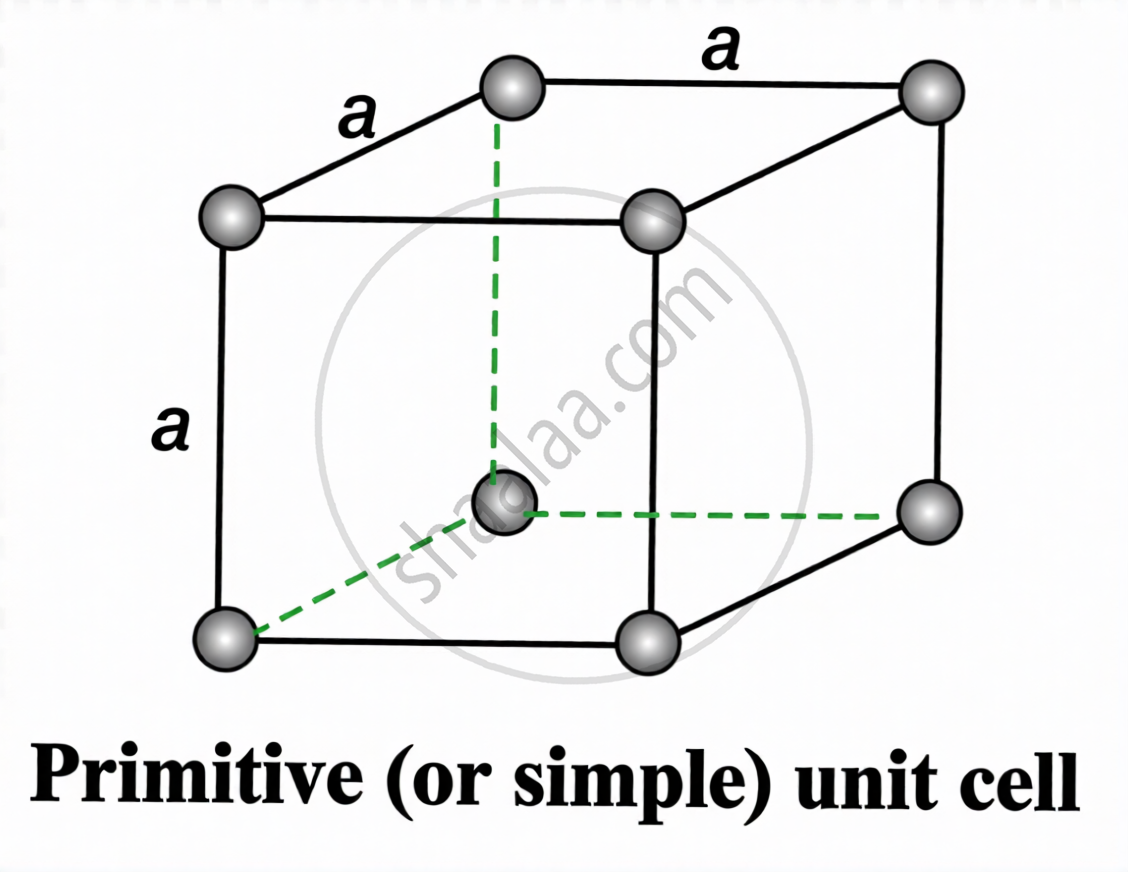
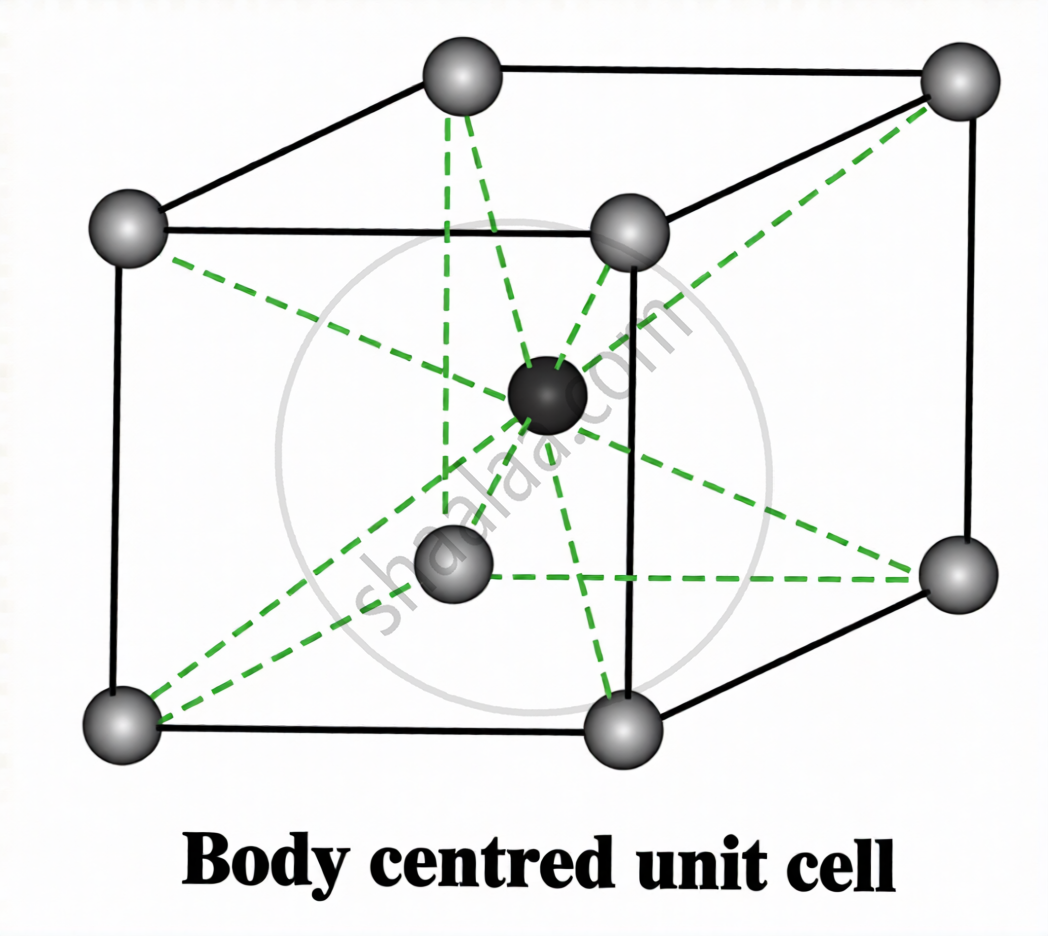
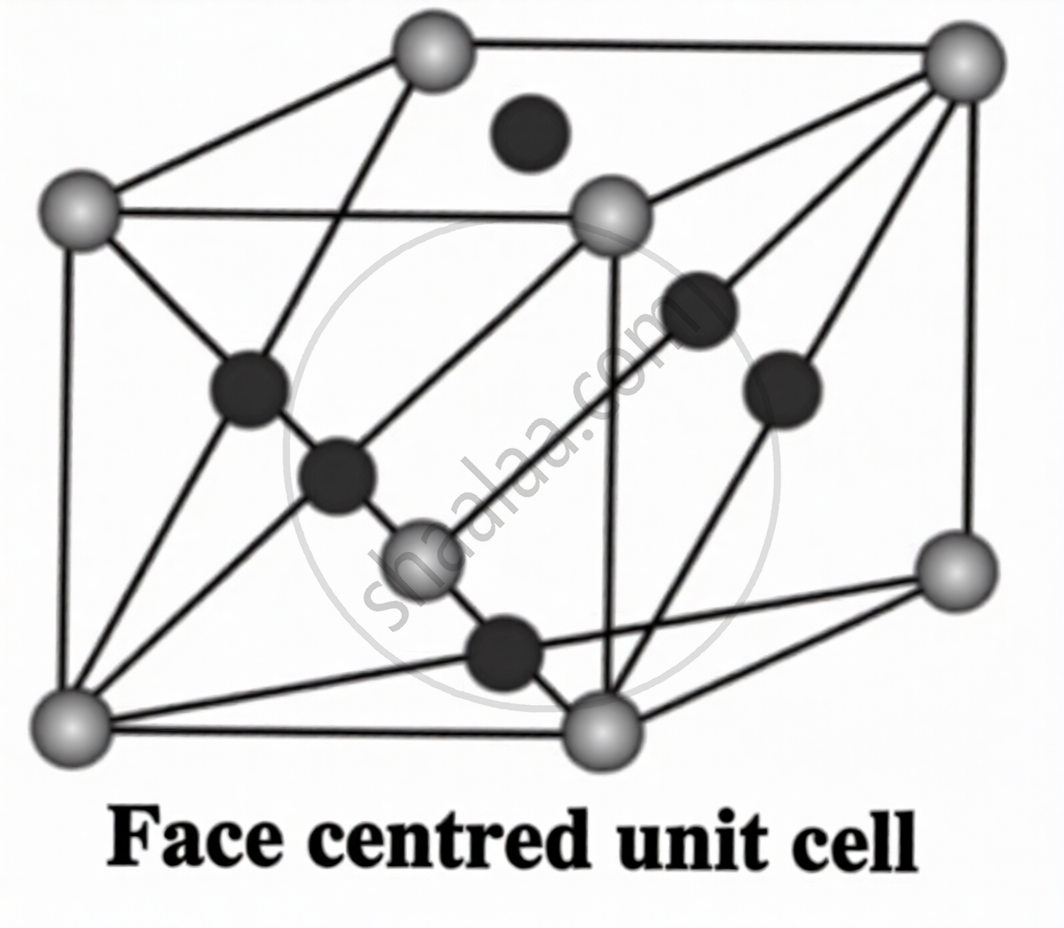
Types of Unit Cells:
| Type | Location of Particles | Atoms per Unit Cell |
|---|---|---|
|
Simple / Primitive
|
Corners only | (1/8 × 8) = 1 |
|
Body-centred (bcc)
|
Corners + 1 at body centre | (1/8 × 8) + 1 = 2 |
|
Face-centred (fcc)
|
Corners + 1 at each face centre | (1/8 × 8) + (1/2 × 6) = 4 |
| Base-centred | Corners + centres of two opposite faces | (1/8 × 8) + (1/2 × 2) = 2 |
Seven Crystal Systems:
| System | Intercepts | Angles | Bravais Lattices |
|---|---|---|---|
| Cubic | a = b = c | α = β = γ = 90° | Primitive, FCC, BCC (3) |
| Tetragonal | a = b ≠ c | α = β = γ = 90° | Primitive, BCC (2) |
| Orthorhombic | a ≠ b ≠ c | α = β = γ = 90° | Primitive, FCC, BCC, End-centred (4) |
| Monoclinic | a ≠ b ≠ c | α = γ = 90°, β ≠ 90° | Primitive, End-centred (2) |
| Triclinic | a ≠ b ≠ c | α ≠ β ≠ γ ≠ 90° | Primitive (1) |
| Hexagonal | a = b ≠ c | α = β = 90°, γ = 120° | Primitive (1) |
| Rhombohedral | a = b = c | α = β = γ ≠ 90° | Primitive (1) |
Close Packing of Spheres:
| Packing | Type | Coordination Number |
|---|---|---|
| 1D (linear) | Spheres in a row | 2 |
| 2D square (AAAA) | Square close packed | 4 |
| 2D hexagonal (ABAB) | Hexagonal close packed | 6 |
| 3D simple cubic (AAAA) | e.g., Polonium | 6 |
| 3D hcp (ABAB) | e.g., Mg, Zn | 12 |
| 3D ccp/fcc (ABCABC) | e.g., Cu, Ag | 12 |
Both hcp and ccp have the same coordination number (12) and same packing efficiency (74%).
Types of Voids:
| Void | Surrounded by | Size (relative to r) |
|---|---|---|
| Trigonal / Triangular | 3 spheres | 0.15 r |
| Tetrahedral | 4 spheres | 0.225 r |
| Octahedral | 6 spheres | 0.414 r |
Increasing order of void size: trigonal < tetrahedral < octahedral
Number of Voids (in hcp/ccp):
- Tetrahedral voids = 2N
- Octahedral voids = N (N = number of close-packed spheres)
- Octahedral voids = half of tetrahedral voids
Solids are classified into three groups based on conductivity:
| Type | Conductivity (Ohm⁻¹ m⁻¹) | Band Gap | Reason | Examples |
|---|---|---|---|---|
| Metallic conductors | 10⁴ – 10⁷ (very high) | No band gap (overlapping s & p bands) | Motion of electrons | Cu, Al, Ag |
| Insulators | 10⁻²⁰ – 10⁻¹⁰ (very low) | Large (forbidden zone) | Electrons cannot cross | Diamond, wood, rubber |
| Semiconductors | 10⁻⁶ – 10⁴ (moderate) | Small | Motion of interstitial electrons/holes | Si, Ge |
Conductivity of metals decreases with increase in temperature; conductivity of semiconductors increases with temperature.
Motion of electrons generates a magnetic field — each electron behaves like a tiny bar magnet with a magnetic moment measured in Bohr Magneton (μ_B) = 9.27 × 10⁻²⁴ A m².
| Type | Nature | Electron Configuration | Examples |
|---|---|---|---|
| Diamagnetic | Weakly repelled by magnetic field; magnetised in opposite direction | All electrons paired | NaCl, H₂O, N₂, C₆H₆, F₂, benzene |
| Paramagnetic | Weakly attracted by magnetic field; magnetised in same direction | Unpaired electrons; lose magnetism when field removed | O₂, Cu²⁺, Fe³⁺, Cr³⁺ |
| Ferromagnetic | Strongly attracted; can be permanently magnetised (all domains align in field direction) | Unpaired electrons + aligned domains | Fe, Co, Ni, Gd, CrO₂ |
