Theorems and Laws [4]
ABCD is a rhombus. EABF is a straight line such that EA = AB = BF. Prove that ED and FC when produced, meet at right angles.
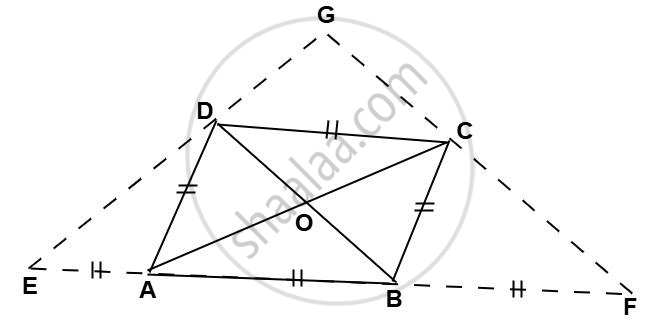
We know that the diagonals of a rhombus are perpendicular bisectors of each other
∴ OA = OC
OB = OD
∠AOD = ∠COD = 90°
And ∠AOB = ∠COB = 90°
In ΔBDE, A and O are midpoints of BE and BD, respectively
OA || DE
OC || DG
In ΔCFA, B and O are midpoints of AF and AC, respectively
∴ OB || CF
OD || GC
Thus, in quadrilateral DOCG, we have
OC || DG and OD || GC
⇒ DOCG is a parallelogram
∠DGC = ∠DOC
∠DGC = 90°
ABC is a triang D is a point on AB such that AD = `1/4` AB and E is a point on AC such that AE = `1/4` AC. Prove that DE = `1/4` BC.
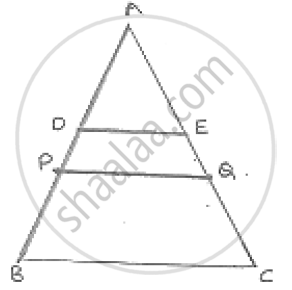
Let P and Q be the midpoints of AB and AC respectively.
Then PQ || BC such that
PQ = `1/2` BC ......(i)
In ΔAPQ, D and E are the midpoint of AP and AQ are respectively
∴ DE || PQ and DE = `1/2` PQ ....(ii)
From (1) and (2) DE = `1/2 PQ = 1/2 PQ = 1/2 (1/2 BC) `
DE = `1 /4`BC
Hence, proved.
Theorem : The line segment joining the mid-points of two sides of a triangle is parallel to the third side.
Observe following Fig. in which E and F are mid-points of AB and AC respectively and CD || BA.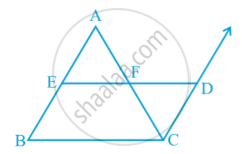
∆ AEF ≅ ∆ CDF (ASA Rule)
So, EF = DF and BE = AE = DC
Therefore, BCDE is a parallelogram.
This gives EF || BC.
In this case, also note that EF = `1/2` ED = `1/2` BC.
Theorem : The line drawn through the mid-point of one side of a triangle, parallel to another side bisects the third side.
In following fig. 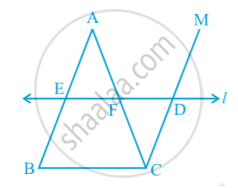
Observe that E is the mid-point of AB, line l is passsing through E and is parallel to BC and CM || BA.
Prove that AF = CF by using the congruence of ∆ AEF and ∆ CDF.
