Definitions [12]
If two variables x and y both vary with respect to a third variable t (like time), you can find the rate of change of y with respect to x using:
(Note: This is only valid if \[\frac{dx}{dt} \neq 0\]).
If a quantity y varies with another quantity x based on a rule y = f(x), then the derivative \[\frac{dy}{dx}\] (or f'(x)) represents the rate of change of y with respect to x.
Evaluating the derivative at a specific point, \[\left.\frac{dy}{dx}\right|_{x=x_0}\], gives the instantaneous rate of change at exactly \[x = x_0\].
A function f(x) is said to be an increasing function on (a, b) if x₁ < x₂ ⇒ f(x₁) ≤ f(x₂)
Strictly Increasing Function:
- If x₁ < x₂ ⇒ f(x₁) < f(x₂)
A function f(x) is said to be a decreasing function on (a, b) if x₁ < x₂ ⇒ f(x₁) ≥ f(x₂)
Strictly Decreasing Function:
- If x₁ < x₂ ⇒ f(x₁) > f(x₂)
A function f is said to be monotonic in an interval if it is either increasing or decreasing in that interval.
A function f is said to be constant on I if f(x) = c for every x ∈ I, where c is a constant.
Let x₀ be a point in the domain of a real-valued function f.
The function f is said to be increasing at x₀ if there exists an open interval containing x₀ in which f is increasing.
Similarly, f is said to be decreasing at x₀ if there exists an open interval containing x₀ in which f is decreasing.
A point in the domain of a function is called a critical point if either the derivative is zero there or the derivative does not exist there. Critical points are checked while locating possible maxima or minima.
The points where a function changes from decreasing to increasing or from increasing to decreasing are called turning points.
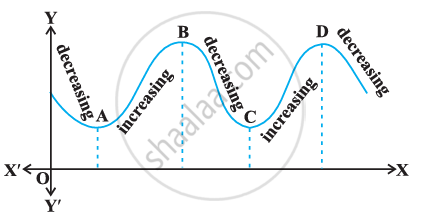
Let f be a function defined on an interval I.
Maximum value: f has a maximum value at c ∈ I if \[ \boxed{f(c) \geq f(x) \quad \text{for all } x \in I} \]
The value f(c) is called the maximum value and c is called a point of maximum.
Minimum value: f has a minimum value at c ∈ I if \[ \boxed{f(c) \leq f(x) \quad \text{for all } x \in I} \]
The value f(c) is called the minimum value and c is called a point of minimum.
Extreme value: A maximum or minimum value of f is called an extreme value.
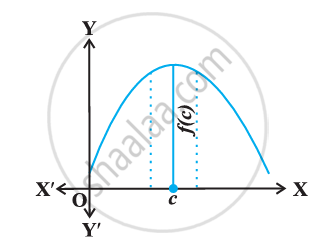
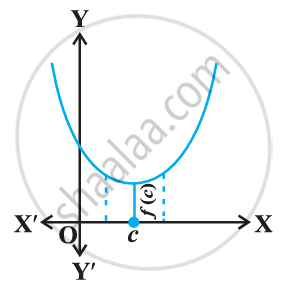
Maximum value Minimum value
Absolute Maximum: The greatest value of a function on the entire given interval is called its absolute maximum value or global maximum value.
Absolute Minimum: The least value of a function on the entire given interval is called its absolute minimum value or global minimum value.
Formulae [1]
\[\mathrm{f(a+h)\approx f(a)+h~f^{\prime}(a)}\]
Theorems and Laws [5]
Assume f'(c) = 0 and the second derivative exists at c:
-
Local Maximum: f''(c) < 0
-
Local Minimum: f''(c) > 0
-
Test Fails: f''(c) = 0. If this happens, you must go back and use the First Derivative Test to check if it is a maxima, minima, or point of inflection.
Let c be a critical point of a continuous function f:
-
Local Maximum: If f'(x) changes sign from positive to negative as x passes through c, then cc is a point of local maximum.
-
Local Minimum: If f'(x) changes sign from negative to positive then c is a point of local minimum.
-
Point of Inflection: f'(x) does not change sign as x passes through c (it is neither a maxima nor a minima).
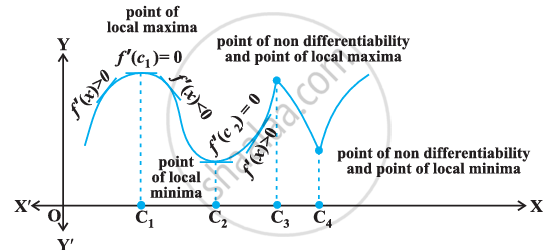
If a differentiable function has an absolute max or min at an interior point c of the interval, then its derivative at that point is zero (f'(c) = 0).
A continuous function on a closed interval [a, b] will attain its absolute maximum and absolute minimum value at least once in that interval.
If y `sqrt(x^2 + 1) = log sqrt(x^2 + 1) - x`, show that `(x^2 + 1)(dy)/(dx) + xy + 1 = 0.`
Given:
y `sqrt(x^2 + 1) = log (sqrt(x^2 + 1) - x)`
Differentiate the Left-Hand Side:
Using the product rule (uv)′ = u′v + uv′:
Let u = y and v = `sqrt(x^2 + 1)`
`d/dx (y sqrt(x^2 + 1)) = (dy)/(dx) . sqrt(x^2 + 1) + y . d/dx (sqrt(x^2 + 1))`
= `sqrt(x^2 + 1) (dy)/(dx) + y . (1/(2sqrt(x^2 + 1)) . 2x)`
= `sqrt(x^2 + 1) (dy)/(dx) + (xy)/sqrt(x^2 + 1)` ...(i)
Differentiate the Right-Hand Side:
Using the chain rule for log(u):
`d/dx [log (sqrt(x^2 + 1) - x)] = 1/(sqrt(x^2 + 1) - x) . d/dx (sqrt(x^2 + 1) - x)`
= `1/(sqrt(x^2 + 1) - x) . (x/sqrt(x^2 + 1) - 1)`
Take the LCM in the bracket:
= `1/(sqrt(x^2 + 1) - x) . ((x - sqrt(x^2 + 1))/sqrt(x^2 + 1))`
= `1/(sqrt(x^2 + 1) - x) . ((-sqrt(x^2 + 1) - x)/sqrt(x^2 + 1))`
= `-1/(sqrt(x^2 + 1)` ...(ii)
Equate LHS and RHS
`sqrt(x^2 + 1) (dy)/(dx) + (xy)/sqrt(x^2 + 1) = -1/(sqrt(x^2 + 1)`
Multiply the entire equation by `sqrt(x^2 + 1)` to clear the denominators:
`(sqrt(x^2 + 1) . sqrt(x^2 + 1)) (dy)/(dx) + xy = -1`
`(x^2 + 1) (dy)/(dx) + xy = -1`
`(x^2 + 1) (dy)/(dx) + xy + 1 = 0`
Hence proved
Key Points
-
Derivative gives instantaneous rate of change.
-
Positive derivative means the quantity is increasing.
-
Negative derivative means the quantity is decreasing.
-
In related rates, first connect the variables by an equation, then differentiate.
-
Always substitute the given value only after differentiation.
-
Do not forget units in the final answer.
-
Marginal cost and marginal revenue are applications of derivatives in economics.
- Increasing means output does not decrease as input increases.
- Strictly increasing means output always increases.
- Decreasing means output does not increase as input increases.
- Monotonic means either increasing or decreasing on an interval.
- f′(x) > 0 implies increasing, f′(x) < 0 implies decreasing, and f′(x) = 0 on an interval implies constant behaviour.
- If \[ f'(x) = 0 \] throughout an interval, the function is constant on that interval.
- A single point where \[ f'(x) = 0 \] does not necessarily make the function constant.
- To find intervals of increase or decrease, find the zeros of f'(x), divide the domain into intervals, and check the sign of f'(x).
- A function that is increasing or decreasing on an interval is called monotonic on that interval.
- A function may be increasing on one interval and decreasing on another; in that case it is not monotonic on its entire domain.
-
Maxima and minima are extreme values of a function.
-
Critical points occur where \(f'(x)=0\) or \(f'(x)\) is not defined.
-
If \(f'(x)\) changes from positive to negative, the function has a local maximum.
-
If \(f'(x)\) changes from negative to positive, the function has a local minimum.
-
If \(f''(c) < 0\), there is a local maximum at \(x=c\).
-
If \(f''(c) > 0\), there is a local minimum at \(x=c\).
-
For absolute extrema on \([a,b]\), compare values at critical points and endpoints.
-
Not every critical point gives a maximum or minimum.
-
The second derivative test is quick, but the first derivative test is often more reliable in detailed reasoning.
-
Continuity on a closed interval guarantees existence of absolute extrema.
-
Differentiability at an interior extremum implies \(f'(c)=0\).
-
Endpoints must always be checked in closed interval problems.
-
Local extrema and absolute extrema are not always the same.
-
A critical point occurs when \(f'(x)=0\) or \(f'(x)\) is undefined.
-
Optimisation problems in calculus are applications of maxima and minima.
Concepts [9]
- Introduction to Applications of Derivatives
- Rate of Change of Quantities
- Increasing and Decreasing Functions
- Tangents and Normals
- Approximations
- Maxima and Minima
- Maximum and Minimum Values of a Function in a Closed Interval
- Graph of Maxima and Minima
- Simple Problems on Applications of Derivatives
