Definitions [5]
Define lubricants and lubrication. Discuss the hydrodynamic lubrication in detail.
Any substance placed between two moving or sliding surfaces with a view to reduce the frictional resistance between them is known as lubricant.
Lubricants may be used in solid, liquid or semi solid form. The process of reducing friction between two metallic sliding surfaces by the introduction of lubricants is called as lubrication.
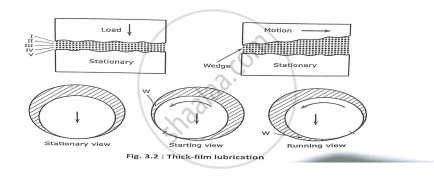
HYDRODYNAMIC OR FLUID-FILM OR THICK -FILM LUBRICATION.
In this type of lubrication, the lubricant is forming a thick film having about 7 000 A0 thickness between the moving surfaces so that the direct surface to surface contact and welding of junction rarely occurs. The coefficient of friction is very low i.e., 0.007 to 0.03 under hydrodynamic lubrication.
When oil is introduced between the moving surfaces, some of the oil molecules are held up tightly at the surface due to adsorption. The remaining oil molecules are loosely arranged away from metal surfaces. Frictional resistance is only due to the internal resistance between the particles of lubricants moving over each other. Hence lubricant chosen should have the maximum viscosity.

Hydrodynamic lubrication occurs when the surfaces are rigid and retain the shape during operations. For hydrodynamic lubrication to occur ,two essential conditions are to be satisfied: (1) liquid must be viscous and, {2) the shape of the surface should be such that a wedge shaped film should be formed. Journal bearing consist of a shaft or journal that rotates freely in a supporting metal sleeve or shell with lubricating oil in the interface between them. During normal operations the shaft rotates at sufficient speed to force the oil between the conforming curved surfaces of the shaft and the shell thus creating the oil wedge and hydrodynamic film. This film allows these bearing to support extremely heavy loads. Watches, clock, sewing machine, fans, guns etc. requires hydrodynamic lubrication.
Define the Pour point .
POUR POINT.
After cooling oil, the temperature at which it ceases to flow is called its pour point. Good lubricant should have low POUR POINT.
Define the Oiliness .
OILINESS.
Oiliness of a lubricant is the measure of its capacity to stick on to the surface of machine parts under conditions of pressure or load. Mineral oils have very poor oiliness whereas vegetable oils posses good oiliness.
Define the Flash point.
FLASH POINT.
Flash point is defined as the lowest temperature at which the lubricants gives off enough vapours to cause a momentary flash when a standard test flame is brought near it Good lubricant should have high FLASH POINT.
Define flash and fire points.
Flash point:- Flash point is defined as the lowest temperature at which the lubricant gives
off enough vapours to cause a momentary flash when a standard test flame is brought near it.
Fire point:- Fire point is the lowest temperature at which the oil vapours catch fires for at least 5 seconds, on being lighted by a test flame.
Fire point is usually 5-40ºC above the flash point. A good lubricant should have flash point at least above the working temperature . This ensures safety against the risk hazards. Thus flash point acts as a guide for the safe storage, transportation and use in machine.
Good lubricant oil should have hiah flash and fire point.
Important Questions [26]
- What Are Lubricants ? Define Lubrication .Explain Hydrodynamic Lubrication Mechanism with Neat Diagram .
- Define Lubricants and Lubrication. Mention the Various Mechanisms Involved in Lubrication of Machine. Discuss Boundary Lubrication.
- What are the functions of lubricants.
- When would solid lubricants are used?
- What is Lubrication? Explain the Mechanism of Fluid Film Lubrication.
- Explain the mechanism of Extreme pressure lubrication.
- Define Lubricants and Lubrication. Discuss the Hydrodynamic Lubrication in Detail.
- What are the conditions for use of solid lubricants? Discuss the structure and uses of Graphite.
- Mention the Conditions Under Which Semi-solid Lubricants Can Be Used
- Write a Note on Greases.
- What is grease ? What are the conditions in which greases are used ?
- 1.4 Gm of Oil Required 1.8 Ml of 0.01n Koh for Neutralization. Calculate the Acid Value and Mention Whether the Oil is Suitable to Be Used Or Not.
- Name Two Additives Added in Blended Oils .Give One Example of Each .
- Find the Acid Value of the Given Oil Whose 20 Ml Required 2.8 Ml of N/10 Koh During Titration .( Density of Oil =0.86 G/Ml )
- 20ml of Lubricating Oil Was Dissolved in Alcohol the Solution Was Titrated Against 0.1 N Koh Solution. at the End Point the Burette Reading Was Found to Be 2. 5ml Calculate the Acid Value of the Oil.
- What is Oiliness? What is Its Importance in Lubrication?
- Define Cloud Point and Pour Point of a Lubricant.
- Define the Flash Point.
- Define the Oiliness .
- Define the Pour Point .
- Define Oiliness. What is its significance {
- Define Flash Point and Fire Point? Give Its Significance.
- 9ml of Oil is Taken from Machine and It Requires 1.5ml of 0.04 N Koh. Find Acid Value( Density= 0.81 G/Ml)
- Write the Significance of the Following Properties of Lubricants. I)Emulsification Ii)Cloud Point Iii)Fire Point
- Define Flash and Fire Points.
- 6gms of Oil Was Saponified with 50ml of 0.5n Alcoholic Koh Solution. After Refluxing for 2 Hours the Mixture Was Titrated with 25ml O.Sn Hcl Rnd the Sponification Value of Oil .
