Definitions [3]
Definition: Organic Chemistry
The branch of chemistry that deals with compounds originally derived from living organisms, such as sugar, starch, proteins, and acetic acid.
or
Organic compounds are the hydrides of carbon (hydrocarbons) and their derivatives. The branch of chemistry dealing with these compounds is called organic chemistry.
Definition: Inorganic Chemistry
The branch of chemistry that deals with compounds obtained from non-living sources or minerals, such as common salt, blue vitriol, and nitrates.
Definition: Nomenclature
Nomenclature is the system of assignment of names to organic compounds.
Key Points
Key Points: Classification of Organic Compounds
(i) Based on Functional Group:
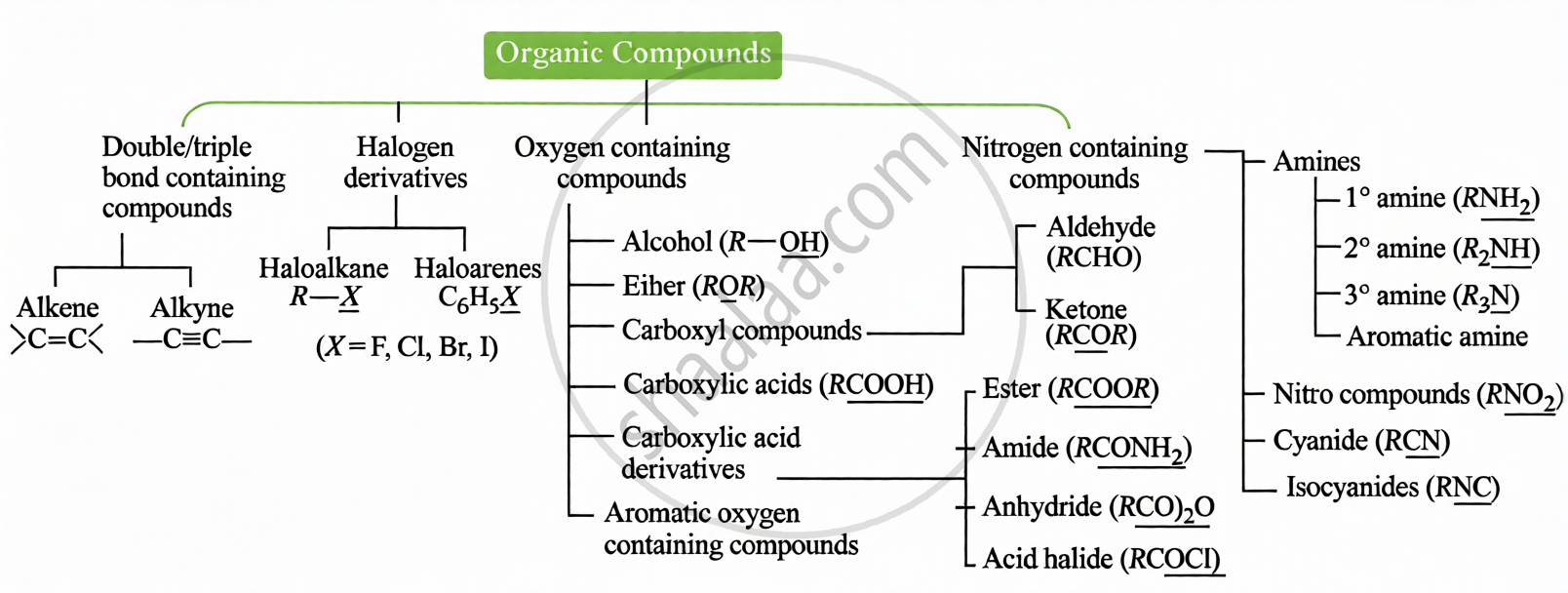
(ii) Based on Carbon Skeleton:
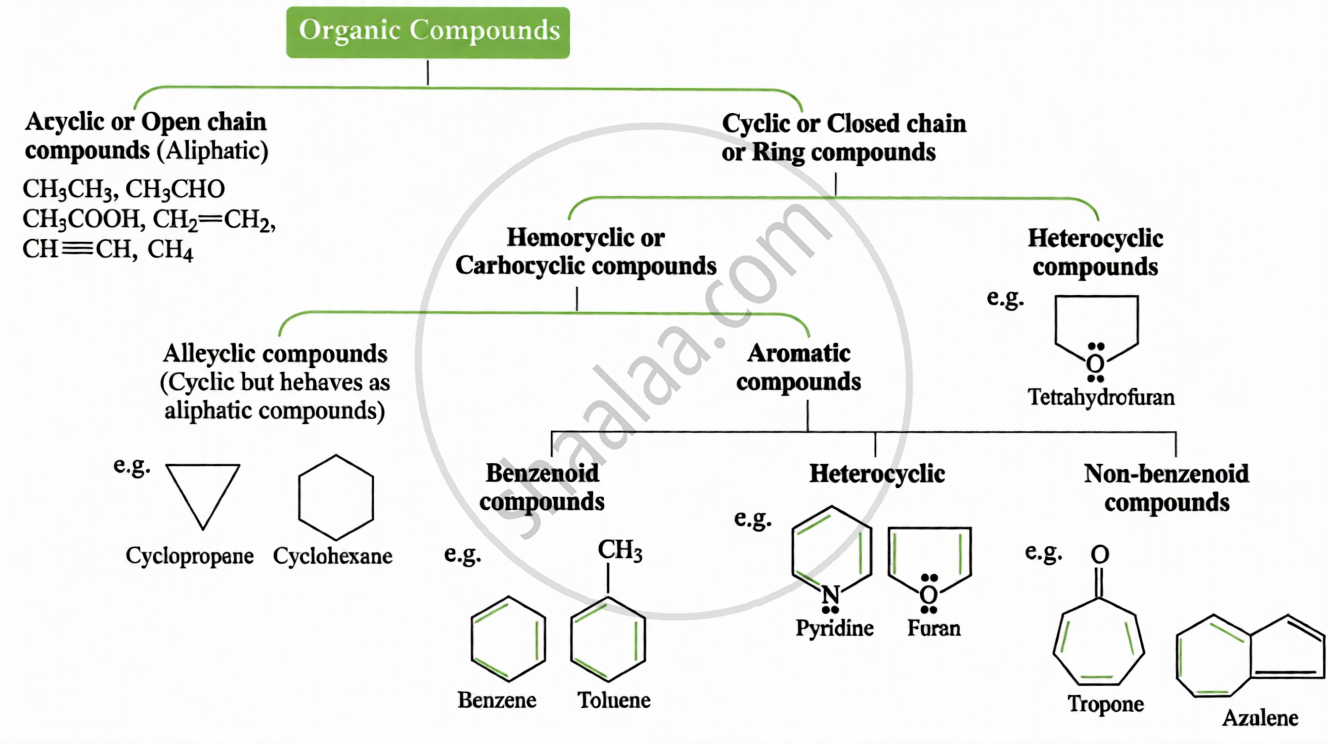
Key Points: Nomenclature
- Nomenclature is the process of giving a unique scientific name to each organism for universal identification.
- Scientific names follow rules set by ICBN (for plants) and ICZN (for animals).
- Names are usually derived from Latin or Greek and may describe features or honour scientists.
- Scientific names are written in italics (printed) or underlined (handwritten), with genus capitalised and species in lowercase.
Key points: Nomenclature of Carbon Compounds
- The IUPAC system provides a unique, systematic way to name carbon compounds based on structure, replacing confusing common names.
- An IUPAC name has three parts: prefix, parent, and suffix, reflecting the carbon chain and functional group.
- The parent name is based on the longest carbon chain, and its ending changes to –ane, –ene, or –yne depending on the number of bonds.
- Functional groups are shown as prefixes or suffixes, and the chain is numbered to give them the lowest possible number.
- If the suffix begins with a vowel, the final ‘e’ in the parent alkane name is dropped (e.g., propane → propanone).
Key Points: Lassaigne's Test
- Used for detection of: Nitrogen (N), Sulfur (S), Chlorine (Cl), Bromine (Br), Iodine (I)
- Cannot detect Fluorine (AgF is soluble, so no precipitate forms)
- Principle: Small amount of organic compound + sodium metal → fused → plunged in distilled water → boiled → filtered → Sodium Fusion Extract (SFE) obtained
Key Points: Purification of Organic Compounds
- Organic compounds obtained from natural sources or prepared in the laboratory are usually impure.
- Purification is required to obtain compounds in a pure form for the study of physical and chemical properties.
- Impurities may be solids, liquids, or gases mixed with the compound.
- Different purification methods are used based on physical properties like solubility, boiling point, and volatility.
- The choice of method depends on the nature of the compound and impurity.
Concepts [8]
- Organic Chemistry
- Classification of Organic Compounds
- Nomenclature
- Structural Representation of Organic Compounds
- Isomerism in Organic Compounds
- Detection of Elements: Lassaigne's Test
- Estimation of Elements
- Purification of Organic Compounds
