Definitions [2]
Compounds in which one or more hydrogen atom(s) of an alkane is (are) replaced by halogen.
General formula: R–X.
Compounds in which one or more hydrogen atom(s) directly bonded to an aromatic ring is (are) replaced by halogen.
General formula: Ar–X.
Key Points
Formation of Alkyl Halide from Alcohols:
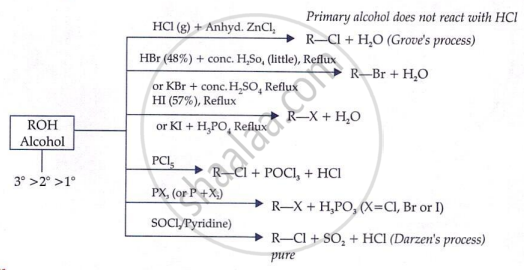
From Alkenes
(a) Addition of halogen acids:

(b) Allylic halogenation:
\[\ce{\underset{Propene}{CH3 - CH} = CH2 + Cl2 ->[775K] \underset{\underset{(Allyl chloride)}{3-Chloro-1-propene}}{ClCH2 - CH = CH2 + HCl}}\]
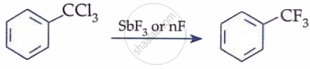
From alkanes (Swarts reaction)
Alkyl chloride or bromide react with AgF, SbF3, or Hg2F2 give alkyl fluoride. This reaction is known Swarts reaction. Antimony trifluoride (SbF2) is commonly used in this reaction.
2CH3CH3CI + Hg2F2→ 2CH3CH2F+ Hg2Cl2
From the halide exchange method (Finkelstein reaction)
Alkyl chloride or bromide react with Nal or KI in presence of acetone give alkyl iodide. It is halide exchange reaction or Finkelstein reaction. It is a SN2 reaction.
\[\ce{R - Cl + Nal ->[Acetone or Methanol] R - I + NaCl}\]
\[\begin{array}{cc}
\phantom{..........}\ce{Cl}\phantom{................................................}\ce{I}\phantom{..}\\
\phantom{..........}|\phantom{..................................................}|\phantom{.}\\
\phantom{}\ce{CH3 - CH2 - CH - CH3 ->[Nal][Acetone] CH3 - CH2 - CH - CH3}\phantom{}
\end{array}\]
Borodine-Hunsdiecker reaction
Silver salt of carboxylic acid on heating with Br2 + carbon tetrachloride give alkyl bromide
\[\ce{\underset{Silver acetate}{CH3COOAg} + Br2 ->[CCl4/Reflux] \underset{Methyl bromide}{CH3 - Br} + AgBr + CO2}\]
Note: If silver salt of carboxylic acid is heated with I2 in presence of CCI4 ester is obtained. This reaction is known as simonini reaction.
\[\ce{2RCOOAg + I2 ->[CCl4] \underset{Ester}{RCOOR} + 2CO2 + 2AgI}\]
If silver salt of carboxylic acid is heated with I2 in presence of HgO or lead tetra acetate than alkyl iodide is obtained
\[\ce{2RCOOAg ->[I2/HgO][Δ] 2R - X + 2CO2 + HgI2 + H2O}\]
On the Basis of Number of Halogen Atoms-
| Type | Description | Example |
|---|---|---|
| Monohalogen | One H replaced by one halogen | R–CH₂X |
| Dihalogen | Two H replaced (gem or vic) | R–CHX₂ |
| Trihalogen | Three H replaced | R–CX₃ |
| Tetrahalogen | Four H replaced | CX₄ |
Gem dihalide: Both halogens on the same carbon (e.g., 1,1-dichloroethane).
Vic dihalide: Halogens on adjacent carbons (e.g., 1,2-dichloroethane).
On the Basis of Type of Carbon Bearing the Halogen:
| Type | Description | Example |
|---|---|---|
| Primary (1°) | –X bonded to 1° carbon | RCH₂X |
| Secondary (2°) | –X bonded to 2° carbon | R₂CHX |
| Tertiary (3°) | –X bonded to 3° carbon | R₃CX |
| Allylic | –X bonded to allylic carbon | CH₂=CH–CH₂X |
| Benzylic | –X bonded to benzylic carbon | C₆H₅–CH₂X |
| Vinylic | –X bonded to sp² carbon of C=C | CH₂=CH–X |
| Aryl halide | –X bonded directly to aromatic ring | C₆H₅–X (Ar–X) |
Alkyl halide carbon (with X) is sp³ hybridised; aryl halide carbon is sp² hybridised — this is why aryl C–X bond is shorter and stronger.
Common Names:
- Alkyl halide or aryl halide
- e.g., CH₃Cl → Methyl chloride; CH₂=CHCl → Vinyl chloride
IUPAC Names:
- Haloalkane or arylhalide
- Rule 1: Find the longest carbon chain containing the halogen. If a double/triple bond is present, give it priority.
- Rule 2: Number from the end nearer the first substituent. Assign each substituent a position number.
- Multiple same halogens → di-, tri-, tetra- prefix.
- Different halogens → list alphabetically and number to give the alphabetically first halogen the lowest possible number.
Examples:
- CH₃Cl → Chloromethane
- CH₂=CHCl → Chloroethene
- (CH₃)₃CCl → 2-Chloro-2-methylpropane (common: tert-butyl chloride)
- 2-Chloro-1-methylbenzene → o-Chlorotoluene → IUPAC: 1-Chloro-2-methylbenzene
Concepts [10]
- Concept of Haloalkanes and Haloarenes
- Methods of Preparation of Haloalkanes
- Chemical Properties of Haloalkanes
- Stereochemistry
- Nucleophilic substitution Mechanism
- Classification of Haloalkanes and Haloarenes
- Nomenclature of Haloalkanes and Haloarenes
- Nature of C-X Bond of Haloalkanes and Haloarenes
- Chemical Properties of Haloarenes
- Polyhalogen Compounds
