Definitions [29]
The study of electricity/electric charges at rest is called electrostatics.
The closed surface over which the surface integral of the electric field intensity (i.e. total electric flux) is considered in Gauss' Law is called a Gaussian surface.
Electric charge is an intrinsic property of certain fundamental particles (like electrons and protons) that gives rise to electric and magnetic forces, causing them to experience a force when placed in an electromagnetic field.
OR
Electric charge is the physical property of matter that causes it to experience a force when placed in an electric field.
Key facts:
- SI Unit: Coulomb (C)
- Dimensional Formula: [A T] (Ampere × Time)
- Two types exist: positive and negative
The smallest unit of electric charge, denoted by e, is called the elementary charge.
OR
The smallest unit of free electric charge, denoted e, with value e ≈ 1.602 × 10⁻¹⁹ C.
A charged body whose size is negligibly small compared to the distance between the charges under consideration, is called a point charge.
OR
A charged body is treated as a point charge when its physical size is negligible compared to the distance between it and other charges under consideration.
The force of attraction or repulsion acting between two electric charges is called the electric force.
The total electrostatic force on any charge in a system of multiple charges is the vector sum of the forces exerted on it individually by each of the other charges, with each pairwise force being unaffected by the presence of the remaining charges.
The charge q that tests the effect of the source charge is called the test charge.
Define electric field.
The region in which the charge experiences an electric force is the electric field around the charge.
The electric field intensity at any point is the strength of the electric field at that point.
- It is defined as the force experienced by a unit positive charge placed at that point.
\[\vec{E}=\frac{\vec{F}}{q_0}=\frac{kq}{r^2}\hat{r}=\frac{kq}{r^3}\vec{r}\]
- The SI unit of E is NC−1 (newtons per coulomb).
The charge Q that produces the electric field is called the source charge.
The space surrounding an electric charge q in which another charge q0 experiences a (electrostatic) force of attraction or repulsion, is called the electric field of the charge q.
OR
Electric field due to a charge Q at a point in space may be defined as the force that a unit positive charge would experience if placed at that point.
OR
The region surrounding an electric charge or a group of charges in which another charge experiences a force is called an electric field.
Electric line of force is an imaginary curve drawn in an electric field such that the tangent at any point on it gives the direction of the electric field at that point.
- It represents the path along which a unit positive test charge would tend to move if free to do so.
- Lines are imaginary — they have no physical existence; they are a visualization tool only.
A measure of electric field through a surface, given by the number of electric lines of force per unit area enclosing the electric lines of force, is called electric flux.
OR
Electric flux through a surface is defined as the dot product of the electric field vector and the area vector of the surface.
For any general surface,
Define Electric Flux.
Electric dipole moment \[\vec p\] is a vector quantity defined as the product of the magnitude of either charge and the separation between them.
Mathematical definition: \[\vec p\] = q × 2a
| Symbol | \[\vec p\] |
| Magnitude | p = q × 2a |
| Direction | From −q to +q (along the dipole axis) |
| SI Unit | Coulomb-metre (C·m) |
| Dimensional Formula | [M0L1T1A1] |
An electric dipole is a pair of equal and opposite point charges placed at a short distance apart.
OR
A system formed by two equal and opposite point charges placed at a small distance apart is called an electric dipole.
OR
A system of two equal and opposite point charges +q and −q separated by a small fixed distance 2a is called an electric dipole.
- The total charge of an electric dipole is zero
- Zero net charge does not mean zero electric field - the field exists because the charges are spatially separated
- The midpoint of the line joining −q and +q is called the centre of the dipole
The midpoint of the line joining the two charges is called the centre of the dipole.
Define electric dipole moment.
The electric dipole moment is defined as the product of the magnitude of one of the charges and the distance between the two equal and opposite charges.
The line passing through the centre of the dipole and perpendicular to the dipole axis is called the equatorial line.
OR
The plane passing through the centre of the dipole and perpendicular to the dipole axis is called the equatorial plane; the line along which the equatorial field is evaluated is the equatorial line (perpendicular bisector).
“The line joining the two charges, pointing from the negative charge to the positive charge. This is known as the ‘direction of dipole axis’.”
OR
The line passing through both charges +q and −q is called the dipole axis (also called the axial line or axis of the dipole).
When charge is distributed over a surface, the charge distribution is called surface charge distribution.
OR
The surface charge density σσ is the charge per unit area at any point on the surface.
When charge is distributed over the volume of an object, it is called volume charge distribution.
OR
The volume charge density ρρ is the charge per unit volume at any point inside the body.
A charge distribution in which charge is treated as continuously spread over a line, surface, or volume (ignoring microscopic discreteness), is called continuous charge distribution.
When charge is distributed along a line, the charge distribution is called a linear charge distribution.
OR
The linear charge density λ is the charge per unit length at any point on the line.
The charge per unit area on a surface, is called surface charge density.
The charge per unit volume in a region of space, is called volume charge density.
OR
When charge is distributed over the volume of an object, it is called volume charge distribution.
The charge per unit length along a line (such as a wire), is called linear charge density.
OR
When charge is distributed along a line, the charge distribution is called linear charge distribution.
A Gaussian surface is an imaginary, closed mathematical surface chosen to apply Gauss's Law conveniently.
Formulae [7]
\[\vec{E}=\frac{1}{4\pi\varepsilon_0}\frac{Q}{r^2}\hat{r}\]
The dimensional formula of the electric field E is:
E = \[\frac {F}{q_0}\] = \[\frac{[LMT^{-2}]}{[IT]}=[MLT^{-3}I^{-1}]\]
E = \[\frac {\text {Number of electric lines of force}}{\text {Area enclosing the electric lines of force}}\]
OR
Φ = EA cos θ
where:
- Φ = electric flux
- E = magnitude of the electric field
- A = area of the surface
- θ = angle between \[\vec{E}\] and the area vector \[\vec{E}\]
SI Unit
- SI unit of electric flux = N m² C⁻¹
- Equivalent SI unit = V m
Dimensional Formula: [ML3T-3A-1]
| Expression | Formula | Condition |
|---|---|---|
| Magnitude of Torque | τ = pE sin θ | θ = angle between \[\vec p\] and \[\vec E\] |
| Vector form | \[\vec τ\] = \[\vec p\] × \[\vec E\] | Cross product |
| Maximum Torque | τmax = pE | When θ = 90° |
| Minimum Torque | τmin = 0 | When θ = 0° or 180° |
ρ = \[\frac {ΔQ}{ΔV}\] ⇒ dq = ρ dV
where ΔQ is the charge distributed over a small volume ΔV of the material.
- SI Unit: C m⁻³ (coulomb per cubic metre)
- Nature: Scalar quantity
\[\vec{E}=\frac{1}{4\pi\varepsilon_0}\sum\frac{\rho\Delta V}{r^{\prime2}}\hat{r}^{\prime}\]
λ = \[\frac {ΔQ}{Δl}\] ⇒ dq = λdl
where ΔQ is the charge distributed over a small length Δl of the wire.
- SI Unit: C m⁻¹ (coulomb per metre)
- Nature: Scalar quantity
σ = \[\frac {ΔQ}{ΔS}\] ⇒ dq = σ dS
where ΔQ is the charge distributed over a small surface area ΔS.
- SI Unit: C m⁻² (coulomb per square metre)
- Nature: Scalar quantity
Theorems and Laws [7]
- Since force is a vector, Coulomb's Law is better expressed in vector notation.
- The vector leading from charge 1 to charge 2 is r21 = r2 − r1, and from charge 2 to charge 1 is r12 = r1 − r2 = −r21.
- The corresponding unit vectors are \[\hat r_{21}\] = \[\frac {r_{21}}{r_{21}}\] and \[\hat r_{12}\] = \[\frac {r_{12}}{r_{12}}\], with \[\hat r_{21}\] =−\[\hat r_{12}\].
- The vector form of Coulomb's Law is:
F21 = \[\frac {1}{4πε_0}\] ⋅ \[\frac {q_1q_2}{r^2_{21}}\]\[\hat r_{21}\] ...(3) - If q1 and q2 are of the same sign, F21 is along \[\hat r_{21}\], representing repulsion.
- If q1 and q2 are of opposite signs, F21 is along −\[\hat r_{21}\], representing attraction.
- Eq. (3) handles both like and unlike charges correctly within a single equation — no separate formulas are needed.
- The force F12 on q1 due to q2 is obtained by interchanging 1 and 2: F12 = −F21, confirming agreement with Newton's Third Law.
- Eq. (3) gives the force in vacuum; when charges are placed in matter, the situation becomes more complex due to the charged constituents of the medium.
The force of attraction or repulsion between two point charges at rest is directly proportional to the product of the magnitude of the charges and inversely proportional to the square of the distance between them.
Scalar Form:
Vector Form:
where q1 and q2 are charges separated by distance r, and \[\hat r_{12}\] is the unit vector from q1 to q2.
Statement
The principle of superposition states that the net electric force acting on a given charge due to a number of other charges is equal to the vector sum of the individual forces exerted on it by each charge taken separately, assuming the other charges are absent.
Explanation / Mathematical Form
Consider a system of nnn point charges q1,q2,q3,…,qn.
The force acting on charge q1 due to the other charges is:
where
\[\vec F_{12}\] is the force on q1 due to q2,
\[\vec F_{13}\] is the force due to q3, and so on.
According to Coulomb’s law, the force on q1 due to q2 is:
\[\vec F_{12}\] = \[\frac{1}{4\pi\varepsilon_0}\frac{q_1q_2}{r_{12}^2}\hat{r}_{12}\]
Similarly, forces due to other charges can be written, and their vector sum gives the resultant force on q1.
Thus, the force between any two charges is independent of the presence of other charges.
Conclusion
The principle of superposition shows that:
- Electric forces obey vector addition.
- Each pair of charges interacts independently.
- The net force on a charge in a multi-charge system is found by adding all individual Coulomb forces vectorially.
Like charges repel each other while unlike charges attract each other. This is a fundamental behaviour arising from the nature of electric charge. For example, two positively charged bodies brought near each other will experience a repulsive force, while a positively charged body brought near a negatively charged body will experience an attractive force.
State Gauss’s law on electrostatics and drive expression for the electric field due to a long straight thin uniformly charged wire (linear charge density λ) at a point lying at a distance r from the wire.
Gauss' Law states that the net electric flux through any closed surface is equal to `1/epsilon_0` times the net electric charge within that closed surface.
`oint vec" E".d vec" s" = (q_(enclosed))/epsilon_o`
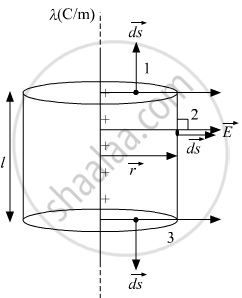
In the diagram, we have taken a cylindrical gaussian surface of radius = r and length = l.
The net charge enclosed inside the gaussian surface `q_(enclosed) = lambdal`
By symmetry, we can say that the Electric field will be in radially outward direction.
According to gauss' law,
`oint vec"E".d vec"s" = q_(enclosed)/epsilon_o`
`int_1 vec"E" .d vec"s" + int_2 vec"E" .d vec"s" + int_3 vec"E". d vec"s" = (lambdal)/epsilon_o`
`int_1 vec"E". d vec"s" & int_3 vec"E". d vec"s" "are zero", "Since" vec"E" "is perpendicular to" d vec"s"`
`int_2 vec"E" . d vec"s" = (lambdal)/epsilon_o`
`"at" 2, vec"E" and d vec"s" "are in the same direction, we can write"`
`E.2pirl = (lambdal)/epsilon_o`
`E = lambda/(2piepsilon_o r)`
"The total electric flux through any closed surface is equal to \[\frac {1}{ε_0}\] times the net charge enclosed by that surface."
Three Forms of the Law
1. Verbal Form:
The net outward electric flux through a closed surface equals the net enclosed charge divided by ε₀.
2. Algebraic Form:
ΦE = \[\frac {Q_enc}{ε_0}\]
3. Integral Form:
\[\oint\vec{E}\cdot d\vec{S}=\frac{Q_{\mathrm{enc}}}{\varepsilon_0}\]
Variable Legend
| Symbol | Meaning | SI Unit |
|---|---|---|
| ∮ | Closed surface integral | — |
| E | Electric field at the surface | N C⁻¹ |
| dS | Area element vector (outward normal) | m² |
| Qenc | Net charge enclosed by the surface | Coulomb (C) |
| ε0 | Permittivity of free space = 8.85 × 10⁻¹² C² N⁻¹ m⁻² | C² N⁻¹ m⁻² |
For an isolated system, the net charge always remains constant. This law states that charge can neither be created nor destroyed; it can only be transferred from one body to another. For example, when a glass rod is rubbed with silk, the rod gains a positive charge and the silk gains an equal negative charge — the total charge of the system remains zero.
Key Points
- Law of Conservation of Charge: Charge can neither be created nor destroyed; it can only be transferred from one body to another.
- Additivity: If a system has charges q1, q2, q3, ... qn, the total charge is:
Q = q1 + q2 + q3 + ... +qn
Analogy: Think of charge like money in a closed economy — it only moves between accounts (bodies); no new "charge currency" is printed or destroyed.
- Quantisation of charge: Electric charge exists in discrete packets, and the charge on any body is given by
q = ±ne
where n is an integer and e = 1.6 × 10⁻¹⁹ C is the elementary charge. - No fractional charge: Charge cannot exist as a fraction of e (like 0.5e or 2.3e); hence, electric charge is atomic in nature.
- Conservation of charge: The total electric charge of an isolated system remains constant; charge can neither be created nor destroyed, only transferred.
- Experimental support: Processes such as rubbing, pair production and annihilation, and radioactive decay always conserve the net charge of the system.
- Invariance of charge: The value of electric charge does not change with velocity, unlike mass, which varies with speed.
- A charge creates an electric field around it, and the field exists even if the charge is removed because the space has already been modified.
- The electric field exists at every point in three-dimensional space and does not depend on the test charge used to measure it (if the test charge is very small).
- For a positive source charge, the electric field is directed radially outward, while for a negative source charge, it is directed radially inward.
- The strength of the electric field decreases as the distance from the charge increases, and at equal distances from a point charge, the field has the same magnitude.
- The force on a charge in an electric field is given by \[\vec F\](r) = q\[\vec E\](r), and the SI unit of electric field is N/C.
- Applicable to any closed surface, regardless of shape or size — sphere, cube, irregular shape
- Only enclosed charges contribute to the net flux; external charges do not
- The electric field E at the Gaussian surface is due to all charges (inside and outside), but the net flux depends only on enclosed charge
- Gauss's Law is valid for both stationary and moving charges
- It is one of Maxwell's four equations of electromagnetism
- Gauss's Law can be derived from Coulomb's Law for static charges, and vice versa — both are equivalent
- If net enclosed charge = 0, net flux = 0 (but E ≠ 0 necessarily)
Concepts [15]
- Concept of Electrostatics
- Electric Charges
- Properties of Electric Charge
- Coulomb’s Law
- Forces Between Multiple Charges: Superposition Principle
- Force between Charges
- Electric Field
- Electric Lines of Force
- Electric Flux
- Electric Dipole
- Dipole in a Uniform External Field
- Continuous Charge Distribution
- Gauss’s Law
- Application of Gauss' Law
- Conservation of Charge
