Definitions [11]
Diffraction is the phenomenon of bending of light (or any wave) around the corners or edges of an obstacle or aperture, causing it to spread into the geometrical shadow region and produce alternate dark and bright regions.
A Polaroid is a thin film of ultramicroscopic crystals used to produce plane-polarised light.
An unpolarised wave is one in which the plane of vibration changes randomly in very short time intervals.
The plane of polarisation is the plane in which vibrations are present — it is perpendicular to the plane of vibration and contains the direction of propagation.
Polarisation is the phenomenon of restricting the vibration of a light wave to a particular plane perpendicular to the direction of propagation of the wave, or confining the electric vector vibrations to one direction perpendicular to the direction of propagation.
A transverse wave is one in which the displacement of particles is perpendicular to the direction of propagation of the wave.
A wave in which the electric field vectors are confined in one plane and are parallel to a unique direction is called a linearly polarised wave or plane polarised wave.
The plane of vibration is the plane in which the electric field vector \[\vec{E}\] vibrates or oscillates.
Electric Polarisation is the phenomenon in which an external electric field induces or aligns molecular dipoles within a dielectric, producing equal and opposite bound surface charges on its faces.
Dielectric Constant (K) is the ratio of the applied field to the net field inside the dielectric, indicating how much the material reduces the electric field.
Dielectric Strength is the maximum electric field a dielectric can withstand without electrical breakdown (i.e., before it starts conducting).
Formulae [2]
K = \[\frac {E_0}{E}\]
K = \[\frac {\sigma}{\sigma-\sigma_i}\]
where σ = surface charge density on plates, σi = induced (bound) charge density.
Eds = \[\frac {V_{max}}{d}\]
SI unit: V/m
Theorems and Laws [3]
Statement
When a beam of plane polarised light is incident on an analyser, the intensity of the transmitted light is directly proportional to the square of the cosine of the angle θ between the pass-axis of the analyser and the plane of polarisation of the incident light.
Where:
- I0 = intensity of plane-polarised light incident on the analyser
- I = intensity of the transmitted light
- θ = angle between the pass axes of the polariser and analyser
Step 1: Set up
- Let plane-polarised light with amplitude a and intensity I0 be incident on analyser P2. The pass-axis of P2 makes an angle θ with the pass-axis of P1.
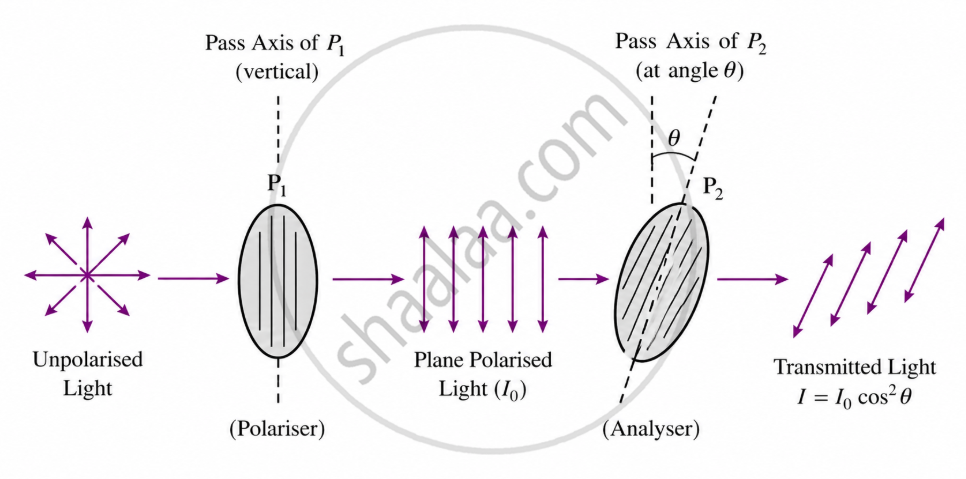
Step 2: Resolve the amplitude
The electric field amplitude aaa is resolved into two rectangular components relative to P2's pass-axis:
- Component parallel to P2's pass-axis: a cos θ → transmitted
- Component perpendicular to P2's pass-axis: a sin θ → absorbed/blocked
Step 3: Calculate transmitted intensity
Since only the parallel component passes through, and intensity ∝ (amplitude)2:
- I ∝ (a cos θ)2 = a2 cos2 θ
Step 4: Substitute I0
Since I0 ∝ a2 (the maximum intensity when θ = 0°):
- I = I0 cos2 θ
Statement:
When unpolarised light is incident at polarising angle iB on an interface separating air from a medium of refractive index μ, then the reflected light is plane polarised (perpendicular to the plane of incidence), provided:
Additional condition at polarising angle:
i.e., the reflected plane polarised light is at right angles to the refracted light.
OR
Statement:
- When the angle of incidence equals the polarising angle (θB), the reflected and refracted rays are perpendicular to each other.
- "The refractive index of a medium is equal to the tangent of the polarising angle θB."
State law of Malus.
It states that when a completely plane polarised light beam is incident on an analyzer, the intensity of the emergent light varies as the square of the cosine of the angle between the plane of transmission of the analyzer and the polarizer.
I = I0cos2θ
Concepts [9]
- Diffraction of Light
- Types of Diffraction
- Fraunhofer's Diffraction Due to a Single-slit
- Resolving Power of Microscope and Astronomical Telescope
- Polarisation of Light
- Electric Polarisation of Dielectrics
- Brewster's Law
- Law of Malus
- Polaroids
