Definitions [2]
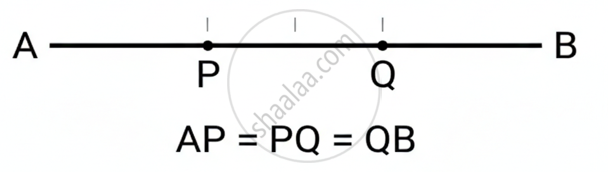
Let points P and Q lie on line segment AB and divide it into three equal parts, i.e., AP = PQ = QB; then P and Q are called points of trisection of AB.
The centroid of a triangle is the point of intersection of its medians
Formulae [3]
\[P\left(\frac{m_1x_2+m_2x_1}{m_1+m_2},\frac{m_1y_2+m_2y_1}{m_1+m_2}\right)\]
\[M\left(\frac{x_1+x_2}{2},\frac{y_1+y_2}{2}\right)\]
The point of concurrence (centroid) divides the median in the ratio 2:1.
\[G\left(\frac{x_1+x_2+x_3}{3},\frac{y_1+y_2+y_3}{3}\right)\]
Theorems and Laws [4]
Let `A(bara)` and `B(barb)` be any two points in the space and `R(barr)` be the third point on the line AB dividing the segment AB externally in the ratio m : n, then prove that `barr = (mbarb - nbara)/(m - n)`.
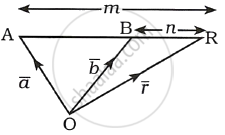
As the point R divides the line segment AB externally, we have either A-B-R or R-A-B.
Assume that A-B-R and `bar(AR) : bar(BR)` = m : n
∴ `(AR)/(BR) = m/n` so n(AR) = m(BR)
As `n(bar(AR))` and `m(bar(BR))` have same magnitude and direction,
∴ `n(bar(AR)) = m(bar(BR))`
∴ `n(barr - bara) = m(barr - barb)`
∴ `nbarr - nbara = mbarr - mbarb`
∴ `mbarr - nbarr = mbarb - nbara`
∴ `(m - n)barr = mbarb - nbara`
∴ `barr = (mbarb - nbara)/(m - n)`
Hence proved.
Let `A(bara)` and `B(barb)` are any two points in the space and `R(barr)` be a point on the line segment AB dividing it internally in the ratio m : n, then prove that `barr = (mbarb + nbara)/(m + n)`.
R is a point on the line segment AB(A – R – B) and `bar(AR)` and `bar(RB)` are in the same direction.
Point R divides AB internally in the ratio m : n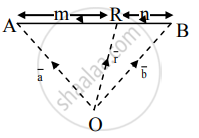
∴ `(AR)/(RB) = m/n`
∴ n(AR) = m(RB)
As `n(bar(AR))` and `m(bar(RB))` have same direction and magnitude,
`n(bar(AR)) = m(bar(RB))`
∴ `n(bar(OR) - bar(OA)) = m(bar(OB) - bar(OR))`
∴ `n(vecr - veca) = m(vecb - vecr)`
∴ `nvecr - nveca = mvecb - mvecr`
∴ `mvecr + nvecr = mvecb + nveca`
∴ `(m + n)vecr = mvecb + nveca`
∴ `vecr = (mvecb + nveca)/(m + n)`
By vector method prove that the medians of a triangle are concurrent.

Let A, B and C be vertices of a triangle.
Let D, E and F be the mid-points of the sides BC, AC and AB respectively.
Let `bara, barb, barc, bard, bare` and `barf` be position vectors of points A, B, C, D, E and F respectively.
Therefore, by mid-point formula,
∴ `bard = (barb + barc)/2, bare = (bara + barc)/2` and `barf = (bara + barb)/2`
∴ `2bard = barb + barc, 2bare = bara + barc` and `2barf = bara + barb`
∴ `2bard + bara = bara + barb + barc`, similarly `2bare + barb = 2barf + barc = bara + barb + barc`
∴ `(2bard + bara)/3 = (2bare + barb)/3 = (2barf + barc)/3 = (bara + barb + barc)/3 = barg` ...(Say)
Then we have `barg = (bara + barb + barc)/3 = ((2)bard + (1)bara)/(2 + 1) = ((2)bare + (1)barb)/(2 + 1) = ((2)barf + (1)barc)/(2 + 1)`
If G is the point whose position vector is `barg`, then from the above equation it is clear that the point G lies on the medians AD, BE, CF and it divides each of the medians AD, BE, CF internally in the ratio 2 : 1.
Therefore, three medians are concurrent.
If D, E, F are the midpoints of the sides BC, CA, AB of a triangle ABC, prove that `bar(AD) + bar(BE) + bar(CF) = bar0`.
Let `bara, barb, barc, bard, bare, barf` be the position vectors of the points A, B, C, D, E, F respectively.
Since D, E, F are the midpoints of BC, CA, AB respectively, by the midpoint formula
`bard = (barb + barc)/2, bare = (barc + bara)/2, barf = (bara + barb)/2`
∴ `bar(AD) + bar(BE) + bar(CF) = (bard - bara) + (bare - barb) + (barf - barc)`
= `((barb + barc)/2 - bara) + ((barc + bara)/2 - barb) + ((bara + barb)/2 - barc)`
= `1/2barb + 1/2barc - bara + 1/2barc + 1/2bara - barb + 1/2bara + 1/2barb - barc`
= `1/2(barb + barc - 2bara + bar c + bara - 2barb + bara + barb - 2barc)`
= `(bara + barb + barc) - (bara + barb + barc) = bar0`.
Important Questions [2]
- The coordinates of the vertices of ΔABC are respectively (–4, –2), (6, 2), and (4, 6). The centroid G of ΔABC is ______.
- In the given diagram, ABC is a triangle, where B(4, – 4) and C(– 4, –2). D is a point on AC. (a) Write down the coordinates of A and D. (b) Find the coordinates of the centroid of ΔABC.
