Advertisements
Advertisements
प्रश्न
Write the overall chemical equation for photosynthesis.
Write a balanced chemical equation showing photo-synthesis in plants.
Advertisements
उत्तर
\[\ce{\underset{dioxide}{\underset{Carbon}{6CO2}} + \underset{Water}{12H2O}->[Sunlight][Chlorophyll]\underset{Glucose}{C6H12O6} + \underset{Water}{6H2O} + \underset{Oxygen}{6O2}\uparrow}\]
APPEARS IN
संबंधित प्रश्न
How would you demonstrate that green plants release oxygen when exposed to light?
How do non-green plants such as fungi and bacteria obtain their nourishment?
All life owes its existence to chlorophyll. Give reason.
Given below is the representation of a certain phenomenon in nature. With four organisms 1-4.

- Name the phenomenon represented.
- Name any one organism that could be shown at No. 5.
- Name the biological process which was the starting point of the whole chain.
- Name one natural element which all the organisms 2-4 and even 5 are getting from No. 1 for their survival.
Given alongside is the diagram of an experimental set-up:
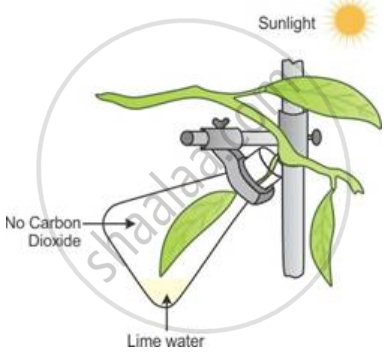
Will it work satisfactorily? Given reason.
ATP is needed for the dark reaction.
Differentiate Between:
Light reaction and Dark reaction.
Name the following:
The green colouring matter of the plants.
