Advertisements
Advertisements
प्रश्न
Write structures of various carbocations that can be obtained from 2-methylbutane. Arrange these carbocations in order of increasing stability.
Advertisements
उत्तर
| (i) | \[\begin{array}{cc} \ce{CH3 - CH - CH2 - \overset{+}{C}H2}\\ |\phantom{.......}\\ \ce{CH3}\phantom{......} \end{array}\] |
| (ii) | \[\begin{array}{cc} \ce{CH3 - CH - \overset{+}{C}H - CH2}\\ |\phantom{.......}\\ \ce{CH3}\phantom{......} \end{array}\] |
| (iii) | \[\begin{array}{cc} \ce{CH3 - \overset{+}{C} - CH2 - CH3}\\ |\phantom{.......}\\ \ce{CH3}\phantom{......} \end{array}\] |
| (iv) | \[\begin{array}{cc} \ce{\overset{+}{C}H2 - CH - CH2 - CH3}\\ |\phantom{.......}\\ \ce{CH3}\phantom{......} \end{array}\] |
The stability order is found to be: (III) > (II) > (I) > (IV)
This is because (III) is tertiary carbocation, (II) is secondary carbocation, (I) and (IV) are primary.
APPEARS IN
संबंधित प्रश्न
For the following bond cleavages, use curved arrows to show the electron flow and classify homolysis or heterolysis. Identify reactive intermediate produced as free radical, carbocation and carbanion.
\[\ce{CH3O - OCH3 -> CH3\overset\bullet{\text{O}} + \overset\bullet{\text{O}}CH3}\]
For the following bond cleavages, use curved-arrows to show the electron flow and classify as homolysis or heterolysis. Identify reactive intermediate produced as free radical, carbocation and carbanion.

For the following bond cleavages, use curved-arrows to show the electron flow and classify as homolysis or heterolysis. Identify reactive intermediate produced as free radical, carbocation and carbanion.
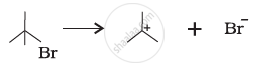
For the following bond cleavages, use curved-arrows to show the electron flow and classify as homolysis or heterolysis. Identify reactive intermediate produced as free radical, carbocation and carbanion.
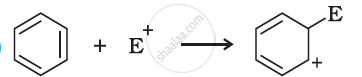
Which of the following carbocation is most stable?
Match the intermediates given in Column I with their probable structure in Column II.
| Column I | Column II |
| (i) Free radical | (a) Trigonal planar |
| (ii) Carbocation | (b) Pyramidal |
| (iii) Carbanion | (c) Linear |
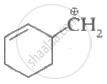
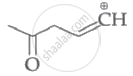
Which of the following carbocation's is most stable?
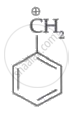 |
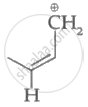 |
 |
 |
| (I) | (II) | (III) | (IV) |
Among the given species the resonance stabilised carbocations are:
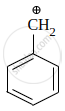
Which of the following is the most stable carbocation?
 |
\[\ce{CH2 = \overset{⊕}{C}H}\] | \[\ce{CH3 - \overset{⊕}{C}H2}\] | \[\ce{HC ≡ \overset{⊕}{C}}\] |
| A | B | C | D |
The correct order of stability of given carbocation is:
A solution of (–) – 1 – chloro–1–phenylethane in toluene racemises slowly in the presence of a small amount of SbCl5, due to the formation of ______.
The increasing order of stability of the following free radicals is ______.
The most stable carbocation among the following is:
