Advertisements
Advertisements
प्रश्न
Write one main difference between asexual and sexual mode of reproduction. Which species is likely to have comparatively better chances of survival – the one reproducing asexually or the one reproducing sexually? Give reason to justify your answer.
Advertisements
उत्तर
One major point of difference between asexual and sexual reproduction is that in asexual reproduction, a single parent gives rise to the new progenies, whereas in sexual reproduction, two different individuals are involved as parents. Both the parents produce two different kinds of gametes, which fuse to give rise to a new individual. Thus, in asexual reproduction, there is almost negligible or minimal change in the genome of the offsprings, while in sexual reproduction, all new offsprings have different genomes.
Organisms undergoing sexual reproduction are at advantage and have better chances of survival in comparison to the one undergoing asexual reproduction. This is because sexual reproduction involves fusion of two different types of gametes derived from two different individuals. This results in variation in the genome of progenies, leading to greater genetic diversity and thus better chances to adapt, escape or evolve through the selection pressures of the nature.
APPEARS IN
संबंधित प्रश्न
How does fertilisation occur in flowers? Name the parts of the flower that develop into (i) seed, and (ii) fruit after fertilisation.
A student has to perform the experiment "To identify the different parts of an embryo of a dicot seed." Select from the following an appropriate group of seeds:
(a) Pea, gram, wheat
(b) Red kidney bean, maize, gram
(c) Maize, wheat, red kidney bean
(d) Red kidney bean, pea, gram
Fill in the following blank with suitable word :
The name of the structure in the flower in which the male gamete is formed is...........
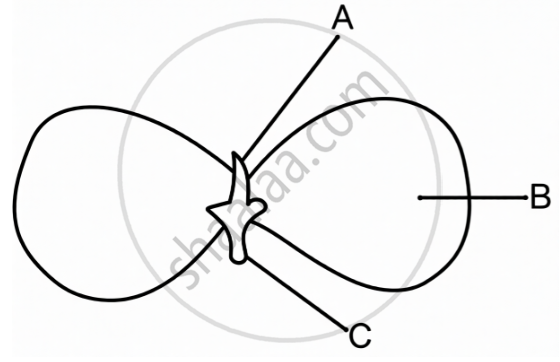
In the figure given alongside, the parts marked A, B and C are sequentially:
What is a flower ? Draw a neat labelled diagram showing the L.S. of a typical flower.
Mention the function of Anther.
The 3-celled egg apparatus at the micropylar end comprises of ______
Variations occur as a result of ______
State the number of sets of chromosomes present in a zygote.
Double fertilization means ______.
