Advertisements
Advertisements
प्रश्न
Write a note on human sperm
Describe the structure of human sperm.
Advertisements
उत्तर

Structure of Sperm
(Sperm = seed, zoon = animal)
It is a microscopic, elongated haploid motile male gamete or paternal gamete measuring about 0.055 mm (60 mu) in length. Sperm remains viable for seventy – two hours, but can fertilize the ovum in the first 12 to 14 hours only.
Human sperm is divisible into three parts - head, middle piece and tail.
- Head: It is a flat and oval region consisting of a large nucleus and an acrosome. Acrosome secretes hydrolytic enzymes like hyaluronidase which helps in the penetration of the egg during fertilization. The acrosome and anterior half of the nucleus are covered by a fibrillar sheath.
- Neck: It is a very short region having two centrioles. The proximal centriole plays a role in the first cleavage of the zygote. The distal centriole gives rise to the axial filament of the sperm.
- Middle piece: It serves as the powerhouse for sperm. It has many mitochondria spirally coiled (Nebenkern) around the axial filament. The mitochondria provide energy for the movement of the sperm in the female genital tract. The posterior half of the nucleus, neck, middle piece of sperm are covered by a sheath.
- Tail: The tail is a long, slender and tapering structure formed of cytoplasm. A fine thread, the axial filament arises from the distal centriole and traverses the middle piece and tail.
संबंधित प्रश्न
Identify True/False statement. Correct false statement to make it true.
Spermatozoa get nutrition from Sertoli cells.
Explain the Term Penis.
Explain the term Gametogenesis.
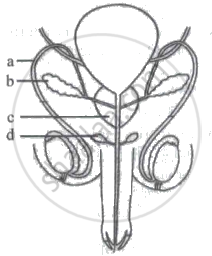
Identify the labels (a, b, c, and d) in the given diagram of the male reproductive system.
Spermatids are transformed into sperm by a process called ______.
The shared terminal duct of the reproductive and urinary system in the human male is ______.
Draw a neat labeled diagram of T.S. of testis.
Name the following:
Three accessory glands of human male reproductive system.
The male accessory gland whose secretion neutralizes the acidity of the urethra and vagina is ______.
Given below is the outline of the male reproductive system. Name the parts labelled 1 to 8. Also name the corresponding structure of part (4) in female reproductive system.
 |
