Advertisements
Advertisements
प्रश्न
Write a short note based on the information known to you.
Connecting link
Advertisements
उत्तर
- A connecting link is an organism that shows characteristics of two different groups of organisms. For example, Peripatus is considered a connecting link between annelids and arthropods.
- It has features such as a segmented body, a thin cuticle, and parapodia-like appendages, similar to those of annelids.
- It also possesses tracheal respiration and an open circulatory system, as in arthropods.
- Another example is the Duck-billed Platypus, which acts as a connecting link between reptiles and mammals because it lays eggs like reptiles and has mammary glands like mammals.
APPEARS IN
संबंधित प्रश्न
State a reason for the increased population of dark coloured moths coinciding with the loss of lichens (on tree barks) during industrialization period in England.
Which of the following is a correct set of homologous organs?
(a) Forelimbs of frog, bird and lizard
(b) Spine of cactus and thorn of bougainvillea
(c) Wings of bat and wings of butterfly
(d) Wings of a bird and wings of a bat
Explain the terms analogous and homologous organs with examples.
The organs which perform similar functions but have different basic structure are called :
(a) asymmetric organs
(b) analogous organs
(c) homologous organs
(d) homophonic organs
Read the following statement and justify the same in your own words with the help of a suitable example.
There is evidence of foetal science among chordates.
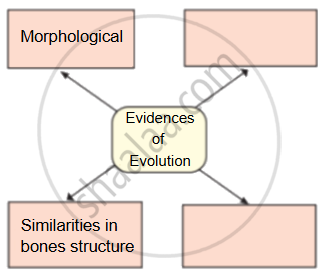
Complete the following chart:
What do you mean by vestigial structures? Name four vestigial organs found in man.
Long answer question.
Would you consider wings of butterfly and bat as homologous or analogous and why?
Match the following.
| Column A | Column B |
| 1) Morphological evidences | a) Tail-bone or wisdom teeth |
| 2) Paleontological evidences | b) Leaf venation |
| c) Fossils |
Write a short note:
Embryological evidences
Homologous organs and vestigial organs are examples of ______ type of evidence in evolution.
Homologous organs are:
Cucurbits do not develop thick and woody stem as they are:
The study of fossil evidence of evolution is called ______
Did aquatic life forms get fossilised? If, yes where do we come across such fossils?
While creation and presence of variation is directionless, natural selection is directional as it is in the context of adaptation. Comment.
What is the function of the appendix of our digestive system?
Define the term:
Homologous organs
Write names of some vestigial organs in the human body.
