Advertisements
Advertisements
प्रश्न
Meanings of the symbols
| Attribute | Significance |
| Broken chains | Being freed |
| Breastplate with eagle | Symbol of the German empire – strength |
| Crown of oak leaves | Heroism |
| Sword | Readiness to fight |
| Olive branch around the sword | Willingness to make peace |
| Black, red and gold tricolour | Flag of the liberal-nationalists in 1848, banned by the Dukes of the German states |
| Rays of the rising sun | Beginning of a new era |
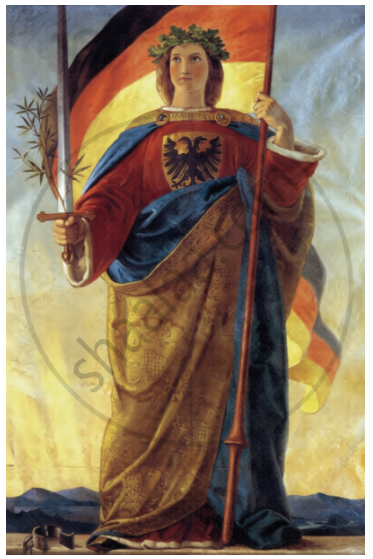
With the help of the chart in the box, identify the attributes of Veit’s Germania and interpret the symbolic meaning of the painting. In an earlier allegorical rendering of 1836, Veit had portrayed the Kaiser’s crown at the place where he has now located the broken chain. Explain the significance of this change.
Advertisements
उत्तर
Germania was an allegory of the German nation. In visual representations, Germania wears an oak leaf crown, as the German oak represents heroism. She is holding a sword and an olive branch, showing both her readiness to battle and her willingness to make peace. The broken chain represents freedom, the breastplate with the eagle represents the might of the German Empire, and the black, red, and gold tricolour was the liberal-nationalist banner in 1848, which was banned by the Dukes of the German states. The rays of the rising sun behind Germania represent the start of a new era. In a previous allegorical rendering from 1836, Veit depicted the Kaiser’s crown, where he now finds the broken chain. This development indicates that the German country is now free of despotic monarchical authority.
