Advertisements
Advertisements
प्रश्न
With the help of suitable diagrams, explain how the age structures determine the trend of population.
Advertisements
उत्तर
The relative proportion of individuals of various age groups in the population is called the age structure of the population.
Role of age structure:
Age structure (distribution of age groups) determines the trend of the population.
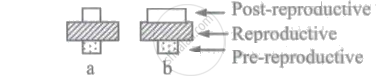
- Growing population: The population having a larger number of individuals of the pre-reproductive age groups shows a very rapid rate of growth.
- Steady population: Population having the same number of pre-reproductive and post-reproductive age groups is stable.
- Declining population: A large number of post-reproductive and a small number of pre-reproductive groups make the population decline.

APPEARS IN
संबंधित प्रश्न
Which of the following is wrongly matched?
Describe the qualitative aspects of population.
The number of individuals of the same species that have come into the habitat from elsewhere during the time period under consideration is known as ______.
A biologist studied the population of rats in a barn. He found that the average natality was 300, average mortality 250, immigration 50 and emigration 100. The net increase in population is ____________.
Calculate the birth rate if a population of 150 Paramoecium present in a pool increases to 450 after an hour.
Identify the type of population shown in the given figures (a and b).
Mortality of a region is assessed by ____________ of individuals per unit area per unit time.
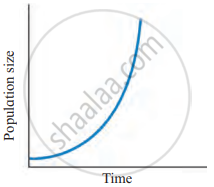
From the given diagram, identify the type of population growth curve:
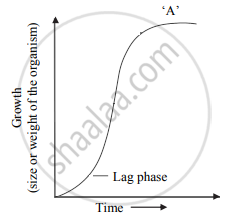
Identify ‘A’ in the given graph of population growth:
Which type of natality represents the number of births under ideal conditions with no competition and abundant resources?
