Advertisements
Advertisements
प्रश्न
Which of the following does not show water shortage?
पर्याय
Taps running dry.
Long queues for getting water.
Marches and protests for demand for water.
A family gets three buckets of water per person per day.
Advertisements
उत्तर
A family gets three buckets of water per person per day.
Explanation:
The United Nations has recommended that a minimum of 50 litres of water should be available to each of us per person per day for drinking, washing, cooking and cleaning. This amount is about two and a half buckets of water per person per day. Therefore, a family getting three buckets of water per person per day does not show a water shortage.
APPEARS IN
संबंधित प्रश्न
Name the gas produced when fossil fuel is burnt.
Answer the following question:
Name two gases dissolved in natural water.
Explain rain water harvesting.
State whether the given statement are true or false. If true, write the reason.
Ganga−Brahmaputra plain of India is an overpopulated region.
How is aquatic life benefited by the fact that water has maximum density at 4oC?
Name the solute, solvent & solution in the statement – ‘sodium chloride dissolves in water to give sodium chloride solution’. Define each of the terms in italics.
Give a balanced equation for the following conversion:
Calcium sulphate in permanent hard water to calcium carbonate using sodium carbonate.
Name a deliquescent substance’.
Pour water from the ice tray into a kettle. Ask an elder at your home to heat the kettle and observe the mouth of the kettle when the water starts boiling.
What do you see?
Name the process which is responsible for the formation of droplets on the surface of a glass of cold drink. _______
Match the following
| 1. | Flood | Lake |
| 2. | Surface water | Evaporation |
| 3. | Sunlight | Water vapour |
| 4. | Cloud | Pole |
| 5. | Frozen water | Increased rainfall |
Write a few slogans of your own on the topic “Save Water”
______ plays a vital role in the evolution and survival of life.
What is the source of water in the following?
Wells
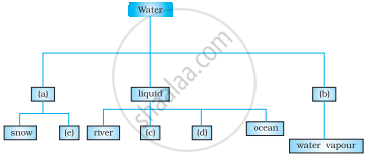
Complete the following chart by writing appropriate words in the boxes marked (a) to (e).
Water polluted by various human activities causes a number of water borne diseases. Which of the following is not a water borne disease?
Why should we not throw used tea leaves into sink?
A mixture (x) in water contains suspended solids, organic impurities, inorganic impurities (a), nutrients (b), disease-causing bacteria and other microbes. Give names for (x), (a) and (b)?
Fill in the blanks selecting words from the following list
snow, rain, clouds, vapour, evaporation, transpiration.
Water, as ______ goes into atmosphere by the processes of ______ and ______ and forms ______, which on condensation fall in the form of ______ and ______.
