Advertisements
Advertisements
प्रश्न
When a green iron salt is heated strongly, its colour finally changes to brown and odour of burning sulphur is given out.
- Name the iron salt.
- Name the type of reaction that takes place during the heating of iron salt.
- Write a chemical equation for the reaction involved.
Advertisements
उत्तर
- Ferrous sulphate (Iron(II) sulphate)
- Thermal decomposition reaction
- \[\ce{2FeSO4_{(s)} ->[Heat] Fe2O3_{(s)} + SO2_{(g)} + SO3_{(g)}}\]
APPEARS IN
संबंधित प्रश्न
Write the balanced chemical equation for the following and identify the type of reaction.
\[\ce{Zinc carbonate(s) -> Zinc oxide(s) + Carbon dioxide(g)}\]
Write one equation for decomposition reactions where energy is supplied in the form of heat.
Decomposition reactions require energy either in the form of heat or light or electricity for breaking down the reactants. Write one equation each for decomposition reactions where energy is supplied in the form of heat, light and electricity
Rewrite the following statements by selecting the correct options:
\[\ce{CaCO3 ->[\Delta] CaO + CO2 ^}\] is a __________ reaction.
Give one example of a decomposition reaction which is carried out by applying heat.
What type of chemical reaction is represented by the following equation?
\[\ce{X -> Y + Z}\]
What is meant by a decomposition reaction?
State the change in colour observed in the following case, mentioning the reason:
Silver chloride is exposed to sunlight.
A metal salt MX when exposed to light splits up to form metal M and a gas X2. Metal M is used in making ornaments whereas gas X2 is used in making bleaching powder. The salt MX is itself used in black and white photography.
- What do you think metal M is?
- What could be gas X2?
- Name the metal salt MX.
- Name any two salt solutions which on mixing together can produce a precipitate of salt MX.
- What type of chemical reaction takes place when salt MX is exposed to light? Write the equation of the reaction.
What is a redox reaction? Explain with an example.
Answer the following question.
2 g of silver chloride is taken in a china dish and the china dish is placed in sunlight for some time. What will be your observation in this case? Write the chemical reaction involved in the form of a balanced chemical equation. Identify the type of chemical reaction.
Classify the following reaction into different type:
\[\ce{2KClO3(s)->[\Delta] 2KCl(aq) + 3O2(g)}\]
Give a balanced equation for the following type of reaction:
A thermal decomposition reaction in which a compound decomposes to give two new compounds.
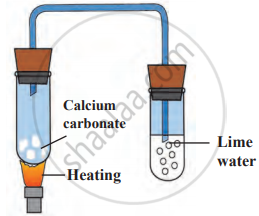
Explain the reaction given in the figure.
Electrolysis is type of ______ reaction.
Marble statues are corroded or stained rain water. Identify the main reason.

Balance the following chemical equation and identify the type of chemical reaction.
`"HgO"("s") overset("(heat)")(->) "Hg"("l") + "O"_2("g")`
On heating blue coloured powder of copper (II) nitrate, in a boiling tube, copper oxide (black), oxygen gas and a brown gas X is formed
- Write a balanced chemical equation of the reaction.
- Identify the brown gas X evolved.
- Identify the type of reaction.
- What could be the pH range of aqueous solution of the gas X?
These consist of two statements – Assertion (A) and Reason (R). Answer these questions selecting the appropriate option given below:
Assertion: Silver bromide decomposition is used in black and white photography.
Reason: Light provides energy for this exothermic reaction.
What is observed when silver chloride is exposed to sunlight? Give the type of reaction involved.
