Advertisements
Advertisements
प्रश्न
Answer the following question.
What was Soapy’s first plan? Why did it not work?
Advertisements
उत्तर
Soapy's first plan was to go and have a good dinner at some fine restaurant. He would then say that he had no money to pay. And then a cop would be called. It would all be done very quietly. The cop would arrest him. He would be taken to a judge. The judge would do the rest.
It did not work because as he put his foot inside the restaurant door, the head waiter saw his broken old shoes and the torn clothes that covered his legs. Strong and ready hands turned Soapy around and moved him quietly and quickly outside again.
संबंधित प्रश्न
Discuss in group and answer the following question in two or three paragraphs (100
−150 words)
Of the three, Jerome, George and Harris, who do you think is the best or worst packer?
Support your answer with details from the text.
Thinking about the Poem
What does the poet like to do when it rains?
1. What kind of place is Innisfree? Think about:
- the three things the poet wants to do when he goes back there (stanza I);
- what he hears and sees there and its effect on him (stanza II);
- what he hears in his “heart’s core” even when he is far away from Innisfree (stanza III).
2. By now you may have concluded that Innisfree is a simple, natural place, full of beauty and peace. How does the poet contrast it with where he now stands? (Read stanza III).
3. Do you think Innisfree is only a place, or a state of mind? Does the poet actually miss the place of his boyhood days?
Read the lines given in the boxes on the next page. They are in random order.
Now listen to the recording of the poem carefully. As you listen, number the
stanzas given in the boxes sequentially.
I am beautiful pearls, plucked from the
Crown of Ishtar by the daughter of Dawn
To embellish the gardens
I emerge from the heart of the Sea and
Soar with the breeze. When I see a field in
Need, I descend and embrace the flowers and
The trees in a million little ways
The voice of thunder declares my arrival :
The rainbow announces my departure.
I am like earthly life, which begins at
The feet of the mad elements and ends
Under the upraised wings of death
I am dotted silver threads dropped from heaven
By the gods. Nature then takes me to adorn
Her fields and valleys.
I touch gently at the windows with my
Soft fingers and my announcement is a
Welcome song. All can hear but only
The sensitive can understand
The field and the cloud are lovers
And between them I am a messenger of mercy.
I quench the thirst of the one,
I cure the ailment of the other.
I am the sigh of the sea, the laughter of the field;
The tears of heaven.
When I cry the hills laugh;
When I humble myself the flowers rejoice;
When I bow, all things are elated
So, with love-
Sighs from the deep sea of affection; Laughter
from the colourful field of the spirit; Tears from
the endless heaven of memories.
Here is a newspaper report of a young girl who went back in time to see how her home town looked seventy years ago.
Dehra Times
|
Purkul, 7 July, 09 It is reported that Kareena, a twelve year old girl living in Purkul, went back in time using a time machine. Seventy years ago her home town was an ideal place to live in. Her home town had not been invaded by the marvels of technology. Industries had not been set up then, so the air was not polluted. She could see children playing in the garden. Some children were listening to the stories told by their grandmothers. Happiness and contentment prevailed everywhere. |
In the newspaper report above, the focus is on the changes as observed by Kareena.
- Kareena’s hometown had not been invaded by the marvels of technology.
- Industries had not been set up.
- The air was not polluted.
- Some children were listening to stories told to them by their grandmothers.
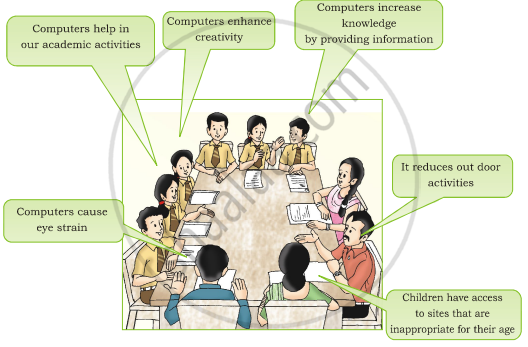
This is a meeting of the school’s Parent-Teacher Association. Some student representatives have also been invited to participate to discuss the role that Information technology/computers play in the growth and development of children.
Mrs. Thompson did not reply, but presently turned towards the little chamber where her husband had deposited Maggie; and, pushing open the door, went quietly in. Joe did not follow; he saw that, her state had changed, and felt that it would be best to leave her alone with the child. So he went to his shop, which stood near the house, and worked until dusky evening released him from labor. A light shining through the little chamber windows was the first object that attracted Joe’s attention on turning towards the house: it was a good omen. The path led him by this windows and, when opposite, he could not help pausing to look in. It was now dark enough outside to screen him from observation. Maggie lay, a little raised on the pillow with the lamp shining full upon her face. Mrs. Thompson was sitting by the bed, talking to the child; but her back was towards the window, so that her countenance was not seen. From Maggie’s face, therefore, Joe must read the character of their intercourse. He saw that her eyes were intently fixed upon his wife; that now and then a few words came, as if in answers from her lips; that her expression was sad and tender; but he saw nothing of bitterness or pain. A deep-drawn breath was followed by one of relief, as a weight lifted itself from his heart.
Read the extract given below and answer the question that follow.
Why did Joe not follow Mr s Thompson? What had changed her?
I was in for a surprise. When the time came for the broad-jump trials, I was startled to see a tall boy hitting the pit at almost 26 feet on his practice leaps! He turned out to be a German named Luz Long. 1 was told that Hitler hoped to win the jump with him. I guessed that if Long won, it would add some new support to the Nazis’ “master race” (Aryan superiority) theory. After all, I am a Negro. Angr about Hitler’s ways, 1 determined to go out there and really show Der Fuhrer and his master race who was superior and who wasn’t. An angry athlete is an athlete who will make mistakes, as any coach will tell you. I was no exception. On the first of my three qualifying jumps, I leaped from several inches beyond the takeoff board for a foul. On the second jump, I fouled even worse. “Did I come 3,000 miles for this?” I thought bitterly. “To foul out of the trials and make a fool of myself ?” Walking a few yards from the pit, 1 kicked disgustedly at the dirt.
Read the extract given below and answer the question that follow.
Why did Owens kick the pit in disgust?
So after that, dimly, dimly, she sensed it, she was different and they knew her difference and kept away. There was talk that her father and mother were taking her back to Earth next year; it seemed vital to her that they do so, though it would mean the loss of thousands of dollars to her family. And so, the children hated her for all these reasons of big and little consequence. They hated her pale snow face, her waiting silence, her thinness, and her possible future. “Get away 1” The boy gave her another push. “What’re you waiting for?”Then, for the first time, she turned and looked at him. And what she was waiting for was in her eyes. “Well, don’t wait around here !” cried the boy savagely. “You won’t see nothing!” Her lips moved. “Nothing 1” he cried. “It was all a joke, wasn’t it?” He turned to the other children. “Nothing’s happening today. Is it ?”
Read the extract given below and answer the question that follow.
What was the rumour? What did Margot think?
Read the extract given below and answer the questions that follow:
"What's your name ?" he asked.
"Bmillnvaite," I replied, "Ricardo Bmithwaite.
'"I'm Pinkus and this is Mama Pinkus."
The introduction was effected with a filial devoti~ which was good to see.
"How d'you do, Mama Pinkus."
"I think I know someplace for you." He went the little noticeboard and removed a small car, on which was written a short advertisement of, room to let near-by.
(i) Why was Braithwaite looking for a new placet? stay? Why was he impressed by the place that was on rent?
(ii) What reception did Ile get wizen he reached the address that had been advertised? Whom did tit house belong to?
(iii) Why did Mrs. Pegg come lo see Braithwaite? Wh• reply did Braithwaite give to her?
(iv) What changes occurred in Pamela's persona/ii after the August holiday?
(v) What comment did Potter make wizen Braithwait? hurt himself? What did he mean by that comment How did Pamela react to Potter's remark?
Answer the following question
Explain why no one seemed to be interested in talking about the hilsa-fish which Gopal had bought
What was Purcell’s source of earning?
What did the narrator’s grandfather see at the zoo?
What is a dream?
State an adjective used to describe the tree.
Describe the tone in which the narrator’s father dismissed his wife’s warnings every single time.
Here are some points from a similar story that you might have heard in another language. Dividing the class into two groups try and tell the story in English. One person from each group can speak alternately. Your teacher will help you. As you tell it, one of you may write it down on the board.
A Mouse Maiden
l mouse changed into a girl by a magician...
l wants to marry the strongest person...
l asks whether sun or cloud stronger (why?)...
l but mountain stronger than clouds (how?)...
l but mouse stronger than mountain (how?)...
l girl asks to marry mouse, becomes a mouse again.
Multiple Choice Question:
The kite rides over _____________
Multiple Choice Question:
When does the flier have to run?
Write ‘True’ or ‘False’ against each of the following sentences.
Gopal was a clever man. ________
