Advertisements
Advertisements
प्रश्न
What is the principle of an ideal machine?
Advertisements
उत्तर
The principle of an ideal machine is that the work output is equal to the work input.
Work input = Work output
APPEARS IN
संबंधित प्रश्न
A scissor is a ______ multiplier.
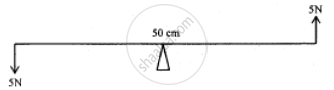
Two forces each of 5N act vertically upwards and downwards respectively on the two ends of a uniform metre rule which is placed at its mid-point as shown in the diagram. Determine the magnitude of the resultant moment of these forces about the midpoint.
State the incorrect statement:
A force of 5 kgf is required to cut a metal sheet. A pair of shears used for cutting the metal sheet has its blades 5 cm long, while its handles is 10 cm long. What effort is needed to cut the sheet?
The diagram below shows a claw hammer used to remove a nail :
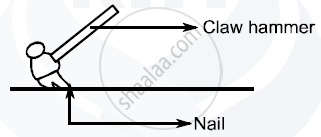
(i) To which class of lever does it belong ?
(ii) Give one more example of the same class of lever mentioned by you in (i) for which the mechanical advantage is greater than one.
Stat the principle of an ideal machine.
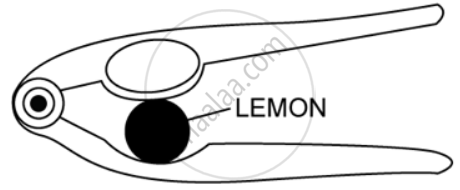
Shows a lemon crusher.
- In the diagram, mark the position of the fulcrum F and the line of action of load L and effort E.
- Name the class of lever
What is a machine?
Name a machine which can be used to multiply force and change the direction of force applied.
Mention the advantages of using a machine.
