Advertisements
Advertisements
प्रश्न
What is photoelectric effect? State the result of photoelectric effect experiment that could not be explained on the basis of laws of classical physics. Explain this effect on the basis of quantum theory of electromagnetic radiations.
Advertisements
उत्तर
When the beam of light gets exposed to the metal surface then the electrons get emitted from the metal. This effect is said to be photoelectric effect and the emitted electrons are said to be photoelectrons.
The result of photoelectric experiment are as follows:-
(i) There is no time gap between the striking of a light beam and the ejection of electrons from the metal surface i.e. electrons emit as soon as a beam of light strikes the metal surface.
(ii) The number of electrons ejected is directly proportional to the intensity of light.
(iii) For every metal there is minimum emitting frequency which is said to be threshold frequency, `ν_o`. The kinetic energies of these electrons is directly proportional to the frequency of the light used.
As per the quantum theory of electromagnetic radiation when a photon with energy greater than the threshold energy of the metal strikes the metal then the electrons get emitted from the metal without any delay and its kinetic energy depends upon the frequency of the light.

APPEARS IN
संबंधित प्रश्न
Yellow light emitted from a sodium lamp has a wavelength (λ) of 580 nm. Calculate the frequency (ν) and wave number (`bar v`) of the yellow light.
Find energy of each of the photons which have the wavelength of 0.50 Å.
What is the number of photons of light with a wavelength of 4000 pm that provide 1 J of energy?
A photon of wavelength 4 × 10⁻⁷ m strikes on the metal surface, the work function of the metal being 2.13 eV. Calculate
- the energy of the photon (eV),
- the kinetic energy of the emission, and
- the velocity of the photoelectron (1 eV = 1.6020 × 10⁻¹⁹ J).
A 25-watt bulb emits monochromatic yellow light of the wavelength of 0.57μm. Calculate the rate of emission of quanta per second.
Electrons are emitted with zero velocity from a metal surface when it is exposed to radiation of wavelength 6800 Å. Calculate threshold frequency (v0) and work function (W0) of the metal.
Following results are observed when sodium metal is irradiated with different wavelengths. Calculate (a) threshold wavelength and, (b) Planck’s constant.
| λ (nm) | 500 | 450 | 400 |
| v × 10-5 (cm s-1) | 2.55 | 4.35 | 5.35 |
The electron energy in the hydrogen atom is given by En = (–2.18 × 10⁻¹⁸)/n2 J. Calculate the energy required to remove an electron completely from the n = 2 orbit. What is the longest wavelength of light in cm that can be used to cause this transition?
In astronomical observations, signals observed from the distant stars are generally weak. If the photon detector receives a total of 3.15 × 10⁻¹⁸ J from the radiations of 600 nm, calculate the number of photons received by the detector.
The work function for caesium atom is 1.9 eV. Calculate
- the threshold wavelength and
- the threshold frequency of the radiation. If the caesium element is irradiated with a wavelength 500 nm, calculate the kinetic energy and the velocity of the ejected photoelectron.
The ejection of the photoelectron from the silver metal in the photoelectric effect experiment can be stopped by applying the voltage of 0.35 V when the radiation 256.7 nm is used. Calculate the work function for silver metal.
If travelling at same speeds, which of the following matter waves have the shortest wavelength?
Which of the following will not show deflection from the path on passing through an electric field?
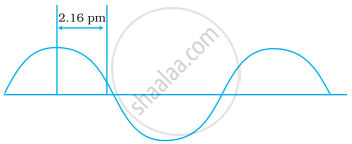
A hypothetical electromagnetic wave is shown in Figure. Find out the wavelength of the radiation.