Advertisements
Advertisements
प्रश्न
What do you understand by poles of a magnet?
टीपा लिहा
Advertisements
उत्तर
The magnetic forces appear to be concentrated at the near ends of the magnet. These points are called the magnetic poles.
shaalaa.com
या प्रश्नात किंवा उत्तरात काही त्रुटी आहे का?
APPEARS IN
संबंधित प्रश्न
Match the following
| Column A | Column B |
| A) Steel | 1) to store magnets |
| B) Soft iron | 2) temporary magnet |
| C) Use in electric bell | 3) permanent magnet |
| D) Magnetic keepers | 4) electromagnet |
Define the following term regarding a bar magnet:
Effective length
Bar magnets are often stored in pairs as shown in the figure. E and F being pieces of metal.
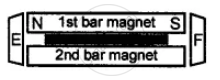
What is the material of darkened part?
What is a natural magnet? State three properties of a magnet.
What is a lodestone?
Match the following.
| Magnetite | Magnetic lines |
| A tiny pivoted magnet | Natural magnet |
| Cobalt | Compass box |
| Closed curves | Ferromagnetic material |
| Bismuth | Diamagnetic material |
How can you identify non-magnetic materials? Give an example of a nonmagnetic material.
What will happen when we place magnets near cell phones, computers, and DVDs?
What is the connection between electricity and magnetism?
Define electromagnet.
