Advertisements
Advertisements
प्रश्न
What happens when a pressure greater than the atmospheric pressure is applied to pure water or a solution?
Advertisements
उत्तर १
The water potential of pure water or a solution increases on the application of pressure values more than atmospheric pressure. For example: when water diffuses into a plant cell, it causes pressure to build up against the cell wall. This makes the cell wall turgid. This pressure is termed as pressure potential and has a positive value.
उत्तर २
If a pressure greater than atmospheric pressure is applied to pure water or a solution, its water potential increases. It is equivalent to pumping water from one place to another. Pressure can build up in a plant system when water enters a plant cell due to diffusion causing a pressure built up against the cell wall, it makes the cell turgid.
APPEARS IN
संबंधित प्रश्न
Briefly describe water potential. What are the factors affecting it?
Identify the INCORRECT statement.
Water absorption takes place through ______
The relation between water potential, solute potential and pressure potential is
Define water potential and solute potential.
Why is solute potential always negative? Explain yw = ys + yp
Observe the figure and answer the question provided below the figure.
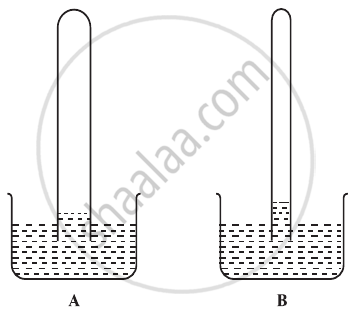
Why does tube B show higher water rise than A?
Identify the INCORRECT statement.
Cell A has water potential - 10 bars and cell B has - 5 bars, the movement of water will occur from______.
Explain factors affecting water absorption.
