Advertisements
Advertisements
प्रश्न
What considerations have been made while deciding the IDL?
Advertisements
उत्तर
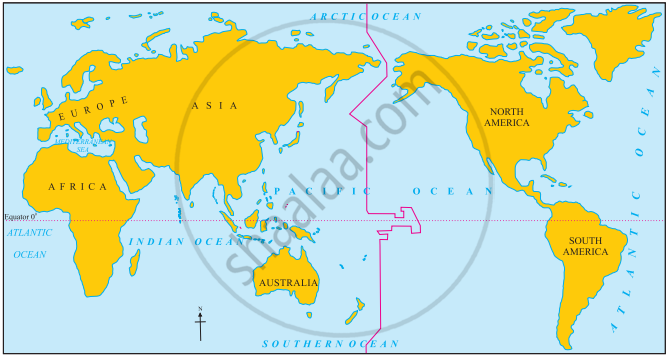
The International Date Line (IDL) is an imaginary line on Earth's surface that marks the transition from one day to the next. While it generally follows the 180 ° meridian, various practical considerations were addressed throughout its creation to prevent administrative and social disorder.
- Avoiding Landmasses: The 180° meridian runs through certain landmasses and countries. If the IDL were a perfectly straight line following this meridian, it would divide a single country into two distinct calendar dates. To avoid confusion, the IDL is designed to travel mostly through Pacific Ocean waters.
- Maintaining Unity of Island Groups: Many island states and archipelagos are spread around the 180° meridian. To ensure that a collection of islands belonging to the same country or political entity has the same day and date, the IDL deviates (zig-zags) to the east or west. This permits the entire country to follow a unified administrative calendar.
- Establishing a Global Start Point: The IDL serves as the official line where a new day and date begin for the entire world. By convention:
- The region to the West of the IDL (towards Asia/Australia) is always one day ahead.
- The region to the East of the IDL (towards the Americas) is one day behind.
- Preventing Local Confusion: By guaranteeing that the line does not cross over occupied area, the approach avoids the logistical nightmare of neighbours living on opposite sides of a line in the same town living on separate days (for example, one on Sunday and the other on Monday).
APPEARS IN
संबंधित प्रश्न
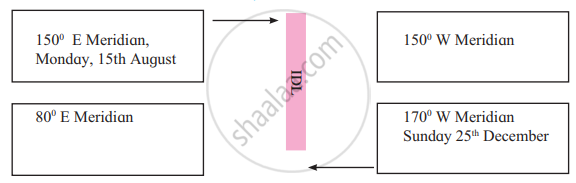
Two boxes in different hemispheres are given in the following diagram. The IDL passes through both the boxes. In one box, the meridian, day and date is given. Find the day and date for the other box.
At which direction of the IDL does a new day start immediately?
IDL brings coordination in which of the following?
Give geographical reason.
The day starts in Pacific Ocean on the earth.
Why is the IDL not a straight line like the 180° meridian?
Why is the IDL considered with respect to the 180° meridian only?
180° line of longitude is ______.
The world is divided into ____________ time zones.
Using an atlas, tell if, on the following route, the IDL will be crossed and show it on the map.
Delhi - Kolkata - Singapore - Melbourne
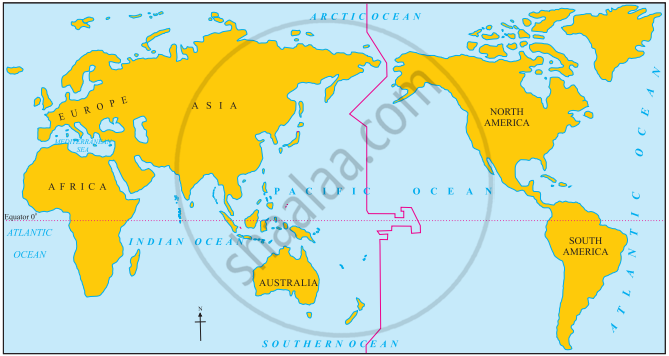
Using an atlas, tell if, on the following route, the IDL will be crossed and show it on the map.
Delhi - London - New York