मराठी
महाराष्ट्र राज्य शिक्षण मंडळएस.एस.सी (इंग्रजी माध्यम) इयत्ता १० वी

Vestigial organ ______ present in human body is proof of evolution. - Science and Technology 2

Advertisements
Advertisements

प्रश्न

Vestigial organ ______ present in human body is proof of evolution.

पर्याय

  • Human hand  

  • Appendix   

  • Ear muscles

  • Tail-bone

  • Gradual development 

  • Mutation

  • Gene

  • Transcription

  •  Translocation

MCQ
रिकाम्या जागा भरा
Advertisements

उत्तर

Vestigial organ appendix present in human body is proof of evolution.

Explanation:

Appendix, which is useless to human, is useful and fully functional organ in ruminants. Similarly, muscles of ear pinna, which are useless to human, are useful in monkeys for movement of ear pinna. Various vestigial organs like tail-bone (coccyx), wisdom teeth, and body hairs are present in body of human being.

shaalaa.com

Notes

Above question has three possible answers, [Option (B), (C) and (D)]. 

  या प्रश्नात किंवा उत्तरात काही त्रुटी आहे का?
पाठ 1: Heredity and Evolution - Exercises [पृष्ठ ११]

APPEARS IN

बालभारती Science and Technology 2 [English] Standard 10 Maharashtra State Board
पाठ 1 Heredity and Evolution
Exercises | Q 3.5 | पृष्ठ ११

संबंधित प्रश्‍न

Mammals : _________ : : Amphibia : Fishes


Differentiate between homology and analogy. Give one example of each.


(a) Select the homologous structures from the combinations given below:

(i) Forelimbs of whales and bats

(ii) Tuber of potato and sweet potato

(iii) Eyes of octopus and mammals

(iv) Thorns of Bougainvillea and tendrils of Cucurbita


(b) State the kind of evolution they represent.


Differentiate between analogy and homology giving one example each of plant and animal respectively.


State a reason for the increased population of dark coloured moths coinciding with the loss of lichens (on tree barks) during industrialization period in England.


Which of the following is a correct set of homologous organs?

(a) Forelimbs of frog, bird and lizard

(b) Spine of cactus and thorn of bougainvillea

(c) Wings of bat and wings of butterfly

(d) Wings of a bird and wings of a bat


Four students A, B, C and D reported the following set of organs to be homologous. Who is correct ?

(A) Wings of a bat and a butterfly

(B) Wings of a pigeon and a bat

(C) Wings of a pigeon and a butterfly

(D) Forelimbs of cow, a duck and a lizard


 An example of homologous organs is


Attempt giving a clear definition of the term species.


Enlist any four sequential evolutionary names of human ancestors.


Give the importance of fossil in support of organic evolution


Some dinosaurs had feathers although they could not fly birds have feathers that help them to fly. In the context of evolution, this means that ______


 The wings of a housefly and the wings of a sparrow are an example of :
(a) analogous organs
(b) vestigial organs
(c) respiratory organs
(d) homologous organs


Explain with suitable examples importance of anatomical evidence in evolution. 


Observe the picture and answer the following questions.
A) Which evidence of evolution is shown in the picture?
B) What can be proven with this proof?
C) Give one more example of evidence of evolution


What do you mean by vestigial structures? Name four vestigial organs found in man.


Differentiate between connecting links and the missing links.


Define phylogeny.


Find an odd one out.


I am a connecting link between reptiles and mammals. Who am I?


Appendix : vestigial organ : : Peripatus : ____________


Match the following.

Column A Column B
1) Morphological evidences a) Tail-bone or wisdom teeth
2) Paleontological evidences b) Leaf venation
  c) Fossils

Give scientific reason.

Vertebrates have slowly originated from invertebrates.


Give scientific reason.

Duck-billed platypus shows relationship with mammals.


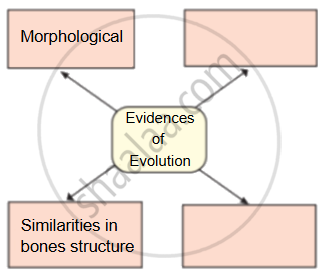
Complete the flowchart.


Write the answers to the questions by observing the figure below.

(a) (b) (c)
  1. Write the name of the animal ‘(a)’ in the figure.
  2. Write the name of the animal ‘(b)’ in the figure.
  3. Write the name of the animal ‘(c)’ in the figure.
  4. Which evolutionary evidence is illustrated by this figure?
  5. Write the definition of that evidence for evolution.

How do you differentiate homologous organs from analogous organs?


Define vestigial organs.


Homologous organs are:


Tendons and ligaments are examples of ______.


The bones of forelimbs of whale, bat, cheetah and man are similar in structure, because ______.


Appearance of antibiotic-resistant bacteria is an example of ______.


What were the characteristics of life forms that had been fossilised?


Give an example for convergent evolution and identify the features towards which they are converging.


How do we compute the age of a fossil?


You have studied the story of Peppermoths in England. Had the industries been removed, what impact could it have had on the moth population? Discuss.


Industrial melanism in England after 1850 is an excellent example of Natural selection. Explain how?


Give one example of homologous organs found in plants.


Define Palaeontology.


Share
Notifications

Englishहिंदीमराठी


      Forgot password?
Use app×