Advertisements
Advertisements
प्रश्न
Using Biot Savarts law, obtain the expression for the magnetic induction near a straight infinitely long current-carrying wire.
थोडक्यात उत्तर
Advertisements
उत्तर
- Consider a straight wire of length l carrying current I.
- Let a point P situated at a perpendicular distance R from the wire as shown below.
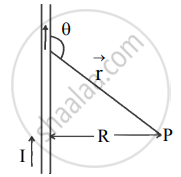
- Consider infinitesimal length `vec"d"`l of wire carrying current I, then-current element = `"I"vec"d"l` .
- The current element is situated at distance r from point P making an angle θ, as shown in the figure above.
- Using Biot Savart law, magnetic field, produced `vec"dB"` at P due to current element `"I"vec"d"l` is,
`vec"dB" = mu_0/(4pi) ("I"vec"d"l sin theta)/"r"^2` ....(1) - According to properties of cross-product, `vec"d"l xx vec"r"` indicates the direction of `vec"dB"`, in this case, is into the plane of the paper.
- Summing up all current elements from the upper half of infinitely long wire,
Bupper = `int_0^∞ "dB" = mu_0/(4pi) int_0^∞ ("I"vec"d"l sintheta)/"r"^2` ….(2) - Taking into account the symmetry of wire, current elements in the lower half of infinitely long wire will also contribute the same as the upper half.
i.e., `"B"_"lower" = "B"_"upper"` ….(3) - Adding contributions from the lower and upper part, total magnetic field point P is
B = `2int_0^∞ "dB"` ….[using equation (2)]
= `(2mu_0)/(4pi) int_0^∞ ("Id"l sintheta)/"r"^2` ….[using equation (1)]
But r = `sqrt(l^2 + "R"^2)` and
sin θ = sin (π - θ)
= `"R"/"r"`
= `"R"/sqrt(l^2 + "R"^2)`
∴ B = `(mu_0"I")/(2pi) int_0^∞ ("Rdl")/((l^2 + "R"^2)sqrt(l^2 + "R"^2))`
= `(mu_0"I")/(2pi) "R" int_0^∞ "dl"/(l^2 + "R"^2)^{3/2}`
Solving the integration,
B = `(mu_0"I")/(2pi) "R" xx 1/"R"^2 = (mu_0"I")/(2pi"R")` ….(4)
This is the equation for magnetic field at a point situated at a perpendicular distance R from infinitely long wire carrying current I.
shaalaa.com
या प्रश्नात किंवा उत्तरात काही त्रुटी आहे का?
