Advertisements
Advertisements
प्रश्न
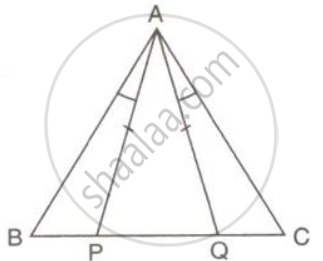
Use the given figure to prove that, AB = AC.
Advertisements
उत्तर
In ΔAPQ,
AP = AQ .........[Given]
∴ ∠APQ = ∠AQP .........(i) [angles opposite to equal sides are equal]
In ΔABP,
∠APQ = ∠BAP + ∠ABP .......(ii) [Ext. the angle is equal to the sum of opp. int. angles]
In ΔAQC,
∠AQP = ∠CAQ + ∠ACQ ...(iii) [Ext. angle is equal to sum of opp. int. angles]
From (i), (ii) and (iii)
∠BAP + ∠ABP = ∠CAQ + ∠ACQ
But, ∠BAP = ∠CAQ .......[Given]
⇒ ∠CAQ + ∠ABP = ∠CAQ + ∠ACQ
⇒ ∠ABP = ∠CAQ + ∠ACQ − ∠CAQ
⇒ ∠ABP = ∠ACQ
⇒ ∠B = ∠C ...........(iv)
In ΔABC,
∠B = ∠C
⇒ AB = AC ......[Sides opposite to equal angles are equal]
APPEARS IN
संबंधित प्रश्न
An isosceles triangle ABC has AC = BC. CD bisects AB at D and ∠CAB = 55°.
Find:
- ∠DCB
- ∠CBD
In the figure given below, LM = LN; angle PLN = 110o.
calculate: (i) ∠LMN
(ii) ∠MLN
Calculate x :
In the given figure; AB = BC and AD = EC.
Prove that: BD = BE.
Prove that a triangle ABC is isosceles, if: bisector of angle BAC is perpendicular to base BC.
In the given figure, AD = AB = AC, BD is parallel to CA and angle ACB = 65°. Find angle DAC.

In triangle ABC; AB = AC and ∠A : ∠B = 8 : 5; find angle A.
If the equal sides of an isosceles triangle are produced, prove that the exterior angles so formed are obtuse and equal.
Prove that the medians corresponding to equal sides of an isosceles triangle are equal.
The bisectors of the equal angles B and C of an isosceles triangle ABC meet at O. Prove that AO bisects angle A.
