Advertisements
Advertisements
प्रश्न
TYRANNOSAURUS
(One of the extinct animals which lived on the Earth about 100,000,000 years ago) Tyrannosaurus was about six meters long and it preyed upon other animals.
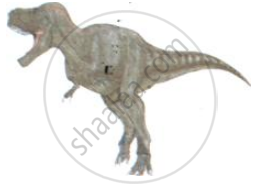
What do you think about its classification-was it an amphibian, a reptile or a mammal?
Can you call it a relative of Kangaroo? Yes/No. Give reason
Advertisements
उत्तर
No, it is not a relative of Kangaroo as Kangaroo is a mammal and Tyrannosaurus is a reptile.
Characteristics of Tyrannosaurus:
- The body has scales which may be horny
- Lays eggs which have a leathery shell
- One of the dinosaurs which moved on the earth. These ruled the earth. Some were vegetarian, others were non-vegetarian. Archaeopteryx is a link between reptiles and birds. Its fossils have been found, which vanished from the earth due to ice-age.
- Had three-chambered heart as ventricles are partially divided
- Cold-blooded animals.
संबंधित प्रश्न
Match the animals given under column A with their respective classification group given under column B
| Column A | Column B | ||
| 1 | Sponge | a | Amphibia |
| 2 | Snail | b | Reptilia |
| 3 | Butterfly | c | Echinodermata |
| 4 | Toad | d | Mollusca |
| 5 | Lizard | e | Arthropoda |
| 6 | Starfish | f | Porifera |
Main characteristics of Nematoda:
Write short note on protochordates.
Give any one difference between the following :
Insecta and Arachnida
Name three animals (belonging to different classes) which breathe by means of lungs but have no external ears (pinnae).
Match the names of animal groups in Column I with the names of animals in column II.
|
Column I (Group) |
Column II (Animals) |
|
Annelida |
Pigeon |
|
Porifera |
Snake |
|
Mollusca |
Earthworm |
|
Reptilia |
Sponge |
|
Amphibia |
Octopus |
|
Pisces |
Trout |
|
Mammal |
Rabbit |
Which names are left out that do not match and why?
Give two examples of each of the following: Annelida
Choose the correct answer: Which of the following is not a helminth parasite?
Choose the correct answer: Protista is the link between
Give scientific reasons.
Body temperature is not constant in amphibians.
