Advertisements
Advertisements
प्रश्न
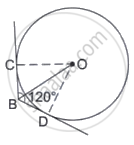
Two tangent segments BC and BD are drawn to a circle with centre O such that ∠CBD = 120°. Prove that OB = 2BC.
Advertisements
उत्तर
Given: Two tangent segments BC and BD are drawn from an external point B to a circle with centre O and points of contact C and D and ∠CBD = 120°.
To Prove: OB = 2BC.
Proof [Step-wise]:
1. BC = BD because tangents drawn from the same external point to a circle have equal lengths.
2. The angle between the two tangents ∠CBD = 120° is supplementary to the central angle subtended by the points of contact C and D; hence ∠COD = 180° – 120° = 60°. (Theorem: angle between two tangents + angle subtended at centre = 180°).
3. OC = OD = r (radii). In isosceles triangle COD the included angle ∠COD = 60°, so by the Law of Cosines or recognizing an equilateral triangle CD = r.
Calculation (Law of Cosines):
CD2 = r2 + r2 – 2r2
`cos 60^circ = 2r^2 - 2r^2(1/2) = r^2`
⇒ CD = r
4. Consider triangle BCD. It is isosceles with BC = BD = t (say) and vertex angle at B equal to 120°.
Use the Law of Cosines to find CD in terms of t:
CD2 = t2 + t2 – 2t2
`cos 120^circ = 2t^2 - 2t^2(-1/2) = 3t^2`
⇒ `CD = tsqrt(3)`
5. Equate the two expressions for CD from steps 3 and 4:
`r = tsqrt(3)`
⇒ `t = r/sqrt(3)`.
Thus `BC = r/sqrt(3)`.
6. In right triangle OCB (OC ⟂ BC because radius to point of contact is perpendicular to tangent).
OC = r, BC = t = `r/sqrt(3)`
So OB2 = OC2 + BC2
= `r^2 + (r^2/3)`
= `(4/3)r^2`
Hence `OB = (2/sqrt(3))r`.
7. Since `BC = r/sqrt(3)`
`2 xx BC = 2 xx (r/sqrt(3))`
= `(2/sqrt(3))r`
= OB
Therefore OB = 2BC.
