Advertisements
Advertisements
प्रश्न
- Two sets A and B of two bulbs each glowing in two separate rooms. When one of the bulb of set A is fused, the other bulb cease to glow. But in the set B, when one bulb fuses, the other continues to glow. Explain, why does the phenomenon occur?
- Why do we prefer arrangement in set B for house wiring?
स्पष्ट करा
Advertisements
उत्तर

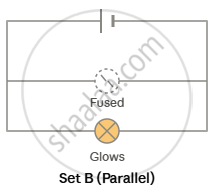
- In set A the bulbs are connected in series, so when one bulb fuses, its filament breaks and the circuit becomes open. The current stops flowing, hence the other bulb also stops glowing. In set B the bulbs are connected in parallel. Each bulb has its own separate path across the supply, so when one bulb fuses, the other branch remains complete and the other bulb continues to glow.
- We prefer the parallel arrangement (set B) for house wiring because every appliance gets the same mains voltage, appliances operate independently, and if one appliance fuses or is switched off, the others are not affected. It also allows each circuit/appliance to have its own switch and fuse, making the system safer and more convenient.
shaalaa.com
या प्रश्नात किंवा उत्तरात काही त्रुटी आहे का?
पाठ 8: Electric Energy, Power and Household Circuits - EXERCISE-2 [पृष्ठ १९३]
