Advertisements
Advertisements
प्रश्न
Two identical charged conducting spheres A and B have their centres separated by a certain distance. Charge on each sphere is q and the force of repulsion between them is F. A third identical uncharged conducting sphere is brought in contact with sphere A first and then with B and finally removed from both. New force of repulsion between spheres A and B (radii of A and B are negligible compared to the distance of separation so that for calculating force between them they can be considered as point charges) is best given as:
पर्याय
`(3 F)/5`
`(2F)/3`
`F/2`
`(3F)/8`
Advertisements
उत्तर
`(3F)/8`
Explanation:
Let the separation between the centres of the two spheres be d.
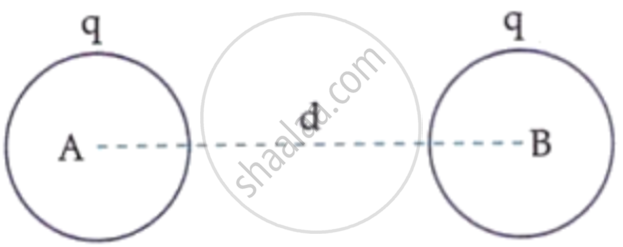
`F = (kq^2)/(d^2)`
When the third identical uncharged sphere C is brought in contact with sphere A, both share equal charges
⇒ VA = VC
`q_A = q_C = q/2`
Now when the third sphere (with charg `q/2`) is brought into contact with sphere B, again both share equal charges
⇒ VB = VC
`q'_B = q'_C`
= `(q + q/2)/(2)`
= `(3q)/4`
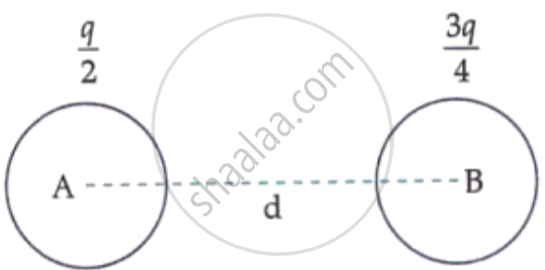
The value of F' between spheres A and B is given by,
`F' = (k(q/2)((3q)/4))/(d^2)`
= `k((3q^2)/8)/(d^2)`
= `3/8 F`
