Advertisements
Advertisements
प्रश्न
Two different types of books have to be stacked in the shelf of a library. The first type of book weighs 1 kg and has a thickness of 6 cm. The second type of book weighs 1.5 kg and has a thickness of 4 cm. The shelf is 96 cm long and can support a maximum weight of 21 kg.
How should both the types of books be placed in the shelf to include the maximum number of books? Formulate a Linear Programming Problem and solve it graphically.
Advertisements
उत्तर
Let x be number of books of first type and y be number of books of second type.
Objective function Max Z = x + y
Constraints are
1x + 1.5y ≤ 21
6x + 4y ≤ 96
And x ≥ 0, y ≥ 0
Now, x + 1.5y ≤ 21 and 6x + 4y ≤ 96
2x + 3y ≤ 42, 3x + 2y ≤ 48
Convert inequalities into equations
2x + 3y = 42 ...(i)
| x | 0 | 21 |
| y | 14 | 0 |
3x + 2y = 48 ...(ii)
| x | 0 | 16 |
| y | 24 | 0 |
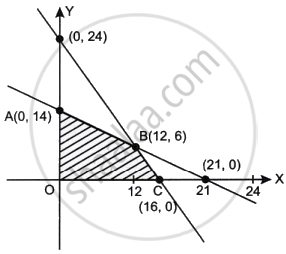
Solve equations (i) and (ii)
2x + 3y = 42 × 2
3x + 2y = 48 × 3
4x + 6y = 84
9x + 6y = 144
– – –
– 5x = – 60
x = 12
Put the value of x in equation (i),
2 × 12 + 3y = 42
3y = 42 – 24 = 18
y = 6
Coordinates of point B(12, 6).
| Corner points | Value of Z = x + y |
| A(0, 14) | ZA = 0 + 14 = 14 |
| B(12, 6) | ZB = 12 + 6 = 18 |
| C(6, 0) | ZC = 16 + 0 = 16 |
The maximum value of Z is 18, which occurs at B(12, 6).
The maximum number of books which can be placed on the self is 18. Placing 12 books of first type and 6 books of the second type.
