Advertisements
Advertisements
प्रश्न
Two congruent circles intersect each other at points A and B. Through A any line segment PAQ is drawn so that P, Q lie on the two circles. Prove that BP = BQ.
Advertisements
उत्तर
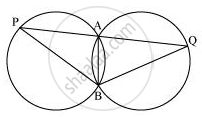
AB is the common chord in both the congruent circles.
∴ ∠APB = ∠AQB
In ΔBPQ,
∠APB = ∠AQB
∴ BQ = BP (Angles opposite to equal sides of a triangle)
संबंधित प्रश्न
In the given figure, ∠PQR = 100°, where P, Q and R are points on a circle with centre O. Find ∠OPR.

If diagonals of a cyclic quadrilateral are diameters of the circle through the vertices of the quadrilateral, prove that it is a rectangle.
Prove that the circles described on the four sides of a rhombus as diameters, pass through the point of intersection of its diagonals.
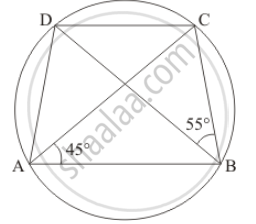
In the given figure, ABCD is a cyclic quadrilateral in which AC and BD are its diagonals. If ∠DBC = 55° and ∠BAC = 45°, find ∠BCD.
Prove that the perpendicular bisectors of the sides of a cyclic quadrilateral are concurrent.
ABCD is a cyclic quadrilateral in which BA and CD when produced meet in E and EA = ED. Prove that EB = EC.
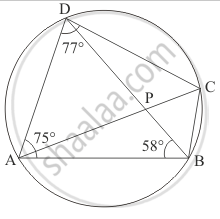
In the given figure, ABCD is a cyclic quadrilateral in which ∠BAD = 75°, ∠ABD = 58° and ∠ADC = 77°, AC and BD intersect at P. Then, find ∠DPC.
If a pair of opposite sides of a cyclic quadrilateral are equal, prove that its diagonals are also equal.
If bisectors of opposite angles of a cyclic quadrilateral ABCD intersect the circle, circumscribing it at the points P and Q, prove that PQ is a diameter of the circle.
The three angles of a quadrilateral are 100°, 60°, 70°. Find the fourth angle.
