Advertisements
Advertisements
प्रश्न
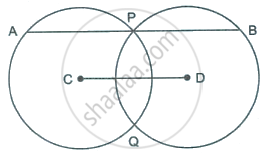
Two circles with centres C and D, intersect each other at points P and Q. If APB is parallel to CD, prove that AB = 2·CD
Advertisements
उत्तर
Given: Two circles with centres C and D intersect at points P and Q. The line APB i.e., the straight line through A, P and B is parallel to CD.
To Prove: AB = 2·CD
Proof [Step-wise]:
1. Set up coordinates (convenient choice).
Place C at (0, 0) and D at (d, 0), so CD = d.
Because APB || CD, the line APB is horizontal; let its equation be y = h(h > 0).
Let P be the common intersection point of the two circles with coordinates P(x0, h).
2. Let r1 = CP and r2 = DP be the radii of the left and right circles, respectively.
Because P lies on both circles.
x02 + h2 = r12 ...(1)
(x0 − d)2 + h2 = r22 ...(2)
3. Subtract (2) from (1) if needed this relation will be used implicitly below.
More directly, note the horizontal line y = h meets the left circle at two x-values `±sqrt(r_1^2 - h^2)`.
One of these x-values is x0 the x-coordinate of P; the other is the point A on the left circle.
So, `x_A = -sqrt(r_1^2 - h^2)`
`x_P = +sqrt(r_1^2 - h^2)` ...(3)
Similarly, the same horizontal line meets the right circle at `x = d ± sqrt(r_2^2 - h^2)`.
One of these is P,
So, `x_P = d - sqrt(r_2^2 - h^2)`
`x_B = d + sqrt(r_2^2 - h^2)` ...(4)
Equating the two expressions for xP from (3) and (4) gives
`sqrt(r_1^2 - h^2) = d - sqrt(r_2^2 - h^2)` ...(5)
4. Compute AB as the difference of x-coordinates of B and A:
AB = xB – xA
= `[d + sqrt(r_2^2 - h^2)] - [-sqrt(r_1^2 - h^2)]`
= `d + sqrt(r_2^2 - h^2) + sqrt(r_1^2 - h^2)`
Substitute (5) i.e., `sqrt(r_1^2 - h^2) = d - sqrt(r_2^2 - h^2)` into the expression:
`AB = d + sqrt(r_2^2 - h^2) + (d - sqrt(r_2^2 - h^2))`
AB = 2d
5. Since d = CD, we obtain AB = 2·CD.
