Advertisements
Advertisements
प्रश्न
There are two old wells in the area where Punita lives. Her grandmother says that about fifteen-twenty years ago there was water in these wells. The wells could have dried up because:
- Water is being pumped up from under the ground, with the help of electric motors.
- The lakes in which rainwater used to collect are no longer there.
- The soil around trees and parks is now covered with cement.
- Is there some other reason for this? Explain.
Advertisements
उत्तर
The reasons mentioned above are, of course, the causes of these sorry states. However, cutting of trees, lack of maintenance, etc. may also be the reason for the same.
APPEARS IN
संबंधित प्रश्न
Look at the area around your school. Are there any fields, farms, pucca roads, drains, etc? Is the area sloping, rocky, or flat? Think, what will happen here when it rains? Where will the rain water go – into the drains, pipes, or pits? Is some water also getting soaked into the soil?
Is there a lake, well or stepwell near your house or school? Visit it and find out more about it.
How old is it? Who got it built?
Have you ever faced a shortage of water in your area? If yes, then what was the reason for it?
Can we even imagine life without water?
Have you ever seen any beautiful building near the place of water? Where?
Is there a lake, well or stepwell near your house or school? Visit it and find out more about it.
Is there any festival celebrated at this place?
Is there a lake, well or stepwell near your house or school? Visit it and find out more about it.
Is there any water today, or is it dry?
Do you have to pay for water? How much? Is the rate of water different in different colonies? Ask your elders.
Bring a water bill, look at it and tell –
This bill is from ______ date to ______ date.
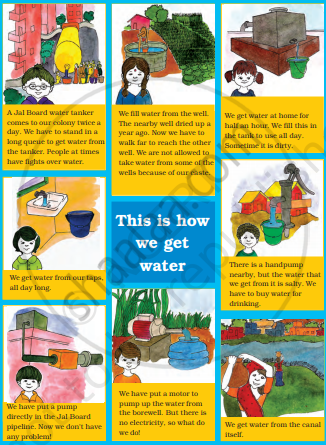
Let us see the different ways in which people manage water today. See the picture give below and discuss.
Do you get water in your house in any of these ways? Put a tick (✓) on that. If you get water in some other way, write in your notebook.