Advertisements
Advertisements
प्रश्न
There ___ ten dogs in my street.
Advertisements
उत्तर
There are ten dogs in my street.
APPEARS IN
संबंधित प्रश्न
Look at these sentences.
- Most snakes are quite harmless, but a few are poisonous.
- Most snakes lay eggs, but the rattlesnake gives birth to its young.
Now write five sentences like these using ‘most’ and the clues below.
1. (90% of) people are honest (10%) are dishonest.
________________________
2. (Lots of) fruit have plenty of sugar, (some) citrus fruit are low in sugar.
________________________
3. (Every soft drink except this one) has lots of ‘empty calories’.
________________________
4. (The majority of) films are romances, (a few) are on other topics.
________________________
5. (A majority of) people agree that he is a good leader, (just a few) disagree.
________________________
Underline the clauses in the below sentence and also the words that link or connect the clauses.
It is believed that The Iliad and The Odyssey were composed and recited by a blind poet named Homer, who lived about 900 BCE and who wandered from one Greek city or village to another, singing his poems to all who would receive him in their homes.
When we reached the park, __________.
Match words from the different columns to make reasonable predictions. Then write them down in the space below. One has been done as an example.
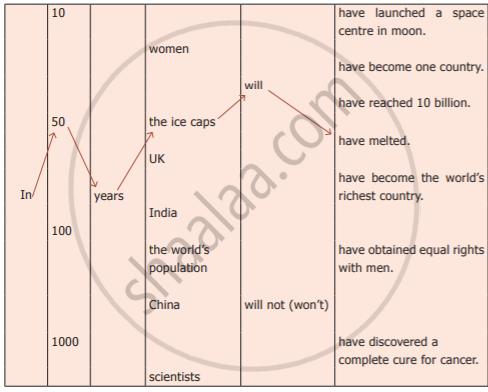
Write the sentences.
- In 50 years the ice cap will have melted.
- ________________________
- ________________________
- ________________________
- ________________________
- ________________________
- ________________________
Fill in the blank with suitable linking word or conjunction.
Rani was late to school ______ she missed the bus.
What we say?

Frame meaningful sentence of your own using the following expression from the story. Use a dictionary if required.
accepted her seclusion with resignation
Fill in the blank with modal auxiliary.
How ______ you open my bag?
Understand the meaning of the given idiomatic expression and choose the right one to complete the sentence.
Our headmistress not only promised us to take us for an excursion, but also announced that on return we would get a holiday. It was like ______.
Replace the comparative adjective in the following sentence with their positive form.
Train journey is more comfortable than bus journey.
