The term that is used for the mode of nutrition in yeast, mushroom and bread-mould is ______.
Advertisements
प्रश्न
The term that is used for the mode of nutrition in yeast, mushroom and bread-mould is ______.
पर्याय
autotrophic
insectivorous
saprophytic
parasitic
Advertisements
उत्तर
The term that is used for the mode of nutrition in yeast, mushroom and bread-mould is saprophytic.
Explanation:
Bread mould, yeast and mushroom are all fungi that derive their food from non-living organic matter. They secrete digestive juices on organic matter which aid in its extracellular digestion and convert it into soluble form. Then they absorb this simplified soluble form of food through their body. This method of getting nutrients in the form of the simple soluble form (liquid) is known as saprophytic nutrition.
APPEARS IN
संबंधित प्रश्न
Give a brief description of the process of synthesis of food in green plants.
Which part of the plant takes in carbon dioxide from the air for photosynthesis?
Which substance is used to remove chlorophyll from a green leaf during photosynthesis experiments?
Why do we boil the leaf in alcohol when we are testing it for starch?
Where is chlorophyll mainly present in a plant?
How do plants obtain food?
The Figure shown below represents an activity to prove the requirements for photosynthesis. During this activity, two healthy potted plants were kept in the dark for 72 hours. After 72 hours, KOH is kept in the watch glass in setup X and not in setup Y. Both these setups are air tight and have been kept in light for 6 hours. Then, Iodine Test is performed with one leaf from each of the two plants X and Y.

Which of the following statements shows the correct results of Iodine Test performed on the leaf from plant X and Y respectively?
The internal (cellular) energy reserve in autotrophs is
Observe the experimental setup shown below. Name the chemical indicated as ‘X’ that can absorb the gas which is evolved as a byproduct of respiration.

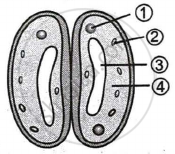
In the given diagram of a closed stomata: (1), (2), (3) and (4) respectively are: