Advertisements
Advertisements
प्रश्न
The solubility product of \[\ce{Al(OH)3}\] is 2.7 × 10⁻¹¹. Calculate its solubility in gL–1 and also find out pH of this solution. (Atomic mass of \[\ce{Al = 27 u}\]).
Advertisements
उत्तर
Let us assume \[\ce{S}\] be the solubility of \[\ce{Al(OH)3}\].
\[\ce{K_{sp} = [Al^{3+}] [OH-]3 = (S) (3S)^3 = 27S^4}\]
S4 = 27Ksp = 27 × 1027 × 10–11 = 1 × 10–12
S = 1 × 10⁻³ mol L–1.
(i) Solubility of \[\ce{Al(OH)3}\]: Molar mass of \[\ce{Al(OH)3}\] is 78g. Hence, solubility of \[\ce{Al(OH)3}\] in gL–1 = 1 × 103 × 78gL–1 = 78 × 10–3 gL–1 = 7.8 × 10⁻²gL–1
(ii) \[\ce{pH}\] of the solution: S = 1 × 10⁻³ mol L−1
\[\ce{[OH]}\] = 3S = 3 × 1 × 10−3 = 3 × 10⁻³
\[\ce{pOH}\] = 3 − log 3
\[\ce{pH}\] = 14 − \[\ce{pOH}\] = 11 + log 3 = 11.4771.
APPEARS IN
संबंधित प्रश्न
The solubility product constant of Ag2CrO4 and AgBr are 1.1 × 10⁻¹² and 5.0 × 10⁻¹³respectively. Calculate the ratio of the molarities of their saturated solutions.
Equal volumes of 0.002 M solutions of sodium iodate and cupric chlorate are mixed together. Will it lead to precipitation of copper iodate? (For cupric iodate Ksp = 7.4 × 10⁻⁸).
A sparingly soluble salt gets precipitated only when the product of concentration of its ions in the solution (Qsp) becomes greater than its solubility product. If the solubility of \[\ce{BaSO4}\] in water is 8 × 10⁻⁴ mol dm–3. Calculate its solubility in 0.01 mol dm–3 of \[\ce{H2SO4}\].
A sparingly soluble salt having general formula \[\ce{A^{p+}_x B^{q-}_y}\] and molar solubility S is in equilibrium with its saturated solution. Derive a relationship between the solubility and solubility product for such salt.
Solubility product of a sparingly soluble salt AX2 is 3.2 × 10⁻¹¹. Its solubility in mol/litre is:
The solubility of AgCl will be maximum in which of the following?
For the following Assertion and Reason, the correct option is:
Assertion (A): When Cu (II) and sulphide ions are mixed they react together extremely quickly to give a solid.
Reason (R): The equilibrium constant of \[\ce{Cu^{2+}(aq) + S^{2-}(aq) <=> CuS(s)}\] is high because the solubility product is low.
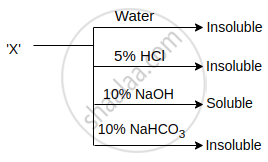
An organic compound X showing the following solubility profile is:
If solubility product of Zr3(PO4)4 is denoted by Ksp and its molar solubility is denoted by S, then which of the following relation between S and Ksp is correct?
Water soluble salt among AgNO3, AgF and AgClO4 are:
Which one of the following arrangements represents the correct order of solubilities of sparingly soluble salts Hg2Cl2, Cr2(SO4)3, BaSO4 and CrCl3 respectively?
