Advertisements
Advertisements
प्रश्न
The parallel sides of a trapezium-shaped field are 25 m and 10 m and non-parallel sides are 14 m and 13 m. What is the area (in m2 ) of the field?
पर्याय
204
196
156
144
Advertisements
उत्तर
196
Explanation:
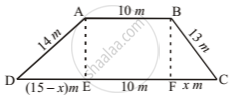
Height of the trapezium
AE = BF = h m
From Δ AED and Δ BCF,
(AE)2 = (BF)2
(14)2 - (15 - x)2 = (13)2 - x2
(196 - 169) = 225 - 30x
30x = 198
x = 6.6 m
In Δ BCF, (13)2 - (6.6)2 = h2
h = `sqrt(169 - 43.56)`
h = 11.2 m
Area of the trapezium
`= 1/2 xx ("a" + "b") xx "h"`
`= 1/2 (10 + 25) xx 11.2`
= 196 m2
APPEARS IN
संबंधित प्रश्न
The area of the region bounded by the curves y2 = 4ax, x = 0 and x = a is
The slop of the tangent to the parabola y2 = 4 ax point (at2, 2at) will be:
A line from center to circumference of a circle is known as
Angles that are greater than 90° and less than 180° are called
Types of triangles are
Two straight poles of unequal length stand upright on a ground. The length of the shorter pole is 10 m. A pole joins the top of the two vertical poles. The distance between the two tops is 5 m. The distance between the poles along the ground is 4 m. The area thus formed by the three poles with the ground is:
The ratio between the perimeter and the breadth of a rectangular is 5 : 1. If the area of the rectangle is 216 sq.cm, then the length of the rectangle is
A sphere of radius 4 cm is melted and recast into smaller spheres of radii 2 cm each. How many such spheres can be made?
The ratio of sides of an equilateral triangle to that of a square is `sqrt3 : 1`, then find the ratio of their area.
The ratio of surface area of two cubes is 9 : 4. Find the ratio of their volume.
