Advertisements
Advertisements
प्रश्न
The monthly income of a group of 320 employees in a company is given below:
| Monthly income (in ₹) |
No. of Employees |
| 6000 - 7000 | 20 |
| 7000 - 8000 | 45 |
| 8000 - 9000 | 65 |
| 9000 - 10000 | 95 |
| 10000 - 11000 | 60 |
| 11000 - 12000 | 30 |
| 12000 - 13000 | 5 |
Draw an ogive the given distribution on a graph sheet taking 2 cm = Rs. 1000 on one axis and 2 cm = 50 employees on the other axis. From the graph determine:
- the median wage
- the number of employees whose income is below Rs. 8500.
- if the salary of a senior employee is above Rs. 11500, find the number of senior employees in the company.
- the upper quartile.
Advertisements
उत्तर १
| Monthly Income | No. of Employees | c.f. |
| 6000 - 7000 | 20 | 20 |
| 7000 - 8000 | 45 | 65 |
| 8000 - 9000 | 65 | 130 |
| 9000 - 10000 | 95 | 225 |
| 10000 - 11000 | 60 | 285 |
| 11000 - 12000 | 30 | 315 |
| 12000 - 13000 | 5 | 320 |
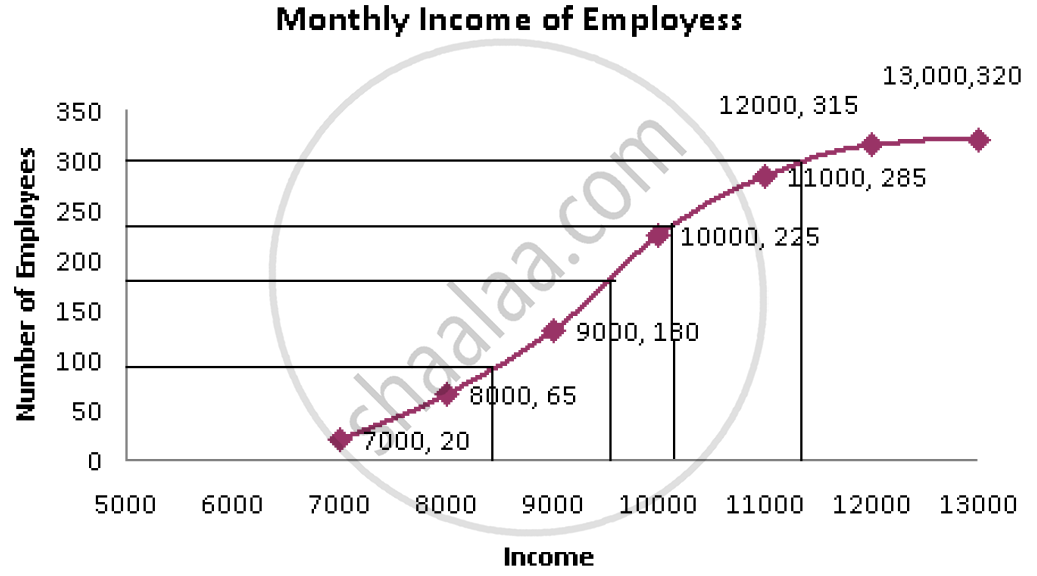
Here, n = 320
1. Media = `(n/2)^(th)` term = 160th term
From the graph, the corresponding x coordinate is 9400
Median wage = 9400 approx
2. The number of employees whose income is below Rs. 8500 = 95 (approx.)
3. The number of senior employees whose salary is above Rs. 11500
= 320 – 305
= 15 (approx.)
4. The upper quartile `Q_3 = ((3n)/4)^"th"` term = 240th term
From the graph, the corresponding x co-ordinate is 10,300 (approx.)
उत्तर २
| Monthly | No. of Employees | c.f. |
| 6000 - 7000 | 20 | 20 |
| 7000 - 8000 | 45 | 65 |
| 8000 - 9000 | 65 | 130 |
| 9000 - 10000 | 95 | 225 |
| 10000 - 11000 | 60 | 285 |
| 11000 - 12000 | 30 | 315 |
| 12000 - 13000 | 5 | 320 |
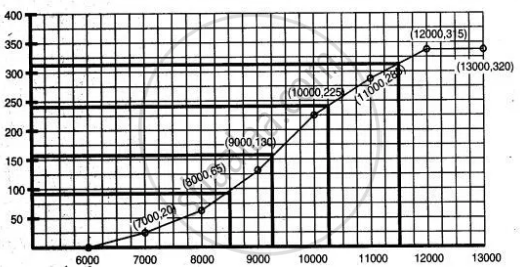
i. From the graph, the median wage = 160.5 (appro.)
ii. The number of employees whose income is below ₹ 8500 = 90 (appro.)
iii. The number of senior employees whose salary is above ₹ 11500 = 20 (appro.)
iv. The upper quartile Q3 = 240 (appro.)
उत्तर ३
To draw the Less Than Ogive, we use the upper class limits and cumulative frequencies:
| Monthly Income (₹) |
No. of Employees (f) |
Cumulative Frequency (cf) |
Points to Plot |
| 6000 - 7000 | 20 | 20 | (7000, 20) |
| 7000 - 8000 | 45 | 65 | (8000, 65) |
| 8000 - 9000 | 65 | 130 | (9000, 130) |
| 9000 - 10000 | 95 | 225 | (10000, 225) |
| 10000 - 11000 | 60 | 285 | (11000, 285) |
| 11000 - 12000 | 30 | 315 | (12000, 315) |
| 12000 - 13000 | 5 | 320 | (13000, 320) |
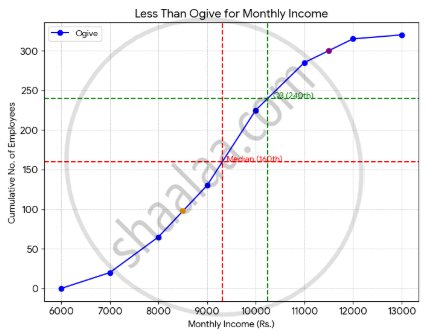
1. Calculate cumulative frequencies
First, we find the cumulative totals for each bracket to plot the curve.
Total employees (N) = 320.
The points are plotted using the Upper Limit on the X-axis and Cumulative Frequency on the Y-axis.
2. Determine median wage
The median is the `(N/2)^(th)` term, which is the 160th employee.
Locate 160 on the Y-axis.
Draw a horizontal line to the curve, then drop a perpendicular to the X-axis.
Result: The median wage is approximately ₹ 9,300 to ₹ 9,460.
3. Employees income below ₹ 8,500
Locate ₹ 8,500 on the X-axis.
Draw a vertical line up to the curve, then a horizontal line to the Y-axis.
Result: There are approximately 95 to 98 employees with an income below ₹ 8,500.
Senior employees earn above ₹ 11,500.
Find the cumulative frequency for ₹ 11,500 on the graph. This is approximately 300 to 305 employees those earning below ₹ 11,500.
Subtract this from the total: 320 – 300 = 20.
Result: There are approximately 15 to 20 senior employees.
5. Find the upper quartile (Q3)
The upper quartile is the `((3N)/4)^(th)` term, which is the 240th employee.
Locate 240 on the Y-axis.
Draw a horizontal line to the curve, then drop a perpendicular to the X-axis.
Result: The upper quartile is approximately ₹ 10,250.
- Median Wage: Approximately ₹ 9,300.
- Employees below ₹ 8,500: Approximately 95 - 98 employees.
- Senior Employees (> ₹ 11,500): Approximately 15 – 20 employees.
- Upper Quartile (Q3): Approximately ₹ 10,250.
