Advertisements
Advertisements
प्रश्न
The hypotenuse of a right angled triangle has its ends at the points (1, 3) and (−4, 1). Find the equation of the legs (perpendicular sides) of the triangle that are parallel to the axes.
Advertisements
उत्तर
Let triangle ABC be a right angled triangle whose hypotenuse is AB. The coordinates of A and B are (1, 3) and (−4, 1) respectively.
Let the slope of BC be m.
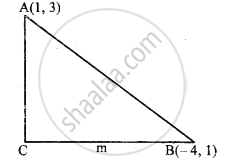
AC ⊥ BC
∴ Slope of AC = `-1/"m"`
Equation of line BC,
y – y1 = m(x – x1)
y – 1 = m(x + 4)
or mx – y + 4m + 1 = 0 .......(i)
Equation of line AC
y – 3 = `- 1/"m" ("x" - 1)`
or my – 3m = – x + 1
or x + my – 3m – 1 = 0 ........(ii)
The equation of both these lines can be found from the given value of m. If side BC is parallel to x-axis, then m = 0
Equation of BC, y – 1 = 0
or y = 1
∴ AC is parallel to y-axis and it goes through A(1, 3). Hence, the equation of AC is x = 1
Hence, the equations of BC and AC are y = 1 and x = 1.
